Bridgefolk is a movement of sacramentally-minded Mennonites and peace-minded Roman Catholics who come together to celebrate each other's traditions, explore each other's practices, and honor each other's contribution to the mission of Christ's Church.
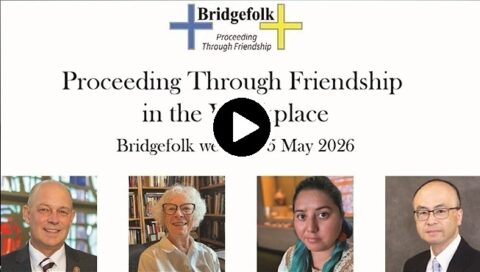
What happens when a Catholic goes to work in a Mennonite institution or vice versa? This will be the topic of conversation among four persons who have done just that. Bridgefolk board Co-chair Phil Waite will moderate a conversation with Jeff Gingerich, president of St. Bonaventure University, located in Olean, New York; Judith Davis, Professor Emerita of French and Humanities at Goshen College, Indiana; Shuji Moriichi, Director of the Pastoral Care Department at Mercy Medical Center, Cedar Rapids, Iowa; and Karla Cuca Vásquez, a nonprofit leader who serves as Ambassador of SEMILLA, the Latin American Anabaptist Seminary in Guatemala. This conversation will explore how these experiences have shaped each person’s spiritual practices and deepened their understanding of both Mennonite and Catholic institutional cultures.
Holy Week liturgical texts this year in Rome became occasions for Pope Leo XIV to speak out against wars around the world, and especially in Iran. Less than a year after beginning his papacy with words of peace affirming explicitly that “the peace of the risen Christ” is a “disarmed and disarming peace,” Leo has been remarkably blunt.
Vatican diplomacy requires understatement, and Leo’s Palm Sunday homily did not name world leaders by name. But the pope’s message was unmistakable. Reflecting on Jesus’ entrance into Jerusalem as the King of Peace who rejected violence, and citing Isaiah 1:15, Leo pointedly declared that Jesus “does not listen to the prayers of those who wage war, but rejects them.”
At a time when US Secretary of War Pete Hegseth is conducting regular prayer meetings in the Pentagon praying for military victory in Jesus name, commentators have underscored the contrast (see here and here). On Holy Thursday, Leo furthered his unmistakable message by lamenting Christians’ historical support for colonialist violence. Through the cross, he preached, “The imperialist occupation of the world is thus disrupted from within.”
Meanwhile, Mennonite World Conference has joined with numerous global church bodies in condemning US and Israeli attacks on Iran as “clearly illegal under international law.”
“Having taken this path, Israel and the United States of America must not be permitted to once again create a desolation and call it peace. … We appeal for an immediate ceasefire, for the urgent resumption of diplomatic engagement and political dialogue through established international and regional mechanisms, and for full compliance by all States with their obligations under international law, including the UN Charter.”
Click here for links to Holy Week homilies and messages at the Vatican. (see especially: *)
Click here for joint statement by ACT Alliance, Christian Conference of Asia, Lutheran World Federation, Mennonite World Conference, Middle East Council of Churches, World Communion of Reformed Churches, World Council of Churches, World Methodist Council.
Due to various technical difficulties, it has taken us a few months to post videos from our summer conference in Winnipeg. We apologize for the delay.
Thankfully, they are now available by clicking here. You will find keynote addresses by Dr. Jennifer Otto and Fr. John Klassen OSB, along with Q&A sessions following each one. Also available is a panel discussion with stories of ecumenical dialogue.
When Bridgefolk formed in 2002, Saint John’s Abbey in Collegeville, MN – under the leadership of Abbot John Klassen – offered to be a home for this fledgling movement. Initial annual conferences were hosted by the Abbey. After several years, some of the Catholic participants expressed interest in visiting Mennonite settings. Conferences began to alternate between the abbey (as well as Saint Benedict’s Monastery) and various Mennonite institutional settings locations in Virginia, Pennsylvania, Ontario, Manitoba, Washington, and Indiana. Over the years, Anabaptist Mennonite Biblical Seminary (AMBS) in Elkhart, Ind. hosted three conferences and several of its faculty members served key roles in Bridgefolk leadership and on the board.
In 2024 the Bridgefolk board initiated conversations with AMBS leadership about the possibility of establishing a formal institutional relationship, so that Bridgefolk would have both Catholic and Mennonite “homes.” This has now been formalized in a memo of understanding, signed in summer 2025.
Some of the items of mutual benefit outlined in the agreement include:
a designated Bridgefolk board member appointed from the AMBS teaching or administrative faculty.
opportunities to co-sponsor events of shared interest and to collaborate in the development of biblical and theological resources that further our shared call to peacemaking.
providing a safe space for Catholics and Mennonites who wish to study and worship in each other’s milieu, together with Saint John’s Abbey
The bylaws of Bridgefolk specify that one director of the board be “an official representative of a recognized body or institution within the Mennonite tradition.” This agreement formalizes AMBS as this “recognized institution body or institution,” for the sake of continuity and accountability.
Bridgefolk participant and liturgist Sarah Kathleen Johnson recently shared findings from her research on occasional religious practice and its contributions to grassroots ecumenism in a lecture at the Centre for Christian Engagement at St. Mark’s College in Vancouver.
Johnson has introduced the concept of occasional religious practice as a novel yet intuitive way to describe, analyze, and respond to widespread patterns she has observed in three years of ethnographic fieldwork in the Anglican Diocese of Toronto. While church leaders often see the pattern as a problem, Johnson notes ways that it can contribute to grassroots ecumenical dialogue. In her lecture Johnson explored these dynamics in dialogue with Roman Catholic priest Fr. Nick Meisl and Anglican deacon Rev. Alisdair Smith.
Occasional religious practice is a way of relating to religion that is characterized by participation in religious practices occasionally rather than routinely, most often in connection with certain types of occasions, including holidays, life transitions, and times of crisis. In a North American religious landscape characterized by declining participation in religious institutions, increasing uncertainty about matters of faith, and a growing population who identify as nonreligious, occasional religious practice is a primary way that people continue to relate to religion.
A reflection on Anabaptism@500 in Zurich by Gerald Schlabach
Long-time Bridgefolk participants remember the booming voice of the late Ivan Kauffman celebrating historic moments that have marked the development of closer relationships between Mennonites, Roman Catholics, and other divided Christians: “It’s a miracle!”
Kauffman would almost shout it. But he had a solidly empirical definition for miracles to match his exuberance: “Things that everybody agreed could not happen, but that happened anyway.”
If Kauffman could have been in Zurich, Switzerland on 29 May 2025, we would surely have heard his booming voice again. Commemorating the 500th anniversary of the Anabaptist movement that began in January of 1525, its spiritual descendants in Mennonite, Amish, Hutterite, and related churches gathered at the city’s Grossmünster cathedral there at the invitation of Mennonite World Conference (MWC).
The site itself was a miracle. For another invitation had come from the Reformed Church of Switzerland, and the City of Zurich, which once had violently condemned the Anabaptists. The cathedral is where Ulrich Zwingli – inspired by Martin Luther but a formidable theologian in his own right – began his preaching in 1519, and with it the Swiss branch of the Protestant Reformation.
Photo by Alan Koppschall, managing editor at Plough.
Roughly 70 people met together at St. Mary’s Parish in Lancaster, Pennsylvania on 11 April to initiate a new dialogue between Roman Catholics and Anabaptist-related groups. The number was far more than expected and included not only Mennonites but Brethren, Bruderhof, and Old-Order Amish as well.
Organized by Sean Domencic, a Catholic Worker and lay Franciscan, along with Luke Haldeman, who found inspiration in the Catholic tradition even as he moved from evangelicalism to Anabaptism, the event took place with the encouragement of the Roman Catholic Diocese of Harrisburg. Domencic and Halderman took inspiration from the coincidence of the current Jubilee Year in the Catholic Church and the 500th anniversary of Anabaptism.
The evening began with a light potluck meal and a service of evening prayer that modified a Catholic Vespers liturgy by incorporating a hymn popular with Mennonites, a commentary on nonviolence from Menno Simons, and appropriate antiphons and intercessions. Talks from six different speakers, both Mennonite, Catholic, and “Mennonite Catholic” were limited to five minutes in order to allow for small-group discussion at 11 different tables.
In a 20 May 2025 editorial in Anabaptist World, editor Paul Schrag reflects on Pope Francis’s legacy of humility and ecumenical outreach. In it, he notes the groundbreaking work of Bridgefolk and interviews longtime leaders Marlene Kropf and former abbot John Klassen.
Francis Like every pope, Francis was the world’s leading Christian cleric, but the similarity ended there. Distancing himself from institutional power, he inspired by moral example. Francis championed a compassionate faith that stood in contrast to authoritarian forms of Christianity rising today.
Servant leadership? That was Francis. In an unprecedented gesture of humility in 2013, he washed and kissed the feet of four inmates, including two women and a Muslim, at a juvenile detention center in Rome. It was the first time a pope included women in this ritual.
A voice for migrants, the poor and marginalized? That was Francis. Addressing a joint session of Congress in 2015, he reminded U.S. lawmakers that America was built by immigrants. “We, the people of this continent,” he said, referencing his Argentinian roots, “are not fearful of foreigners, because most of us were once foreigners.”
An advocate for faith-based environmental care? That was Francis. In a landmark 2015 encyclical, he declared Christian values align with action to mitigate climate change. He emphasized the biblical basis for creation care and cited irresponsible lifestyles as a cause of the climate crisis.
For Mennonites, Francis was a kindred spirit, a model of peace, humility, simplicity and stewardship. …
Mennonite World Conference press release 21 April 2025
Mennonite World Conference joins Catholics and other faith communities across the world in mourning the loss of Pope Francis, who died on 21 April 2025, at the age of 88. He had been recovering at his residence Domus Sanctae Marthae after hospitalization for bilateral pneumonia.
“With gratitude, we remember the life of Pope Francis,” says César García, MWC general secretary.
“We reflect on how, through his life and teachings, he highlighted important issues for our Anabaptist communion: the imitation of Christ in his approach to power; his understanding of leadership as service; his commitment to peace; his focus on marginalized individuals, the poor, and immigrants; his concern for church unity as demonstrated in his relationships with other Christian communions and the practice of synodality; his respect for different faiths; and his care for God’s creation. These efforts, among others, endeared him to many of our brothers and sisters throughout his years of ministry.”
The first Argentine pope in the history of the church was born Jorge Mario Bergoglio in Buenos Aires, Argentina, in 1936. He was trained as a chemical technician, then joined the Jesuit novitiate in 1958. He was ordained a priest in 1969, was consecrated bishop in 1992, archbishop in 1998 and was named a cardinal in 2001. He was elected to the papacy in 2013 when he became the first pope to take the name Francis.
Over the course of his papacy, he followed his namesake who was associated with poverty, simplicity and the renunciation of power. One example was his refusal to live in the Apostolic Palace (the usual residence of popes), choosing to live in an apartment in Domus Sanctae Marthae guesthouse instead.
Pope Francis was an advocate for refugees, for the poor, and for peace, speaking out strongly against war in numerous conflicts. He released the first papal encyclical on the environment, called “Laudato Si” and a subsequent apostolic exhortation, “Laudate Deum.” He appealed for everyone to “cooperate as instruments of God for the care of creation, each according to his or her own culture, experience, involvements and talents.”
“Pope Francis worked to ensure that the Catholic Church became a church that reaches out to the margins, is not self-centred and shows deep concern for minorities (Evangelii Gaudium, 2013). He was determined to involve all the baptized in the decision-making and work of the church. He sought to reflect on synodality with Christians from other churches,” says Anne-Cathy Graber, MWC secretary for ecumenical relations. “His intentional choices of simplicity over ceremony signified a new, different way of being pope, a new way of approaching governance.