Bridgefolk is a movement of sacramentally-minded Mennonites and peace-minded Roman Catholics who come together to celebrate each other's traditions, explore each other's practices, and honor each other's contribution to the mission of Christ's Church.
Bridgefolk participant and liturgist Sarah Kathleen Johnson recently shared findings from her research on occasional religious practice and its contributions to grassroots ecumenism in a lecture at the Centre for Christian Engagement at St. Mark’s College in Vancouver.
Johnson has introduced the concept of occasional religious practice as a novel yet intuitive way to describe, analyze, and respond to widespread patterns she has observed in three years of ethnographic fieldwork in the Anglican Diocese of Toronto. While church leaders often see the pattern as a problem, Johnson notes ways that it can contribute to grassroots ecumenical dialogue. In her lecture Johnson explored these dynamics in dialogue with Roman Catholic priest Fr. Nick Meisl and Anglican deacon Rev. Alisdair Smith.
Occasional religious practice is a way of relating to religion that is characterized by participation in religious practices occasionally rather than routinely, most often in connection with certain types of occasions, including holidays, life transitions, and times of crisis. In a North American religious landscape characterized by declining participation in religious institutions, increasing uncertainty about matters of faith, and a growing population who identify as nonreligious, occasional religious practice is a primary way that people continue to relate to religion.
A reflection on Anabaptism@500 in Zurich by Gerald Schlabach
Long-time Bridgefolk participants remember the booming voice of the late Ivan Kauffman celebrating historic moments that have marked the development of closer relationships between Mennonites, Roman Catholics, and other divided Christians: “It’s a miracle!”
Kauffman would almost shout it. But he had a solidly empirical definition for miracles to match his exuberance: “Things that everybody agreed could not happen, but that happened anyway.”
If Kauffman could have been in Zurich, Switzerland on 29 May 2025, we would surely have heard his booming voice again. Commemorating the 500th anniversary of the Anabaptist movement that began in January of 1525, its spiritual descendants in Mennonite, Amish, Hutterite, and related churches gathered at the city’s Grossmünster cathedral there at the invitation of Mennonite World Conference (MWC).
The site itself was a miracle. For another invitation had come from the Reformed Church of Switzerland, and the City of Zurich, which once had violently condemned the Anabaptists. The cathedral is where Ulrich Zwingli – inspired by Martin Luther but a formidable theologian in his own right – began his preaching in 1519, and with it the Swiss branch of the Protestant Reformation.
Photo by Alan Koppschall, managing editor at Plough.
Roughly 70 people met together at St. Mary’s Parish in Lancaster, Pennsylvania on 11 April to initiate a new dialogue between Roman Catholics and Anabaptist-related groups. The number was far more than expected and included not only Mennonites but Brethren, Bruderhof, and Old-Order Amish as well.
Organized by Sean Domencic, a Catholic Worker and lay Franciscan, along with Luke Haldeman, who found inspiration in the Catholic tradition even as he moved from evangelicalism to Anabaptism, the event took place with the encouragement of the Roman Catholic Diocese of Harrisburg. Domencic and Halderman took inspiration from the coincidence of the current Jubilee Year in the Catholic Church and the 500th anniversary of Anabaptism.
The evening began with a light potluck meal and a service of evening prayer that modified a Catholic Vespers liturgy by incorporating a hymn popular with Mennonites, a commentary on nonviolence from Menno Simons, and appropriate antiphons and intercessions. Talks from six different speakers, both Mennonite, Catholic, and “Mennonite Catholic” were limited to five minutes in order to allow for small-group discussion at 11 different tables.
In a 20 May 2025 editorial in Anabaptist World, editor Paul Schrag reflects on Pope Francis’s legacy of humility and ecumenical outreach. In it, he notes the groundbreaking work of Bridgefolk and interviews longtime leaders Marlene Kropf and former abbot John Klassen.
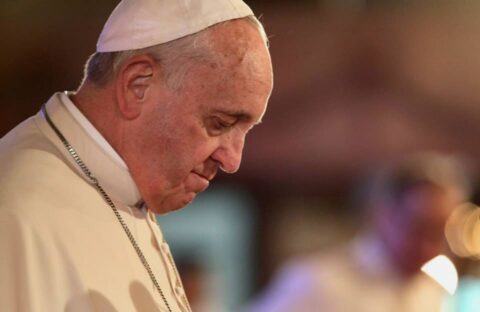
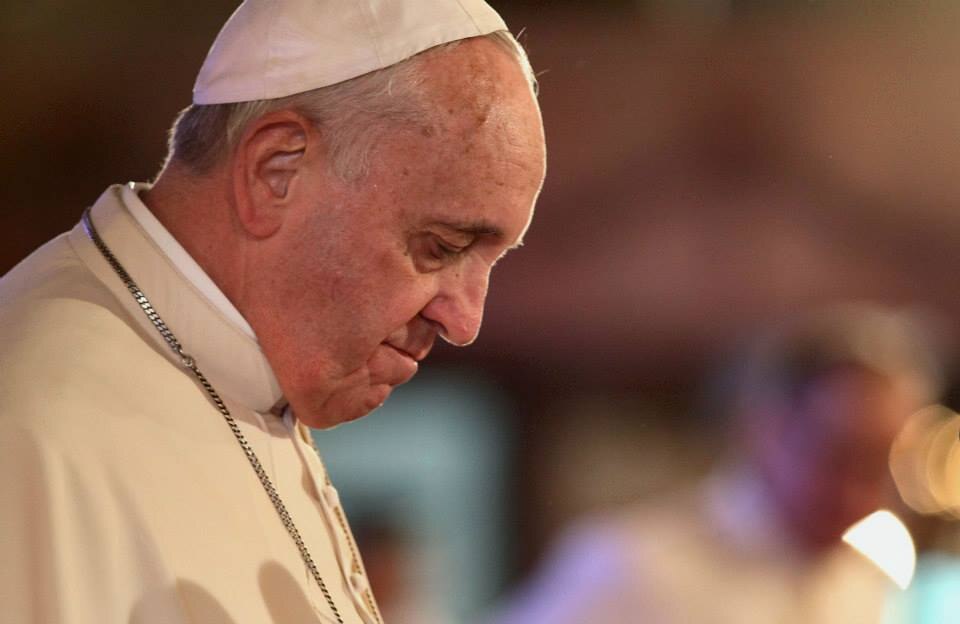
Francis Like every pope, Francis was the world’s leading Christian cleric, but the similarity ended there. Distancing himself from institutional power, he inspired by moral example. Francis championed a compassionate faith that stood in contrast to authoritarian forms of Christianity rising today.
Servant leadership? That was Francis. In an unprecedented gesture of humility in 2013, he washed and kissed the feet of four inmates, including two women and a Muslim, at a juvenile detention center in Rome. It was the first time a pope included women in this ritual.
A voice for migrants, the poor and marginalized? That was Francis. Addressing a joint session of Congress in 2015, he reminded U.S. lawmakers that America was built by immigrants. “We, the people of this continent,” he said, referencing his Argentinian roots, “are not fearful of foreigners, because most of us were once foreigners.”
An advocate for faith-based environmental care? That was Francis. In a landmark 2015 encyclical, he declared Christian values align with action to mitigate climate change. He emphasized the biblical basis for creation care and cited irresponsible lifestyles as a cause of the climate crisis.
For Mennonites, Francis was a kindred spirit, a model of peace, humility, simplicity and stewardship. …
Mennonite World Conference press release 21 April 2025
Mennonite World Conference joins Catholics and other faith communities across the world in mourning the loss of Pope Francis, who died on 21 April 2025, at the age of 88. He had been recovering at his residence Domus Sanctae Marthae after hospitalization for bilateral pneumonia.
“With gratitude, we remember the life of Pope Francis,” says César García, MWC general secretary.
“We reflect on how, through his life and teachings, he highlighted important issues for our Anabaptist communion: the imitation of Christ in his approach to power; his understanding of leadership as service; his commitment to peace; his focus on marginalized individuals, the poor, and immigrants; his concern for church unity as demonstrated in his relationships with other Christian communions and the practice of synodality; his respect for different faiths; and his care for God’s creation. These efforts, among others, endeared him to many of our brothers and sisters throughout his years of ministry.”
The first Argentine pope in the history of the church was born Jorge Mario Bergoglio in Buenos Aires, Argentina, in 1936. He was trained as a chemical technician, then joined the Jesuit novitiate in 1958. He was ordained a priest in 1969, was consecrated bishop in 1992, archbishop in 1998 and was named a cardinal in 2001. He was elected to the papacy in 2013 when he became the first pope to take the name Francis.
Over the course of his papacy, he followed his namesake who was associated with poverty, simplicity and the renunciation of power. One example was his refusal to live in the Apostolic Palace (the usual residence of popes), choosing to live in an apartment in Domus Sanctae Marthae guesthouse instead.
Pope Francis was an advocate for refugees, for the poor, and for peace, speaking out strongly against war in numerous conflicts. He released the first papal encyclical on the environment, called “Laudato Si” and a subsequent apostolic exhortation, “Laudate Deum.” He appealed for everyone to “cooperate as instruments of God for the care of creation, each according to his or her own culture, experience, involvements and talents.”
“Pope Francis worked to ensure that the Catholic Church became a church that reaches out to the margins, is not self-centred and shows deep concern for minorities (Evangelii Gaudium, 2013). He was determined to involve all the baptized in the decision-making and work of the church. He sought to reflect on synodality with Christians from other churches,” says Anne-Cathy Graber, MWC secretary for ecumenical relations. “His intentional choices of simplicity over ceremony signified a new, different way of being pope, a new way of approaching governance.
One of the major challenges that ecumenical dialogue between estranged Christian churches always faces is the question of eucharistic intercommunion: Can they share the Lord’s Supper, or Table of the Lord, or Eucharist, as varying traditions call it?
After struggling with this question for nearly ten years, the board of Bridgefolk — the grassroots organization for dialogue between Mennonites and Roman Catholics — decided that they could not resolve it. There were simply too many ecclesial and liturgical differences. They would need to explore a different approach in order to celebrate, liturgically, the measure of unity and communion that Bridgefolk participants were experiencing when they came together.
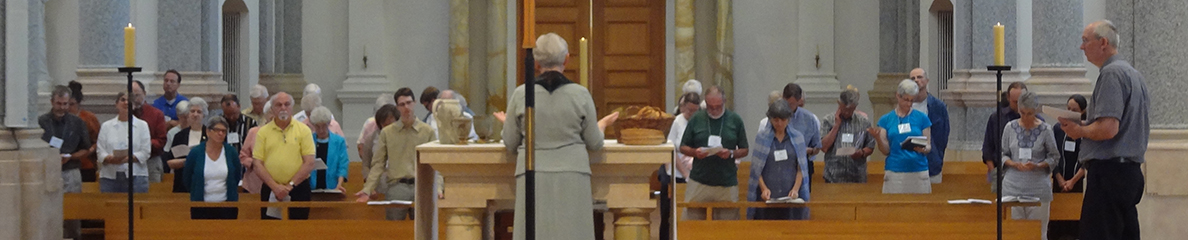
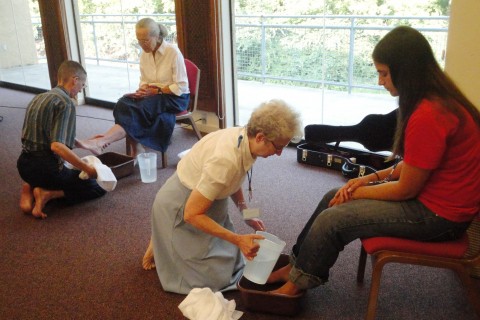
Footwashing service at Bridgefolk 2011.
As a result, the Bridgefolk board charged Professor Mary Schertz of the Anabaptist Mennonite Biblical Seminary and Abbot John Klassen OSB of Saint John’s Abbey with the task of creating a liturgical framework for footwashing. Now, after practicing this rite in its annual conferences for nearly 15 years, Bridgefolk is making it available to all Christians on its webpage, at www.bridgefolk.net/rite-of-footwashing, along with background materials.
As is well known, in John’s Gospel, chapter 13, where one would expect to find an account of Jesus handing on the Eucharist to his disciples, instead he washes their feet in a profound act of service and humility. Since deepening ecumenical relationships involve precisely those commitments, and since John’s Gospel provides a precedent, a rite of footwashing seemed to offer an alternative expression of communion where the sharing of Eucharist is not yet canonically allowed.
In response, Schertz and Klassen created a full liturgy that draws on both Mennonite and Catholic traditions. It includes a formal opening with the sign of the cross, a formal liturgical greeting (from Saint Paul), a specially crafted opening prayer, followed by a Liturgy of the Word (first reading, responsorial psalm, Gospel, and homily). They also composed a major prayer modeled after a eucharistic prayer which includes an institution account, an epiclesis, and anamnesis. After this prayer, the invitation to the sacrament of footwashing follows. The rite concludes with a sign of peace, intercessions, a concluding prayer, and an invitation to an agape meal.
Schertz and Klassen likewise structured an agape meal with formal prayers and scripture that echoes eucharistic language from the early Christian centuries (Didache, chapters 9 and 10). The liturgy opens to a simple meal shared by all participants. A variety of hymns and chants from both Mennonite and Catholic traditions can surround these elements, and a menu of possible scripture readings is available for different situations.
“Bridgefolk has found that this foot washing-agape rite has served us well as a body,” notes Klassen, “because we have freedom to choose preachers and presiders, men or women, from either tradition. The celebration of this rite has become the high point of our conferences each year because it embodies our unity in the mission of Jesus Christ.”
Klassen also notes that the experience of taking an existing rite and shaping it for Bridgefolk’s specific purposes has brought the group to a fundamental insight about the work of mutual exchange. “In formal ecumenical dialogues, there tends to be little formal prayer and liturgical experience because usually those very elements are contested, and adequate ecumenical agreement does not yet exist to practice them. As Bridgefolk, we found it essential to create and shape some existing liturgical experiences to help us celebrate our being together.”
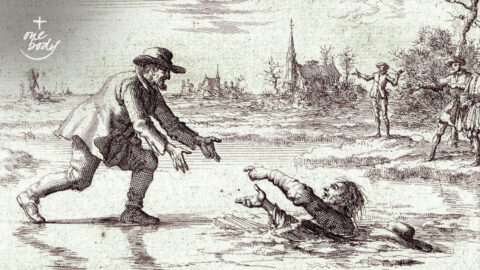
Woodcut of 16th-century Anabaptist leader and eventual martyr Dirk Willems halting his escape from prison to rescue the guard pursuing him. From Wikimedia Commons.
In this recently-published article, Dr. Jeremy M. Bergen of Conrad Grebel University College at the University of Waterloo introduces the Anabaptist-Mennonite movement for Canadian Catholics and reflects on its significance for other Christians.
Jeremy Bergen
Just over 500 years ago, on January 21, 1525, several adults gathered in a home in Zurich. After prayer and discussion, former Catholic priest George Blaurock asked one of the men present, a university student named Conrad Grebel, to baptize him. After Grebel did so, Blaurock proceeded to baptize the others gathered there. This group had initially been keen on Ulrich Zwingli’s religious reforms in the city, but were frustrated by its slow pace and the role of the secular authorities in implementing change. The emerging movement of dissenters believed that baptism was exclusively for (adult) believers. They placed an emphasis on a life of discipleship as following the teachings and example of Jesus, and the local congregation as a voluntary community of committed believers who interpret the Bible together. They believed in the separation of church and “state,” and the rejection of the sword. A movement with these commitments emerged in Switzerland, South Germany, and the Netherlands.
This ritual act in 1525 marked the beginning of the Anabaptist movement. …
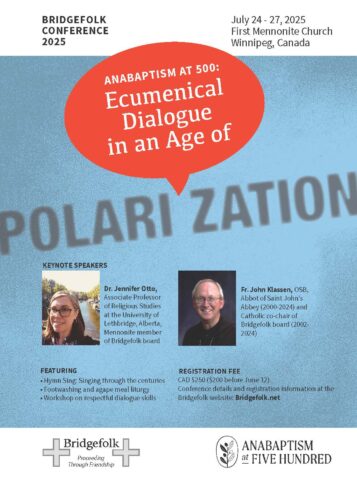
This year’s conference will look at the birth of Anabaptism from both a Mennonite and a Roman Catholic perspective, what has changed in the past five centuries, and what the implications are for ecumenical dialogue today.
The Mennonite keynote address will be given by Dr. Jennifer Otto, Associate Professor in the Department of History and Religion at the University of Lethbridge, where she teaches courses on Christianity, Bible, and Western Religions. Dr. Otto’s current research project, “Remembering Anabaptist Martyrs,” investigates the reception and representation of early Christian martyrs among Anabaptists in the 16th century and in the present day.
We also welcome Fr. John Klassen OSB, as our Roman Catholic keynote speaker. Fr. John was abbot of Saint John’s Abbey, in Collegeville, Minnesota, for over 23 years, and was instrumental in starting and supporting Bridgefolk during that time. Before becoming abbot, he received a doctorate from The Catholic University of America in Washington, DC, in 1985, taught at Saint John’s Preparatory School (1972-77) and Saint John’s University (1983-2000), and was the director of the university’s senior seminar program (1986-88), and of the Peace Studies Program (1988-90). He was the director of monastic formation for the abbey from 1993-99.
This conference will also feature a panel discussion with others who are involved in ecumenical dialogue and work, locally and elsewhere. The conference will feature a workshop to equip participants with practical tools to engage in respectful dialogue as well as small groups in which to practice these tools.
This year Mennonites are marking 500 years since the birth of the Anabaptist movement in January 1525 in Zurich. Within two years, some of those who had been “re-baptized” were martyred. We know the period that followed as a time of persecution and martyrdom, in which Anabaptists were killed by both Reformers and Catholics.
Thankfully, relations grew less violent, but even 50 years ago, recognizing each other as Christians was often a challenge. Now, there is much more understanding and cooperation between their descendants.
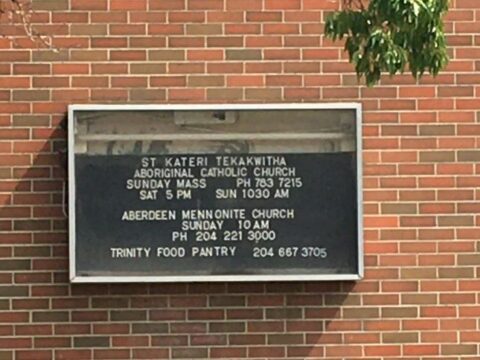
A good example is in Winnipeg’s North End, where a small Mennonite congregation is renting space from the St. Kateri Tekakwitha Indigenous Church, (or Aboriginal Catholic parish), through a history that involves cooperation with a Lutheran church as well.