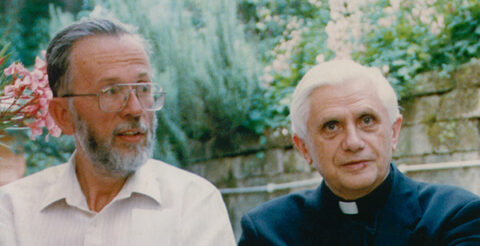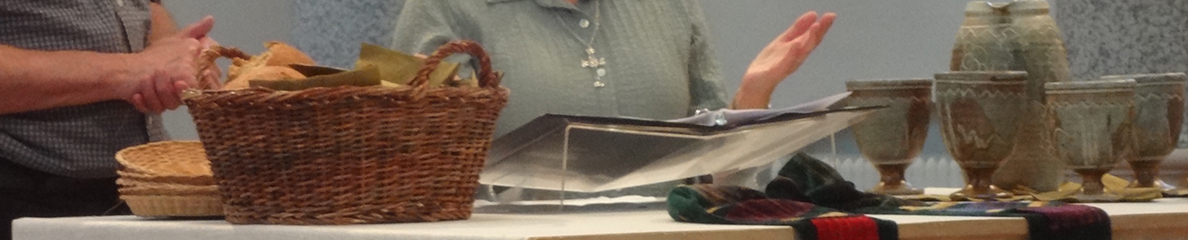
Roughly 50 people met once again at St. Mary’s Parish in Lancaster, Pennsylvania, on Saturday, April 25th, for the second annual Anabaptist-Catholic dialogue. Fr. James Lease, ecumenical officer of the Diocese of Harrisburg gave welcoming remarks on behalf of the Catholic Bishop, Timothy Senior. As in the past, the Anabaptists present included both plain and progressive congregations, Mennonites, Brethren, Bruderhof, and Old-Order Amish. There were also a few Anglicans in attendance. All age groups were present. The dialogue coincided with a Plough Magazine readers meetup and a pizza lunch, hosted by the Bruderhof, earlier in the day.
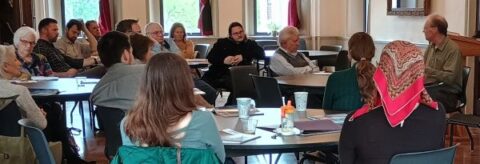
Sean Domencic, co-organizer of the dialogue, presided at the the event. In his opening remarks, Domencic emphasized that the objective of this dialogue was neither to be promote a “feel good” ecumenism which fails to acknowledge doctrinal divisions nor to be a “debate club” which seeks to proselytize one another. Rather, the event was rooted in the prayer of Jesus that “all might be one” (Jn 17:21), which demands we understand the grace of God in other traditions and urgently seek to reconcile our divisions. The concept of the “Anabaptist Ordinariate” (by which Anabaptists might retain their traditions while entering into sacramental communion with Catholics) was reiterated, along with a call for those interested in expanding the scope of the Lancaster dialogues to volunteer.
The dialogue began with prayer, in the form of a hymn, praying Psalm 133, reading a homily of Pope Leo XIV on Gospel non-violence, intercessions, and a short Scripture reading. The meeting focused on the stories of martyrs in the Anabaptist and Catholic traditions. The first reading was the ancient martyrdom account of Saint Polycarp, read in sections by a Mennonite and a Catholic. The second reading was the Martyr’s Mirror account of the martyrdom of Dirk Willems, read by a Catholic. The third reading was the martyrdom of Bishop John Fisher, read by a Mennonite.
In the discussions that followed, Anabaptists were surprised by the early Church emphasis on venerating the relics of the martyrs. Catholics acknowledged grief at the persecution of Willems and the dangers of the Church entangling herself with political power. Several participants expressed hope that these martyrs are, through the mercy of God, reconciled in Heaven and of one mind about Christian doctrine, despite being on opposite sides of the Reformation. The latter half of the discussion surprisingly turned towards church discipline in our respective traditions, and the success and failure of applying it.
The gathering closed with a Catholic reading the martyrdom of Michael and Joseph Hofer (Hutterites killed by the U.S. government for refusing the draft) and an Amishman reading the martyrdom of Franz Jaggerstatter (a Catholic killed by the Nazi government for refusing the draft). A closing prayer was followed by singing the Doxology. Around a dozen people stayed for another hour of free-form discussion.