Mennonite Catholic Theological Colloquium to discuss intercessorary prayer, October 1 at Notre Dame

Mennonite Catholic Theological Colloquium:
Intercessory Prayer

October 1, 2016
University of Notre Dame
Geddes Hall Auditorium
8:30 am to 5 pm

This daylong symposium will feature scholars from the Mennonite and Catholic traditions engaging in discussion of the historical context and contemporary liturgical practices around intercessory prayer. Formal presentations will lay the groundwork for informed engagement among participants, with the goal of advancing ecumenical dialogue through rigorous theological exploration.

Invited Speakers:

  • Marlene Kropf, Emerita, Anabaptist Mennonite Biblical Seminary
  • John Cavadini, University of Notre Dame
  • Kim Belcher, University of Notre Dame
  • Karl Koop, Canadian Mennonite University

There is no charge for participation. Refreshments will be provided, and participants will take meals on their own.

Click here for flyer PDF.

Questions? Please contact Margie Pfeil at mpfeil1@nd.edu.

This event is sponsored by:

“If Any Become Followers” – Living the Disarmed Life

We are Each Other’s Bread and Wine
no. 12

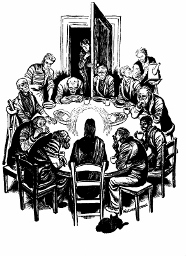
Eichenberg's Lord's Supper (small)by Weldon D. Nisly
Preached at Seattle Mennonite Church
on March 16, 2003
(the week before Nisly left to join a Christian Peacemaker Team in Iraq) 

Genesis 17:1-7, 15-16; Romans 4: 13-25; Mark 8:31-38


Something is wrong

I don’t usually begin with a story, but today I cannot resist.  A young pastor was nervously preparing for his first Sunday worship with his new congregation.  He checked and double-checked everything to make sure every detail was in place.  As worship began, he went to the pulpit for the call to worship.  Wouldn’t you know it?  The microphone wouldn’t work.  He began to panic and said, “Something is wrong with this microphone.”  And the people responded, “And also with you.”

Sisters and brothers, something is wrong – terribly wrong in our world.  There are those who think something is wrong with us or with me.  Why would anyone go to Iraq today?

The Apostle Paul unequivocally told the early Christians that they were called to be “fools for Christ’s sake” and that the wisdom of God exposed the foolishness of the world.  “For the message about the cross is foolishness to those who are perishing, but to those who are being saved it is the power of God” (1 Cor. 1:18).

To cut through the illusion and see what is wrong, we must as always be rooted in Scripture.  We must be biblical people — holding the Bible in one hand and the newspaper in the other hand.  Together, as faithfully as we know how, we live a disarmed life in a world that best knows an armed life.  That’s how foolish Christ and the cross are to the world. Continue reading ““If Any Become Followers” – Living the Disarmed Life”

I Will Make with Them a Covenant of Peace

We are Each Other’s Bread and Wine
no. 11

Eichenberg's Lord's Supper (small)by Jane Roeschley
Associate Pastor of Worship and Lay Ministries
Mennonite Church of Normal, Normal, Illinois
World Communion Sunday, 2008

Genesis 12:1-2, 3b; Ezekiel 37:26-27; 2 Corinthians 3:4-6, 10-11


Hatred Converted by Love

When the drama, The Women of Lockerbie, was performed in Bloomington/Normal, I went to see it.  It was shortly after the Virginia Tech shootings, so that event was especially on my mind, not to mention the Nickel Mine tragedy and the ongoing losses of the Iraq war – all situations of immense hurt, and examples of the way our world is full of violence that begets more violence.

Based on true events, The Women of Lockerbie tells the story of women in the village of Lockerbie, Scotland, the place where the US Pan Am 103 jet was shot down in 1988, in retaliation for US military confrontations with Libya.  All 259 persons aboard the plane, as well as 11 persons in the village, were killed.

The play is set at a point about seven years after the plane went down.  As one can imagine, characters in the play, the loved ones of various victims, voice their hate for those responsible for this tragedy – for both the violent perpetrators as well as those less obviously at fault.   Continue reading “I Will Make with Them a Covenant of Peace”

“Who Are You Having Supper With?”

We are Each Other’s Bread and Wine
no. 10

Eichenberg's Lord's Supper (small)by Doug Wiebe
L’Arche  Community, Lethbridge, Alberta
sermon to the Unitarian Universalist Fellowship of Lethbridge (abridged)

Luke 24:13-35


Two depressed men walked along the road to Emmaus on the first Easter Sunday.  They were not members of Jesus’ 12 disciples, but part of the larger group of men and women who believed Jesus was the long-awaited and hoped for Messiah.  But their hopes and dreams had died with Jesus’ crucifixion two days earlier.  They were suffering from a crisis of meaning in their lives, and the vibrant, life-changing community they belonged to had evaporated overnight.

Their depression was so deep they did not even recognize Jesus when he began walking with them.  Neither did they recognize his voice when he began to teach them.  Something in their hearts was stirred as they listened, but the words they were hearing did not reconnect them to the joy, the meaning, or the community that had filled their lives just a few days earlier. Continue reading ““Who Are You Having Supper With?””

Take No Bread for the Journey

We are Each Other’s Bread and Wine
no. 9

Eichenberg's Lord's Supper (small)by Bradley Roth
Warden Mennonite Church (Warden, Washington)
February 15, 2009

Mark 6:7-13


In Mark 6, Jesus gathers the Twelve together and instructs them in their mission.  They’re to go out in pairs, staying wherever they receive a welcome.  He gives them authority over unclean spirits, and we find them proclaiming repentance, casting out evil spirits, and anointing the sick for healing (vv. 12-13).  In all of this, the disciples are to travel lightly—extremely lightly.  Jesus tells them to take nothing except a staff—“no bread, no bag, no money in their belts” (v.8).  They can wear sandals, but they’re not to take an extra tunic—that is, no change of clothes.

To travel light is to be nimble, free to go where you need to at a moment’s notice—like fitting everything into a carry-on bag.  But it’s also a recipe for an incredible sort of vulnerability.  Jesus desired to remind the disciples of their dependence on God.

Something like this happens at the Lord’s Table.  Continue reading “Take No Bread for the Journey”

Ecumenical relations mark MWC meetings

Miller Elizabeth slide

7.24. 2015 Written By: Gordon Houser, editor of The Mennonite, for Meetinghouse

Photo: Elizabeth Miller of the Moravian Church brings greetings. Photo by Dale Gehman.

During both morning and evening worship sessions on July 22 and 23 at the MWC Assembly in Harrisburg, Pa., representatives from various Christian communions brought greetings to MWC participants. Nearly all praised Mennonites for their long-standing peace witness.

In the morning worship on July 22, Gretchen Castle of the Friends World Committee for Consultation brought greetings. That evening, Larry Miller, former MWC General Secretary, brought greetings from the Global Christian Forum, followed by Monsignor Gregory Fairbanks of the Roman Catholic Church.

On July 23, greetings came from Elizabeth Miller of the Moravian Church and William Wilson of the Pentecostal World Fellowship in the morning, followed by Isabel Phiri of the World Council of Churches, Martin Junge of the Lutheran World Federation and Diop Ganoune of the General Conference of Seventh-day Adventists in the evening. Junge received sustained applause as he expressed gratitude for MWC extending forgiveness to Lutherans in 2010 for their treatment of Anabaptists in the past.

Several workshops also addressed ecumenical concerns. Jonathan Seiling and Fernando Enns led a July 22 workshop, “Introduction to Mennonites and Ecumenism,” which introduced the reasons and contexts in which Mennonites have entered into official dialogue with other Christian denominations.

That same day, Valerie Rempel led the workshop “The MWC-Seventh-day Adventist Dialogue,” which highlighted the outcomes of a dialogue that happened in 2011-12.

On July 23, Alfred Neufeld, John Rempel and Seiling led the workshop “Trilateral Dialogue: Catholics, Lutherans and Mennonite Conversations on Baptism,” which reported on dialogues between MWC and the Lutheran and Catholic churches, a five-year process that has dealt with the healing of memories, theologies and practices that separate us, the meaning and function of a sacrament and the problem of Christian initiation.

Continue reading “Ecumenical relations mark MWC meetings”

Worship’s Feast

We are Each Other’s Bread and Wine
no. 8

Eichenberg's Lord's Supper (small)by Rachel Epp Miller
San Antonio Mennonite Church (Texas)
November 16, 2008


Isaiah 25:6-10; Psalm 34:1-10


When I think of feasts, many stories and images come to mind.  I think of family gatherings where hearty conversation goes in more directions than the people present.  I think of my experience of feasting with new friends in a small village in Kenya where their generosity was displayed with everything they had.  I think of our annual Thanksgiving worship service where we eat together and share about God’s presence in our lives, or the Love Feast on Maundy Thursday when we together remember and reenact Jesus’ last supper with his disciples.  I think of the daily routine of my friend Rosemary who had Alzheimer’s disease who would always say to me, her caregiver, after supper, “My sufficiency has been sufonsified”.  I think of camping with nieces and nephews, roasting sticky marshmallows over the fire and stuffing them with Caramilk bars.  But I also think of the daily reality of food—eating lunch at church while chatting with Jake or Hugo or reading the Mennonite Weekly Review, enjoying a late supper with Wendell while catching up on each other’s day, or laughing together through last night’s John Stewart episode. Continue reading “Worship’s Feast”

Praying with Jesus for unity

OLYMPUS DIGITAL CAMERA

1.30. 2015 Written By: Alan Kreider and Eleanor Kreider

The difference praying for unity can make in our lives and congregations

Silence, prayer, work, worship. Mennonites living like this? We tried it. Thirty years ago we were guests for 11 weeks of the Community of Grandchamp near Neuchâtel, Switzerland, whose sisters live by the Taizé rule of life as a part of the Swiss Reformed Church.

The sisters’ noon prayer, centered on the Beatitudes, always concluded with Jesus’ own prayer for his followers: “May they all be one” (John 17.21). They want Jesus’ prayer to shape their day and change their world—that there may be unity among Christians.

We were astonished by this daily repetition. After all, we were Mennonites. We thought, Weren’t we the ones committed to do what Jesus taught and did? Unlike other Christians who paid too little attention to the Sermon on the Mount, who fought their enemies and swore oaths, we Mennonites were faithful to Jesus. Yet the Grandchamp sisters also listened to Jesus. Further, they prayed with him, using his very words, that his followers may all be one, as the Father and the Son are one …


To read the full article by Bridgefolk participants Alan and Eleanor Kreider, visit The Mennonite.

Anointing Jesus’ Feet: Mary’s Example

By Elizabeth Soto Albrecht

The Gospel of John serves as a genesis. The writer makes a clear case that Jesus, the Word made flesh, was here from the beginning. The Logos, the Word, was here just as love is before service. The public ministry of Jesus, according to the Gospel of John, reaches its climax with the act of Lazarus’ resurrection. This event instigates the plot to kill Jesus and eliminate Lazarus as the living evidence of Jesus’ power over death. The Gospel of John places this miracle at the end of the first part of the narrative about Jesus’ life.

In John 12, Jesus and Lazarus are not taking the main roles, though. That role belongs to Mary; she has center stage. Her anointing of Jesus is an act, as some have stated, of “pure extravagance.” But for Judas it is “a waste, and could have been used for the poor.” In reality the writer wants the reader not to guess what is behind Judas’ comments. He wants the reader to see Judas’ hunger for money and his desire for attention.

But Judas forgets that it is a poor woman performing this prophetic act. She gives all she has as an act of gratitude. For Mary, it is an act of solidarity—“acompañamiento,” as Central Americans would say. The writer gives us the theological meaning of “anticipation of Jesus’ death.”


The full column, parts of which are adapted from Albrecht’s presentation at the 2014 Bridgefolk conference, can be read at Mennonite Church USA.