Bridgefolk is a movement of sacramentally-minded Mennonites and peace-minded Roman Catholics who come together to celebrate each other's traditions, explore each other's practices, and honor each other's contribution to the mission of Christ's Church.
Bridgefolk participant and liturgist Sarah Kathleen Johnson recently shared findings from her research on occasional religious practice and its contributions to grassroots ecumenism in a lecture at the Centre for Christian Engagement at St. Mark’s College in Vancouver.
Johnson has introduced the concept of occasional religious practice as a novel yet intuitive way to describe, analyze, and respond to widespread patterns she has observed in three years of ethnographic fieldwork in the Anglican Diocese of Toronto. While church leaders often see the pattern as a problem, Johnson notes ways that it can contribute to grassroots ecumenical dialogue. In her lecture Johnson explored these dynamics in dialogue with Roman Catholic priest Fr. Nick Meisl and Anglican deacon Rev. Alisdair Smith.
Occasional religious practice is a way of relating to religion that is characterized by participation in religious practices occasionally rather than routinely, most often in connection with certain types of occasions, including holidays, life transitions, and times of crisis. In a North American religious landscape characterized by declining participation in religious institutions, increasing uncertainty about matters of faith, and a growing population who identify as nonreligious, occasional religious practice is a primary way that people continue to relate to religion.
This year Mennonites are marking 500 years since the birth of the Anabaptist movement in January 1525 in Zurich. Within two years, some of those who had been “re-baptized” were martyred. We know the period that followed as a time of persecution and martyrdom, in which Anabaptists were killed by both Reformers and Catholics.
Thankfully, relations grew less violent, but even 50 years ago, recognizing each other as Christians was often a challenge. Now, there is much more understanding and cooperation between their descendants.
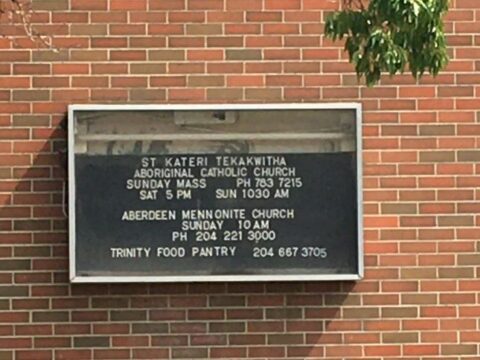
A good example is in Winnipeg’s North End, where a small Mennonite congregation is renting space from the St. Kateri Tekakwitha Indigenous Church, (or Aboriginal Catholic parish), through a history that involves cooperation with a Lutheran church as well.
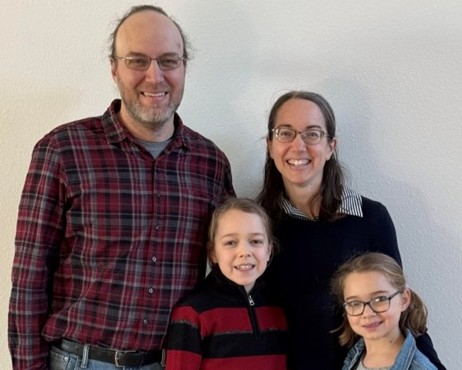
Matt Rissler, Angie Kohlhass, and their children Noah and Miriam.
Matt Rissler is the longest serving Bridgefolk board member, mostly because no one else wants to be treasurer, he suspects, and the office does not have term limits. Matt (a Mennonite) and his future wife, Angie Kohlhass (a Catholic), first attended Bridgefolk events while they were graduate students at the University of Notre Dame in the middle aughts. The final report from the historic international dialogue between Catholics and Mennonites from 1998-2003, “Called Together to be Peacemakers,” had just been released. Matt and Angie have been hooked on Bridgefolk ever since.
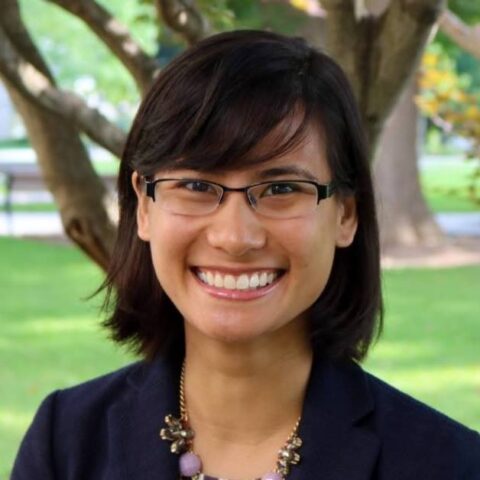
Michelle Sherman came to Bridgefolk two years ago, at the invitation of outgoing board member Elizabeth Groppe. Upon hearing more information about Bridgefolk, Michelle exclaimed, “How have I NOT heard about Bridgefolk before?!” After all, many of its core values — commitment to peacemaking, contemplative spirituality, and an ecumenical sense of proceeding through friendship — deeply resonated with Michelle.
Michelle is a Catholic and is part of Pax Christi USA, the national Catholic peace movement. She is also involved with the Catholic Nonviolence Initiative, a global initiative of Pax Christi International that unites theologians, activists, ministers, and practitioners who affirm that active nonviolence is at the heart of the vision and message of Jesus, the life of the Catholic Church, and the long-term vocation of healing and reconciling both people and the planet.
by Rosanne Fischer Associate of the Franciscan Sisters of Little Falls, Minnesota
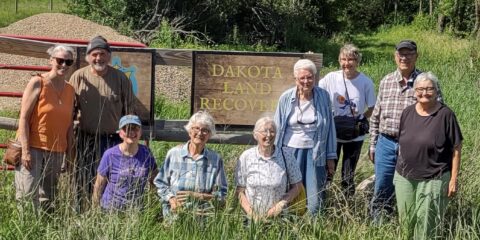
Rosanne Fischer (far left) with other Associates and Members of the Franciscan Sisters of Little Falls during a Repair Community workday. (Photo by John Kellen)
I don’t believe in ‘chance’ encounters. I believe that Spirit connects us, increases our understanding and calls us to action.
In 2022, seven members, sisters, and associates of our Franciscan Community in Little Falls, Minnesota, registered for a Land Justice Futures course. The course coincided with our intentional efforts to act upon Pope Francis’ call in Laudato Si to respond to both the cry of Earth and the cry of People. We had just committed to the Dream Project, seeking to create an environmental learning center with healing and restoration of Land that the Franciscan Sisters inhabit. We realized that the healing of Land inherently involves healing of Peoples upon Land, with priority for those who have been displaced, mistreated, and denied access. Their healing is integrally related to our healing and the healing of Land: we are all connected. We chose to enter into a year-long program with the national Land Justice Futures team which, thankfully, has extended to a second year.
What a journey!! The capable and talented Land Justice Team, along with their BIPOC (Black, Indigenous, People of Color) partners, have guided our learning about the roots of land injustice, including such information as:
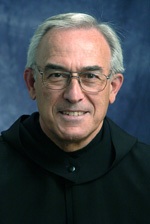
In July’s Give Us This Day, the monthly prayer book published by Liturgical Press at Saint John’s Abbey, long-time Bridgefolk participant Fr. William Skudlarek OSB offers an “explainer” concerning how Catholics in the United States are being prompted to celebrate their Independence Day on July 4th. With permission, we reprint his essay here.
A Liturgical Celebration of July Fourth
Fr. William Skudlarek OSB
A good number of countries where Catholicism is (or used to be) the dominant religion still observe some Catholic feast days as national holidays. In the United States, on the other hand, two civic holidays, Independence Day and Thanksgiving Day, are inscribed in the liturgical calendar and even given a special Mass.
Like the Mass for Thanksgiving, the Mass for July Fourth has proper prayers and a proper preface for the Eucharistic prayer. In addition, it includes the Gloria, an alternate proper preface, and a solemn final blessing. There are, however, no assigned Scripture texts; the readings are to be taken from the Mass for Peace and Justice or the Mass for Public Needs.
The prayers and the choice of readings for the Fourth of July invite us to reflect not so much on what the Declaration of Independence has freed us from, rather, they remind us what it has freed us for: to be a nation that secures justice for all its inhabitants and calls them to be artisans of peace.
In the Scriptures chosen for the Mass on July Fourth, the word peace appears eleven times. The most striking occurrence is in the Responsorial Psalm where it says, Justice and peace shall kiss (85:11). These words call to mind the fervent appeal for peace Pope Saint Paul VI made in his 1972 World Day of Peace message: If you want Peace, work for Justice.
Peace and justice are two of the richest themes in the He- brew and Christian Scriptures. To wish others peace is to wish them the fullness of life. The Liturgy of the Eucharist has us do that right before we receive the Sacrament of the Body and Blood of Christ, who came that we may have life in abundance.
Peace is Christ s gift to us, but the gift goes hand in hand with the practice of justice, that is, with the right ordering of relationships. Such right ordering is always to be carried out with mercy and generosity, especially when disordered relationships are the result of past injustice. Creating a level playing field for everyone is necessary, but not enough. This nation also must try to find ways to make amends for the immense social, economic, and psychological scars left by the injustice of enslaving people who were forcibly brought here from abroad and of dispossessing and massacring Indigenous peoples the two original sins of this nation.
As we consider what it means to celebrate Independence Day liturgically, we cannot overlook the fact that this year the holiday falls in the week when the first reading for week- day Masses is taken from the prophet Amos. Throughout the week, with the exception of July Fourth, this farmer-turned- prophet will rail against the privileged and influential people of eighth-century BCE Israel who mercilessly exploited those they impoverished. On Saturday, however, Amos proclaims God s promise never to forsake a nation that repents of its unjust treatment of the poor and the powerless.
July Fourth is certainly a time to give thanks for what was achieved when this country claimed its place among the family of nations. It is also an occasion to repent for what we have failed to do, to strive for peace with justice, and to place our trust in a merciful God who promises not to abandon us.
Anabaptist World, the denominational magazine of Mennonite Church USA, has published an article on the death of German Catholic New Testament scholar Gerhard Lohfink on 2 April 2024. The article notes the interest that Mennonites took in his work on ecclesiology and the social dimension of Christian faith:
by Wolfgang Krauß
Gerhard Lohfink, a German Catholic New Testament scholar, died on April 2, 2024 in Ebenhausen, Germany. North American Anabaptists, including Mennonites and the Bruderhof, took interest in his work, especially his book Jesus and Community: the Social Dimension of Christian Faith.
The book was published in 1982 in German and is still in print. A translation into English appeared in 1984. From the evidence of the New Testament, Lohfink developed a biblical ecclesiology that is similar to the early Anabaptists’ understanding of the church.
According to Lohfink, the Jesus movement continues in a small, relationship-based community. Through the community’s witness, people come into contact with Jesus and are invited to follow him and live together. Here Jesus is present and lives with the community in contrast to the social and political relationships of power and violence.
Lohfink’s coining of the term “contrast society” for the social dimension of the community of Jesus was an extremely important, and indeed indispensable, contribution to the ecclesiological discourse. …
When Fr. John Klassen retired from his role as Abbot of Saint John’s Abbey and departed for a six-month sabbatical in January 2024, he also concluded his tenure as Catholic Co-chair of the Bridgefolk board, a position he had filled since its formation. Sr. Ann Marie Biermaier, a board member from the St. Benedict Monastery, graciously accepted the invitation to join Mennonite Samantha Lioi as co-chair.
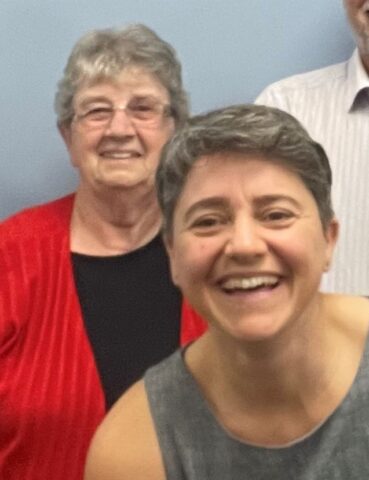
Ann Marie Biermaier, OSB (R) and Samantha Lioi (L), Bridgefolk board co-chairs.
Samantha and Sr. Ann Marie are women of different generations, and both bring a rich diversity of experiences that drew them to ecumenical involvement. Sr. Ann Marie quotes Toni Sorenson as she looks back on her six-decades-long career as a Benedictine sister: “Walking a mile in someone else’s shoes isn’t as much about the walk or the shoes; it’s being able to think like they think, feel what they feel, and understand why they are who and where they are. Every step is about empathy.” Biermaier notes: “I have had several opportunities over the years to attempt to ‘walk in others’ shoes.’ I pray that they and I are better because we’ve shared along the way.”
Living in a religious community has given Biermaier ample opportunities to walk with others. “We are a group of women from a variety of backgrounds—educationally, socially, socioeconomically. We’ve shared formative moments through study and praying together frequently each day. We’ve welcomed individuals from other cultures into our community.” Biermaier also extends welcome through her involvement with the community’s Studium program in which individuals come from around the world to do research, study, and creative work. She finds deep joy in welcoming individuals of other religions and cultures.
At the September 2023 Bridgefolk co-sponsored the Rooted and Grounded conference at Anabaptist Mennonite Biblical Seminary (AMBS), Lioi commented to some new acquaintances, “Some of my best friends are Catholic!” This has been true since childhood when, growing up in north Jersey, both of her best friends from grade school through high school were Catholic. She remains a close friend with Dominique, who is Italian like half of Samantha’s family, and Karla, who is half Mexican, half Okinawan via Hawaii. Samantha remembers meeting Dominique in the bus line one day after school, when they were about eight. “A zealous kid immersed in late-eighties evangelicalism,” Samantha recalls, “I was wearing a small pin that said, ‘Jesus loves you.’ Dominique smiled and said, ‘I like your pin,’ and we soon had a confusing exchange when she asked if I was Catholic, meaning Christian, and I said no and specified the kind of Christian I was.”
Despite having Catholic friends from an early age, Lioi regrets the judgmental attitude she absorbed as a child and youth about “the exclusive rightness of my church’s particular way of being Christian. Especially sad is a lack of connection with my Italian grandmother’s Catholic heritage. My dad’s mom left the Catholic Church to marry my Protestant grandfather, whose father had emigrated from Italy with a bad taste in his mouth from some harsher penance practices he had observed. Yet, my dad bore no hint of shame in telling me about his great aunt Emily, who was a Dominican sister.”
Both Biermaier and Lioi had educational experiences that introduced them to new people and perspectives. Biermaier’s doctoral studies presented a rich opportunity to study with a number of indigenous students. “We exchanged ideas on education, culture, and ways of improving education in our K-16 settings. Through social events we got to know each other personally.”
For her part, Lioi discovered “the rich breadth of Christian history and tradition, including the church year, classic spiritual disciplines including silence, solitude, fasting, celebration and centering prayer, as well as Catholic social teaching. “One of my profs turned me on to Rerum Novarum, and I eagerly studied the full text for a final paper in that class. That same professor dropped phrases like ‘God’s preferential option for the poor’ into theology classes, piquing my interest and planting seeds in me toward a theology of justice and peace.”
For 20-plus years, Biermaier made frequent trips to The Bahamas to work in the Benedictine education program there. She assisted students completing their degrees with the College of Saint Benedict and Saint John’s University. She lived in Nassau for two years, which she describes as “an immersion into the culture – educationally, spiritually, and socially. I grew in understanding their values, their desires for their country and world, and their love of nature and the earth.”
Biermaier made additional trips to Tanzania and India, exploring semester-long study opportunities for education students. As she explored what it might mean for US students to study in those cultural and educational environments, she also considered how African and Asian students would do as they adjusted to the College of St. Benedict and St. John’s University. A pilgrimage to Europe allowed Biermaier to trace the paths of Benedict and Scholastica in Rome and Subiaco. “As I walked the steps up the hill from the town of Subiaco to where Benedict lived, I felt deeply his love for the earth, love for prayer, the countryside, and his love for where his sister lived. I came home with a richer understanding of my Benedictine heritage.”
For her part, Lioi lived for ten months with an American family in Tanzania in her mid-twenties. There she developed friendships with Anglican pastors/missionaries from Australia and England, and many varieties of expatriate Christians worshiped together at an intentionally ecumenical local church. When she returned to the United States and enrolled at AMBS, her emerging Mennonite identity became grounded, fleshed out. “Marlene Kropf became an important mentor, and my formation as a worship leader was threaded through with Catholic contemplative spirituality and attentiveness to liturgical seasons. Professors Mary Schertz’s and Alan Kreider’s ways of reading and teaching the Bible and church history and mission profoundly impacted me.”
In summer 2007, Bridgefolk met on the AMBS campus. Lioi participated as a volunteer and found herself “immersed in mutual love and respect, joy, personal storytelling, worship, earnest faith, energizing conversations.” She was pleasantly surprised several years later to be invited to serve on the Bridgefolk board. “What a gift to be part of Bridgefolk’s ongoing growth in love, understanding, compassion, and relational peacemaking as we ‘proceed through friendship.’ I look forward to the Spirit’s winsome guiding as we continue to watch and listen for what is next. May we find—and spread—more healing and transformation as we continue to embrace one another on the bridge.”
Biermaier’s participation in Bridgefolk began when her good friend and fellow Benedictine sister Theresa Schumacher joined the Bridgefolk board. “Becoming part of Bridgefolk gave me another opportunity of ‘lifelong learning.’ I wanted to learn more about the Mennonite-Catholic relationship—the peace-loving, sacramental emphasis given within each church’s perspective. I look forward to continuing this search as I take on this new role with the board.”
By Laura Larson, Lombard Mennonite Church and Celine Woznica, Ascension-St Edmund Catholic Parish in Oak Park
Making political points with humans as pawns, Governor Abbott of Texas began bussing asylum-seeking migrants from Texas to Chicago in August 2022. By April 2023, the shelters in Chicago were near capacity and by May 2023, migrants were being placed in Chicago police stations, including a station just two blocks from the border of Chicago and the suburb of Oak Park where both of us live.
I (Celine) joined a local volunteer team that quickly responded with blankets, air mattresses, clothes, toiletries, and meals. But what about showers? Where could the migrants refresh themselves after that arduous 3000-mile trip? Having recently learned a new word (NAG-VOCATE), I was able to make arrangements for those we call our “new neighbors” to take showers at the closed rectory of a Catholic parish just three blocks from the station in Oak Park. Volunteers were recruited from the Catholic parishes, towels and personal hygiene supplies were donated, and snacks were made available. Easy-peasy.
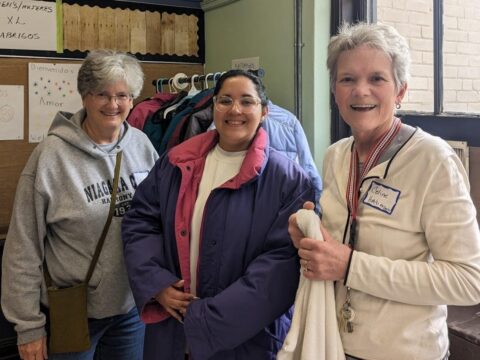
Laura Larson (l) and Celine Woznica (r) with a migrant volunteer trying on a coat.
But as the summer progressed into the fall, the number of migrants at the station swelled from a few dozen to almost two hundred. The demands changed as well. Our new neighbors needed more and a wider variety of clothes, shoes, and toiletries. Snacks turned into a full breakfast and, as the weather turned cooler, our friends needed coats and blankets. We needed help.
And the Spirit provided, breaking down the silos that kept too many faith centers isolated in their ministries. Ahh….
About this time, my heart was aching for the migrant men, women, and children struggling to survive in Chicago without adequate housing and resources. The Wednesday Journal of Oak Park and River Forest was the first place I (Laura) learned of the relief efforts of the Catholic Parishes of Oak Park. Volunteering to assist with their work seemed like the perfect opportunity to contribute. Soon after I started volunteering, the mission commission of my church, Lombard Mennonite, decided that assisting asylum-seekers was a high priority for our congregation. I suggested partnering with the efforts of the Catholic Parishes in Oak Park as one way to help.
Working with our Catholic brothers and sisters was a natural fit because both our traditions place a strong emphasis on compassionate service and justice. Our congregation decided to make the Migrant Ministry the focus of our annual Advent giving project. With enthusiasm we raised significant funds and collected piles of warm coats, clothing, boots and blankets. Several individuals volunteered. Carmen, a retiree, and Emily, a college student, helped distribute jackets. Bill, a social work student, handed out warm blankets. Rebecca and Gray, a mother-daughter team, used their ability to speak Spanish to help the migrants feel welcome as they selected hats, scarves, and gloves. God inspired an outpouring of generosity.
The Catholic Parishes of Oak Park provide the space for what is now known as the Migrant Ministry at Centro San Edmundo, but the effort is so beautifully interdenominational. We are blessed with volunteers from a wide variety of faith traditions and, of course, those who identify their religious affiliation as “none.” We have served thousands of our asylum-seeking brothers and sisters, and in this service, have found joy and fellowship with the other volunteers.
On a personal note, how wonderful it has been for my husband and me (Celine) to reconnect with Mennonites in ministry! Don and I served as Maryknoll Lay Missioners in Nicaragua in the early 1980s. These were tough times, and most of the lay missioners left for their safety. Not the Mennonites and the Catholics! Don and I stuck it out because we had Gerald and Joetta Schlabach for support.
I (Laura) have been so blessed to volunteer for the Migrant Ministry. I appreciate the spirit of cooperation that the volunteers share. Every week Celine says, “We are learning, we are adapting, we are growing.” The dynamic of love propels the mission.
I was pleasantly surprised to learn that Celine considers herself to be a “closet Mennonite”! In turn, my seminary thesis advisor was the Catholic feminist theologian Rosemary Ruether. Both of us have deep regard for our respective faith traditions. After all, Christ commanded, “You shall love your neighbor as yourself”. All of us can be united by this aspiration.
Mennonites and Catholics – we are cut from the same faith-motivated, hope-filled, social justice cloth!
Note: Bridgefolk would like to feature other Catholic-Mennonite collaborations that are happening in Canada, the US — and beyond! If you are involved in such a relationship in your local community, please let us know by sending a message to info@bridgefolk.net.