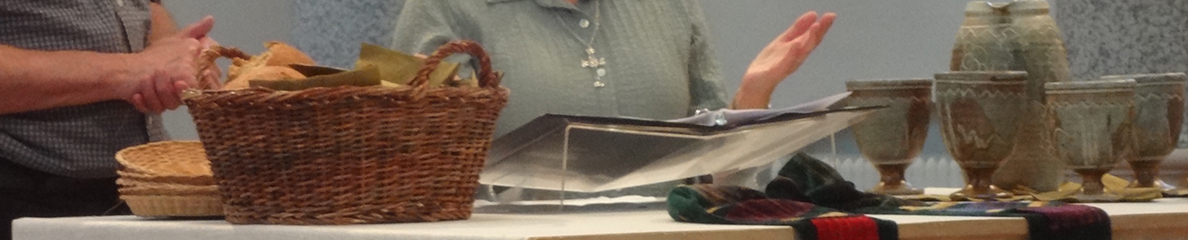
WCC panel on the challenges of dialogue

The following article provides a helpful survey of approaches and issues in interreligious or interfaith dialogue.  While the issues involved in ecumenical dialogue among Christians may be somewhat different, there are many parallels.

Gerald Schlabach
Bridgefolk Executive Director
info@bridgefolk.net
www.bridgefolk.net Continue reading “WCC panel on the challenges of dialogue”
Pentecostal leader at WCC welcomes closer ties with other Christian traditions

When I sent out a Brief earlier this week on Cardinal Kasper’s address to the WCC Assembly, what had caught my eye was his identification of Pentecostalism as a new challenge to ecumenical dialogue, given the vast complexity of the movement and the difficulty knowing with whom to talk.  The relevance of that to Bridgefolk may not be obvious, but some scholars consider the 16th century Anabaptist movement to be the forerunner not only of groups like the Mennonites, but also to the 20th century Pentecostal movement.*  One of our hopes for Bridgefolk is that it might contribute in some way to the wider ecumenical movement by developing a model of grassroots dialogue appropriate to churches like these in the so-called Free Church tradition.

Now comes a news release reporting on a speech by Ghanaian Pentecostal leader Dr. Michael Ntumy, welcoming closer ties not only between Pentecostals and WCC churches, but also with the Roman Catholic Church.  Also reported is an analysis of developments in Latin America.

Gerald Schlabach

Bridgefolk Executive Director
info@bridgefolk.net
www.bridgefolk.net

*For more on these connections see the presentation I made at our first Bridgefolk conference in 2002, on “Globalization and ‘Catholicity-from-Below'” at http://www.bridgefolk.net/conferences/past/2002bridgefolk/schlabach/


World Council of Churches – News Release
Contact: +41 22 791 6153 +41 79 507 6363 media@wcc-coe.org

For immediate release – 20/02/2006

EVANGELICAL AND PENTECOSTAL VOICES HEARD AT ASSEMBLY

More articles and free photos at
www.wcc-assembly.info
Evangelical and Pentecostal participants in the World Council of Churches 9th Assembly have welcomed better relationships with WCC churches and called for greater co-operation in the future.

Speaking to journalists on Monday February 20 were three leading evangelical figures. Rev. Geoff Tunnicliffe, international director and CEO of the World Evangelical Alliance (WEA), said that the WEA “parallel network” of 400m Christians identified with many of the WCC’s themes, such as work on HIV/AIDS, violence and poverty. Continue reading “Pentecostal leader at WCC welcomes closer ties with other Christian traditions”

Bridgefolk participant Marilyn Stahl, peace church representative at WCC

Expect a few more Bridgefolk “Briefs” this week, as we continue noting of news of interest coming out of the WCC Assembly in Brazil.  This article features Bridgefolk participant Marilyn Stahl of Seattle Mennonite Church, as well as German Mennonite ecumenist Fernando Enns, a friend of Bridgefolk.


Historic Peace Churches offer a unique voice for nonviolence
by Walt Wiltschek (*)

Marilyn Stahl has noticed recently that people have a growing interest in her church. “People hear I’m Mennonite, and they say, ‘I wish our church was a peace church’,” said Stahl, who has come to the 9th Assembly of the WCC from the School of Theology and Ministry at Seattle University in the United States. Continue reading “Bridgefolk participant Marilyn Stahl, peace church representative at WCC”

Cardinal Kasper addresses WCC assembly

Addressing the World Council of Churches assembly currently meeting in Brazil, Cardinal Walter Kasper reiterated the Catholic Church’s commitment to ecumenism.  Here is the WCC’s news release.


World Council of Churches – News Release
Contact: +41 22 791 6153 +41 79 507 6363 media@wcc-coe.org

For immediate release – 16/02/2006

CARDINAL KASPER: ROMAN CATHOLICS COMMITTED TO ECUMENISM

More articles and free photos at
www.wcc-assembly.info
The president of the Pontifical Council for Promoting Christian Unity has stressed the “irreversible” commitment of the Roman Catholic Church to ecumenism.
Continue reading “Cardinal Kasper addresses WCC assembly”

MCTC launches conversation on sacramentality. Papers invited.

We are pleased to announce that the Mennonite Catholic Theological Colloquium has opened a new round of conversation on the topic of Sacramentality, appearing at http://www.bridgefolk.net/theology/colloquia.

Since Bridgefolk assumed responsibility for the colloquium our intention has been not only to begin holding face-to-face meetings, as we did last July, but to continue inviting responses to selected papers.  We have modified the format of our earlier colloquia in a couple of important ways, however:

  • While previous exchanges occurred quietly behind the scenes, we will now be using an “open source” approach.  Papers and will appear on our website even as the conversation enfolds.
  • While Mennonite and Catholic scholars are especially invited to participate, others are welcome to contribute as well — including interested scholars from other traditions and all participants in the Bridgefolk movement.

Our new colloquium opens with a paper by Mennonite theologian Thomas Finger on “Sacramentality.”  Certainly there is an anti-sacramental tendency in the Anabaptist-Mennonite tradition, Finger acknowledges.. Yet if sacramentality names the promise that God’s grace can permeate and transform all of creation, he argues, then “historic Anabaptists were extremely sacramental,” for “they insisted, at least as strongly as any current religious movement, that grace inform all their concrete, material activities and relationships.” Finger identifies Anabaptist strands and thinkers who offer theological insights that could lead towards a fuller Mennonite affirmation of sacramentality. He also discusses recent proposals by Roman Catholic theologians attempting to explain sacramental theology in the modern world that might resonate with Mennonite theology. He points out similarities between some of these proposals and key Mennonite convictions about the presence of Christ in the church community and the need for liturgical practices to be ethically and socially transformative.

Initial responses come from two Roman Catholics.  In a paper by Dennis Martin of Loyola University in Chicago entitled  “Two Trains Passing in the Night,” the author insists that for Mennonite theologians such as Finger to engage in serious ecumenical dialogue with Roman Catholicism, they must engage settled  magisterial teaching, not just “cherry-pick” the Catholic theologians that attract them.  To do otherwise is to “converse with one’s Mennonite self, disguised superficially in ‘Catholic’ garb.”

Margaret R. Pfeil of the University of Notre Dame takes a different tack in “Liturgical Asceticism: Where Grace and Discipleship Meet.”  Pfeil especially calls fellow Catholics to practice “liturgical asceticism.” Rooted in the liturgical life of the worshipping community, liturgical asceticism connotes contemplative awareness of the mystery by which God transforms a “frail human community of believers into the Body of Christ,” so that individually and communally believers become icons of Christ in service to the world.

Here is where we invite others to continue the conversation, by responding either to Finger or to others or to both. Specific guidelines appear along with papers at http://www.bridgefolk.net/theology/colloquia.php. Responses should be sent to mctc@bridgefolk.net

Gerald Schlabach
Bridgefolk Executive Director
info@bridgefolk.net
www.bridgefolk.net


Sant’Egidio invitation to International Prayer for Peace,
April 26-27, Washington DC

In celebration of the 20th anniversary of the historical Prayer for Peace held Assisi, Italy, in 1986, the Community of Sant’Egidio, Archdiocese of Washington, Georgetown University and The Catholic University of America, invites us to join them in an International Prayer for Peace: “Religions and Cultures: the Courage of Dialogue,” in Washington D.C. on April 26-27, 2006.

Bridgefolk participants on the East Coast are especially encouraged to attend.

Further information is available at http://prayerforpeace.georgetown.edu/ or email prayerforpeace2006@georgetown.edu


Commentary on “Called Together” now available online

As enthusiastic supporters of the international dialogue between Mennonite World Conference (MWC) and the Pontifical Council for Promoting Christian Unity (PCPCU), Bridgefolk has made a number of resources available for the study of Called Together to be Peacemakers, the final report from its first round.  New on our website is a commentary that appeared with the document upon its initial release by the PCPCU.

Written by Professor Emeritus Jos. E. Vercruysse S.J., the commentary can provide a useful summary of the Called Together for those who have not yet had an opportunity to read it in full, along with certain points of critique that will interest those who are studying it closely.

You will find Called Together to be Peacemakers in various languages, along with information about an abridged study version with discussion questions, and commentaries by Prof. Vercruysse as well as others at http://www.bridgefolk.net/theology/dialogue.

Thanks to Gerald Stover of Bethelehem PA for helping to make Prof. Vercruysse’s commentary available.

Gerald Schlabach
Bridgefolk Executive Director
info@bridgefolk.net
www.bridgefolk.net