Mennonite Catholics and Catholic Mennonites, part two: bearing pain for the good of the church

The following interview was first published on the blog of the Collegeville Institute for Ecumenical and Cultural Research, “On Our Minds.” To see the original post go to http://collegevilleinstitute.org/blog/mennonite-catholics-catholic-mennonites-part-two.

By Janel Kragt Bakker, Collegeville Institute
Mennonite Catholics and Catholic Mennonites: Bearing Pain for the Good of the Church

In Part One of our interview with Gerald Schlabach, Ivan Kauffman, and Weldon Nisly, all of whom are leaders in Bridgefolk (the North American Mennonite-Catholic dialogue), we discussed the origins of contemporary Mennonite-Catholic exchange as well as the gifts the two traditions offer to each other. Though sources of attraction between the Catholic and Mennonite traditions vary, Schlabach, Kauffman, and Nisly identified Mennonite strengths in service and lay participation, and Catholic strengths in sacramental life. Participants in Mennonite-Catholic dialogue are often united by their shared commitment to peace and justice as well as their desire to build understanding and a sense of common purpose across the two traditions. In Part Two of the interview, we discuss how those involved in Mennonite-Catholic dialogue navigate painful divisions and cultural trends hostile to community and tradition.

Continue reading “Mennonite Catholics and Catholic Mennonites, part two: bearing pain for the good of the church”

Palm Sunday homily: The messiah of peace

We are Each Other’s Bread and Wine
no. 2

Eichenberg's Lord's Supper (small)by Abbot John Klassen
Saint John’s Abbey
Collegeville, Minnesota, April 27, 2008


For a long time I have puzzled about the detailed instructions Jesus gives to his disciples regarding the colt he is to ride into Jerusalem.  In the Gospels, Jesus is not an arranger; he is always moving and speaking on the fly. But in this instance, he has set this all up. He’s taking pains to stage this event, to send a particular message.

Unlike the rest of his passion, Jesus’ triumphal entry into Jerusalem is his own initiative. It is a symbolic action at Passover time, when Jerusalem is filled with pilgrims, that manifests the meaning of his life and mission. This symbolic action is also a final plea to the religious authorities who have already decided to condemn him to death after the raising of Lazarus. Continue reading “Palm Sunday homily: The messiah of peace”

Announcing new online series:
We Are Each Other’s Bread and Wine

bfbrief

We Are Each Other’s Bread and Wine:
Mennonite and Roman Catholic Reflections on Eucharist and Peacemaking

As Bridgefolk participants grow in understanding and appreciating the profound gifts of each other’s traditions, we are discovering how deeply the practice of eating together at the Lord’s Table sustains and enriches our life of Christian discipleship and peacemaking. Fed and nourished by the gift of Christ’s love, we are strengthened to share the peace of Christ in the church and in the world.

To illuminate this vital connection, Bridgefolk has begun a new online series, of sermons and homilies that connect discipleship and peacemaking with the Eucharist or Lords’ Supper.  The first installment, “The Table of Countercultural Mission,” was preached by Mennonite pastor Daniel P. Schrock at Berkey Avenue Mennonite Fellowship in Goshen, Indiana. Go to http://www.bridgefolk.net/eucharistic-peacemaking to read, or find guidelines for submitting sermons and homilies on these themes for inclusion in this online collection.

The table of countercultural mission

We are Each Other’s Bread and Wine
no. 1

Eichenberg's Lord's Supper (small)by Daniel P. Schrock
Berkey Avenue Mennonite Fellowship
Goshen, Indiana, April 27, 2008

Then he took a loaf of bread, and when he had given thanks, he broke it and gave it to them, saying, “This is my body, which is given for you. Do this in remembrance of me.” And he did the same with the cup after supper, saying, “This cup that is poured out for you is the new covenant in my blood. But see, the one who betrays me is with me, and his hand is on the table. For the Son of Man is going as it has been determined, but woe to that one by whom he is betrayed!” Then they began to ask one another which one of them it could be who would do this. (Luke 22:19-23, NRSV)

If you want to learn countercultural mission, then eat bread and drink wine at the table of God.

When Jesus sat down at a table with his disciples on that Passover night long ago, he knew what was going on in the mind of Judas Iscariot. Somehow Jesus knew that Judas was plotting to hand him over to the temple leaders. Indeed, a few days before this last supper with the twelve, Judas had quietly visited the chief priests and officers of the temple police in Jerusalem to offer them a deal. In exchange for a fee, Judas offered to help them find Jesus after dusk, when most people in the city were tucked away in their houses for the night. Reward me, said Judas, and I’ll tell you where Jesus is, so you can arrest him under the cover of darkness (Luke 22:3-6).

Jesus knew that Judas was in the process of betraying him (see 22:21). Ponder that for a moment. Continue reading “The table of countercultural mission”

Mennonites, Catholics and Lutherans hold second round of dialogue on baptism

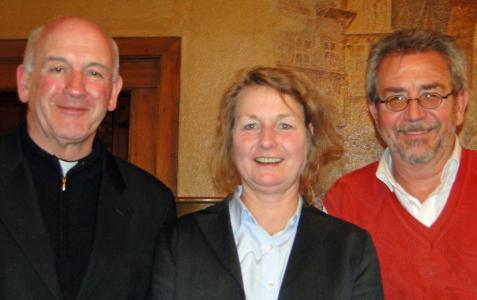
Co-chairs of the commission (from left): Luis Augusto Castro Quiroga, Friederike Nüssel, Alfred Neufeld. Photo by Eleanor Miller

Release date: Sunday, 9 March 2014

Strasbourg, France – “I continue to be inspired by the mutuality of our work,” commented John Rempel of Toronto, Ontario, one of the Mennonite participants in the 26-31 January 2014 second meeting of the Trilateral (Catholic, Lutheran, Mennonite) Dialogue Commission on Baptism.

The general topic of the dialogue, which is to extend over four years, is “Baptism and Incorporation into the Body of Christ, the Church.” The theme for this year was “Baptism: God’s Grace in Christ and Human Sin”.

“Everyone is treated equally even though we are by far the smallest confession,” noted Rempel. “We are all trying to rethink the issues in terms of the 21st century, not only the 16th century.”

He commented further, “I find myself grappling especially with two aspects of this year’s meeting. I’m discovering how important sacraments are to Lutherans and Catholics as expressions of God’s initiative: God is mysteriously at work by means of prayer and water, whether we respond to it or not. And yet I can’t understand God’s initiative in the New Testament without the human response to grace.”

“At the same time our partners fear that we put so much weight on the human decision to believe that God’s initiative is pushed to the background. The participants are aware that only through the work of the Holy Spirit will this dialogue lead us closer to the mind of Christ.”

Continue reading “Mennonites, Catholics and Lutherans hold second round of dialogue on baptism”

Amen to it all: my first Holy Communion and then what happened

by John Kotre

My first Holy Communion was white.  It was back in 1948 and the girls wore little bridal outfits and the boys white shirts and pants.  The priest was vested in white and a white cloth covered the communion rail.  The bread I received was itself white–a thin, almost transparent wafer.  I let it dissolve on my tongue.  “You don’t chew Jesus,” Sister Girard had told us.  It was her way of saying “transubstantiation.”

I didn’t chew Jesus but I don’t remember talking to him either.  My face was buried in my hands, and I was imagining what a softening host looked like in my mouth, far from my teeth.  Sister Girard said that communion poured sanctifying grace into our souls, and for years I pictured that grace as milk.  After each communion I checked my milk-bottle soul and saw that the level of grace had risen.  It must have gone down between communions because I was never able to top off the tank.

In my teens the milk bottle gave way to abstract thinking.  Now I could absorb concepts like transubstantiation, and so I did during six years as a Jesuit seminarian.  Continue reading “Amen to it all: my first Holy Communion and then what happened”

Mennonite worship leaders meet Benedictine hospitality at January retreat

Mount Pleasant, PA —  The 26th Annual Music and Worship Leaders Retreat (MWLR) at Laurelville Mennonite Church Center (LMCC) served as an opportunity for encounter between Mennonites and Catholics in January, as featured speaker Abbot John Klassen OSB, Bridgefolk co-chair, shared concerning Benedictine practices of hospitality.

During their time together, music and worship leaders were inspired and taught by many experienced leaders, including Klassen and Mennonite pastor Isaac S. Villegas. Contained in teachings were various steps and challenges in the area of hospitality among churches. Overall, the planning and resource team created “…a space where change [could] take place”, giving leaders the opportunity to sit back, soak in and worship God as they assessed their current worship styles and brainstormed for years to come.

Continue reading “Mennonite worship leaders meet Benedictine hospitality at January retreat”

Baptism the focus of trilateral dialogue by Mennonites, Catholics and Lutherans

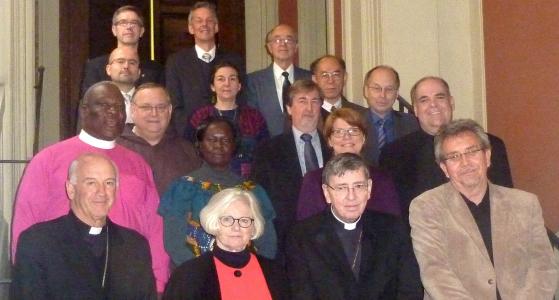
Front row (from left): Luis Augusto Castro Quiroga, Turid Karlsen Sein, Cardinal Koch, Alfred Neufeld. Second row: Musawenkosi Biyela, Rebecca Osiro, Kaisamari Hintikka, Gregory J Fairbanks. Third row: William Henn, Larry Miller, Theodor Dieter. Fourth row: César Garcia, Marie-Hélène Robert, Kwong-Sang Peter Li. Fifth row: Luis M Melo, Fernando Enns, John Rempel.

Rome, Italy/Bogota, Colombia  (MWC) – An international trilateral dialogue between Mennonites, Catholics and Lutherans began in Rome, 9-13 December 2012.

According to a joint release issued after the Rome meeting, the overall theme of the five-year process is “Baptism and Incorporation into the Body of Christ, the Church.” The release further stated: “This innovative trilateral forum will allow the dialogue to take up questions surrounding the theology and practice of baptism in the respective communions.” Continue reading “Baptism the focus of trilateral dialogue by Mennonites, Catholics and Lutherans”

Communion of saints: Miraculous healing leads to sainthood, helps Mennonites and Catholics deepen friendship

by Laurie Oswald Robinson

Mennonite World Review

Because a Japanese Mennonite man was healed from leukemia after Mennonites and Catholics prayed, a new round of ecumenical dialogue on prayer is stirring up the faithful.

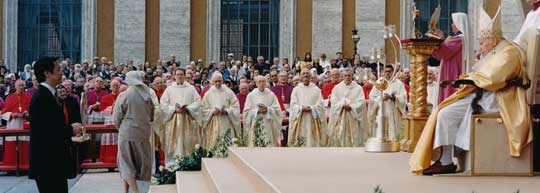
Jun Yamada presents relics of Joseph Freinademetz to Pope John Paul II in the service of canonization for Freinademetz on Oct. 5, 2003, in Rome. — Photo by Society of the Divine Word

Exactly how God said “yes” to prayers for the healing in 1987 of Jun Yamada, a 24-year-old university student in Japan, will always be shrouded in mystery.

But that isn’t keeping participants in Bridgefolk — a group of Mennonites and Catholics united by their faith in Christ — from more deeply exploring the connection between God’s family on Earth and in heaven.

This past July at the annual Bridgefolk gathering, Alan and Eleanor Kreider — longtime Mennonite teachers on church history, worship and mission — shared the account that Jun Yamada’s brother, Nozomu Yamada, had passed on to them in Tokyo. Continue reading “Communion of saints: Miraculous healing leads to sainthood, helps Mennonites and Catholics deepen friendship”