Pax Christi: Dialogue is the only way towards an end of the violence in Syria

Catholic peace organization Pax Christi has issued the following statement:

Pax Christi International is deeply concerned about the latest events in Syria.

While we unequivocally condemn the use of chemical weapons, regardless of who perpetrated the attack, Pax Christi pleads with the nations of the world to recognize the responsibility and authority of the UN Security Council to address this egregious violation of international law and morality and to work with the United Nations to protect – without escalating the violence – the Syrian people. This should be done through urgent diplomatic efforts to stop immediately the flow of arms to both sides and to all militant groups and to bring all stakeholders in the conflict to the negotiating table.  Many states have helped fuel the armed conflict in Syria by sending weapons to the region; now it is time for the International community to cooperate fully on an arms embargo and to unequivocally back dialogue that alone can end the horrific violence.

Continue reading “Pax Christi: Dialogue is the only way towards an end of the violence in Syria”
Pope: Faith and violence are incompatible

(Vatican Radio) Pope Francis on Sunday reiterated his call for peace in the ongoing crisis in Egypt saying, “we continue to pray for peace in Egypt together, Mary Queen of Peace pray for us.” The Holy Father also remembered those who were killed in a ferry disaster in the Philippines this week and prayed for the families in their grief.

The Pope was speaking following the recitation of the Angelus prayer from the Papal Apartments above St Peter’s Square.

During his Angelus address Pope Francis took his cue from Sunday’s Gospel liturgy. Continue reading “Pope: Faith and violence are incompatible”

Nigerian EMU graduate building peace

Nigerian grad has had huge impact on peace in West Africa

gopar_tapika_wife_web

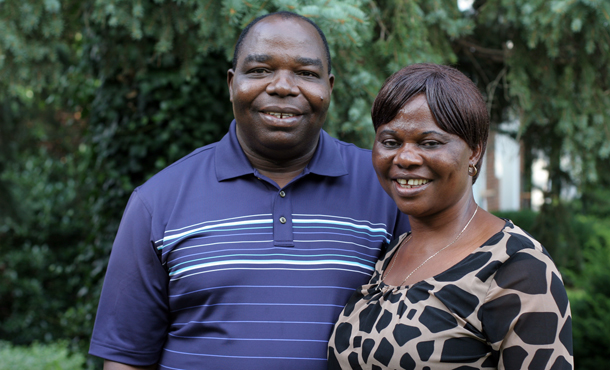
Gopar Tapkida (left) is transitioning from his role as Mennonite Central Committee’s regional peace advisor for West and Central Africa to jointly serving with his wife Monica (right), a former teacher, as MCC’s country representatives for Zimbabwe. Tapkida, a former pastor who holds an MA in conflict transformation from EMU, has seen his seeds of peace take root and grow well despite adverse conditions in Nigeria and the surrounding region. (Photos by Bonnie Price Lofton)

After decades spent establishing a network of Muslim and Christian peacebuilders in Nigeria, the most populous country in Africa, Gopar Tapkida says he is ready to leave his home country for the challenge of doing leadership and peace work in Zimbabwe, one of the poorest countries in Africa.

Tapkida, who earned a master’s in conflict transformation from Eastern Mennonite University (EMU) in 2001, has seen Nigeria move from having virtually no leading citizens committed to peacebuilding to having a network of Muslim and Christian peace practitioners who monitor their neighborhoods and faith communities for signs of budding violence and who intervene to head it off. Continue reading “Nigerian EMU graduate building peace”

John Dear describes his experience at a Catholic Worker house in California, quotes Mennonite volunteer

In a two-part series on National Catholic Reporter, John Dear, SJ writes about his current experience as a short-term volunteer at Kelly Avenue Catholic Worker house in Half Moon Bay, California.

In part one (available in full here), Dear quotes Mennonite volunteer Katerina Friesen as she explains what motivates her involvement there:

I came to the Catholic Worker because, as a follower of Jesus, I wanted to learn how to live a different way of life….  The Catholic Worker tradition of resisting war and serving the poor made sense to me, and it’s turned out to be a really liberating experience. Now, when I see a homeless person, I feel free to talk with him or her, to ask what they need rather than walking past or feeling afraid. And I used to be bound by anxiety about my life, but now I see how my needs are taken care of even as I help care for other people’s needs. Continue reading “John Dear describes his experience at a Catholic Worker house in California, quotes Mennonite volunteer”

Pope Francis preaches on loving our enemies

Preaching on the lectionary readings for June 18, 2013, Pope Francis proclaimed “the hard lesson of loving our enemies” to those gathered for daily Mass in the chapel of Casa Santa Marta (text courtesy of Vatican Radio):

“We too often we become enemies of others: we do not wish them well. And Jesus tells us to love our enemies! And this is not easy! It is not easy … we even think that Jesus is asking too much of us! We leave this to the cloistered nuns, who are holy, we leave this for some holy soul, but this is not right for everyday life.  But it must be right! Jesus says: ‘No, we must do this! Because otherwise you will be like the tax collectors, like pagans. Not Christians.'” Continue reading “Pope Francis preaches on loving our enemies”

Catholic bishop and Mennonite Central Committee partner wins U.N. prize for peace work in South Sudan

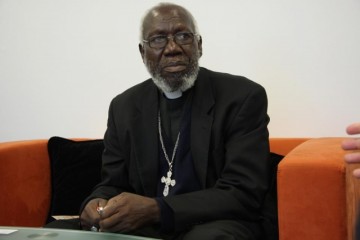
Bishop Emeritus Paride Taban, a long-term friend of Mennonite Central Committee, recently won a U.N. award for peace work he did in South Sudan. (Photo courtesy of Håvard Kleppa, the Oslo Center)

AKRON, Pa. (MCC) – The peacebuilding efforts of Bishop Emeritus Paride Taban, a longstanding friend of Mennonite Central Committee (MCC), were recognized at a March 1 ceremony in Geneva, Switzerland.

The Catholic bishop from South Sudan won the United Nations 2013 Sergio Vieira de Mello Peace Prize for his work with the Holy Trinity Peace Village in Kuron, where he helped to build peace and trust among people in conflict over cattle rustling. Continue reading “Catholic bishop and Mennonite Central Committee partner wins U.N. prize for peace work in South Sudan”

Ivan Kauffman: Pope Francis and peace

Bridgefolk perspectives on Pope Francis

For the past half-century, ever since John XXIII and Vatican II, the popes have been strong advocates of peace. Since John Paul II they have been non-Italians. And beginning with John Paul they have been increasingly attractive to the evangelical community. If early indications endure, this trend will continue under Pope Francis—and if so it will be strengthened, and likely become permanent. This has profound and long-lasting significance for the Mennonite-Catholic reconciliation in which Bridgefolk has played an important role.

This is very good news, but it also comes with a price. A pope from Argentina inevitably brings the legacy of that nation’s “Dirty War” with him—and with it the Churches’ inaction during the reign of terror and state-sanctioned murder, which impacted all the Americas, including the United States in that period. Along with the gift of this attractive new papacy we must now confront our unwillingness and our inability to deal with this great mass of political evil.

In his final speech before being elected pope and choosing the name Francis, Cardinal Bergoglio told his fellow cardinals he heard Jesus knocking at the door, but that he heard Jesus knocking from inside the Church, asking to be let out into the world. It is widely believed this speech played a major role in his election. Belonging to a Church which goes out with Christ into the world’s evil and suffering will be a very different experience for most of us. It will require not only personal and political change, it will require some new institutions.  But this is an opportunity, not a burden, and it is one that both Catholics and Mennonites can enthusiastically embrace. Let us do so.

Ivan J. Kaufman is a co-founder of the Bridgefolk movement.

Fernando Enns publishes new book on ecumenism and peace

Fernando Enns' book on ecumenism and peaceFernando Enns, Professor of Mennonite Peace Theology and Ethics at the University of Amsterdam has recently published a new book Ökumene und Frieden (Ecumenism and Peace).  In it Enns shows how ecumenism “works.” What are realistic goals and methodologies? Enns applies the ecumenical approach to different fields of theology and ethics. The large chapter on the Ecumenical “Decade to Overcome Violence” of the World Council of Churches is the first coherent account on that stimulating enterprise.

Click here for more information