Pentecostal leader at WCC welcomes closer ties with other Christian traditions

When I sent out a Brief earlier this week on Cardinal Kasper’s address to the WCC Assembly, what had caught my eye was his identification of Pentecostalism as a new challenge to ecumenical dialogue, given the vast complexity of the movement and the difficulty knowing with whom to talk.  The relevance of that to Bridgefolk may not be obvious, but some scholars consider the 16th century Anabaptist movement to be the forerunner not only of groups like the Mennonites, but also to the 20th century Pentecostal movement.*  One of our hopes for Bridgefolk is that it might contribute in some way to the wider ecumenical movement by developing a model of grassroots dialogue appropriate to churches like these in the so-called Free Church tradition.

Now comes a news release reporting on a speech by Ghanaian Pentecostal leader Dr. Michael Ntumy, welcoming closer ties not only between Pentecostals and WCC churches, but also with the Roman Catholic Church.  Also reported is an analysis of developments in Latin America.

Gerald Schlabach

Bridgefolk Executive Director
info@bridgefolk.net
www.bridgefolk.net

*For more on these connections see the presentation I made at our first Bridgefolk conference in 2002, on “Globalization and ‘Catholicity-from-Below'” at http://www.bridgefolk.net/conferences/past/2002bridgefolk/schlabach/


World Council of Churches – News Release
Contact: +41 22 791 6153 +41 79 507 6363 media@wcc-coe.org

For immediate release – 20/02/2006

EVANGELICAL AND PENTECOSTAL VOICES HEARD AT ASSEMBLY

More articles and free photos at
www.wcc-assembly.info
Evangelical and Pentecostal participants in the World Council of Churches 9th Assembly have welcomed better relationships with WCC churches and called for greater co-operation in the future.

Speaking to journalists on Monday February 20 were three leading evangelical figures. Rev. Geoff Tunnicliffe, international director and CEO of the World Evangelical Alliance (WEA), said that the WEA “parallel network” of 400m Christians identified with many of the WCC’s themes, such as work on HIV/AIDS, violence and poverty. Continue reading “Pentecostal leader at WCC welcomes closer ties with other Christian traditions”
Bridgefolk participant Marilyn Stahl, peace church representative at WCC

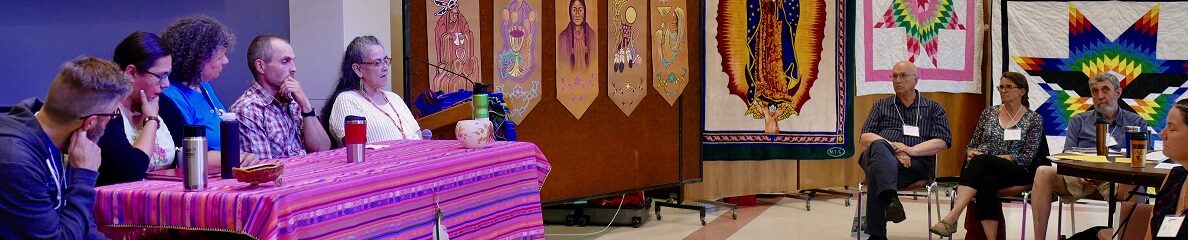
Expect a few more Bridgefolk “Briefs” this week, as we continue noting of news of interest coming out of the WCC Assembly in Brazil.  This article features Bridgefolk participant Marilyn Stahl of Seattle Mennonite Church, as well as German Mennonite ecumenist Fernando Enns, a friend of Bridgefolk.


Historic Peace Churches offer a unique voice for nonviolence

by Walt Wiltschek (*)

Marilyn Stahl has noticed recently that people have a growing interest in her church. “People hear I’m Mennonite, and they say, ‘I wish our church was a peace church’,” said Stahl, who has come to the 9th Assembly of the WCC from the School of Theology and Ministry at Seattle University in the United States. Continue reading “Bridgefolk participant Marilyn Stahl, peace church representative at WCC”

Cardinal Kasper addresses WCC assembly

Addressing the World Council of Churches assembly currently meeting in Brazil, Cardinal Walter Kasper reiterated the Catholic Church’s commitment to ecumenism.  Here is the WCC’s news release.


World Council of Churches – News Release
Contact: +41 22 791 6153 +41 79 507 6363 media@wcc-coe.org

For immediate release – 16/02/2006

CARDINAL KASPER: ROMAN CATHOLICS COMMITTED TO ECUMENISM

More articles and free photos at
www.wcc-assembly.info
The president of the Pontifical Council for Promoting Christian Unity has stressed the “irreversible” commitment of the Roman Catholic Church to ecumenism.
Continue reading “Cardinal Kasper addresses WCC assembly”

Roman Catholic Church & World Council of Churches recommit to dialogue and collaboration

World Council of Churches – Update
Contact: + 41 22 791 6153 +41 79 507 6363 media@wcc-coe.org

For immediate release – 22/11/2005

A TRIED AND TRUE EXPRESSION OF PARTNERSHIP AND COLLABORATION, THE JOINT WORKING GROUP BETWEEN THE ROMAN CATHOLIC CHURCH AND THE WCC SET TO TACKLE NEW CHALLENGES

Becoming a “trusted partner” for one another “has been perhaps the most enduring achievement of the past four decades” of collaboration between the Roman Catholic Church and the World Council of Churches (WCC), and this continued cooperation “must be considered one of the significant achievements of the modern ecumenical movement”. Continue reading “Roman Catholic Church & World Council of Churches recommit to dialogue and collaboration”

A Tribute to Brother Roger of Taizé

by Ken Henke, Princeton Theological Seminary

On Tuesday, August 23, funeral services will be held for Brother Roger of Taizé. At the age of 90, he was attacked with a knife by a woman, most probably mentally disturbed, in the midst of community prayer in the Church of Reconciliation at Taizé, France. He died shortly afterward.

The son of a Swiss Reformed pastor, at age 25 he left his native Switzerland and came bicycling into the tiny, poor hamlet of Taizé in France, seeking a place where he could quietly devote himself to a life of prayer and contemplation. A peasant woman, keeper of the keys to the run-down house and property which Roger Schutz had come to look at, begged him to buy the house and stay. Later on, when asked, “Why Taizé?” Roger Schutz was to say: “I chose Taizé because the woman was poor. Christ speaks through the poor, and it’s good to listen to them. Anyone who begins with the poorest of the poor is not likely to go wrong.” Continue reading “A Tribute to Brother Roger of Taizé”

Update on Lutheran Mennonite Dialogue

For Immediate Release

July 8, 2005

LUTHERAN-MENNONITE INTERNATIONAL STUDY COMMISSION BEGINS WORK ON CONDEMNATIONS OF ANABAPTISTS

Strasbourg, France – The first meeting of the Lutheran-Mennonite International Study Commission took place at the Institute for Ecumenical Research here June 27 to July 1. The Lutheran World Federation (LWF) and the Mennonite World Conference (MWC) sponsor this Study Commission.

The mandate of the commission is to consider the condemnations of Anabaptists in Lutheran confessional writings and their applicability to the teaching of Anabaptists/Mennonites today.

The commission heard major papers by Lutheran Prof. Dr. Gottfried Seebass, Heidelberg, Germany, and Mennonite Prof. Dr. John Roth, Goshen, Indiana, (USA) on “The Condemnations of Anabaptists in the Augsburg Confession and the Book of Concord: Their Historical Meaning, Purpose and Effect.”

Through its deliberations the commission became more deeply sensitive to the lasting memory of the suffering of Anabaptists at the time of the Reformation as a result of persecution by civil authorities in Roman Catholic, Lutheran and Reformed areas. For Mennonites, the condemnations in Lutheran confessions have played a role in this regard. The commission is also aware that Christians of all confessions were victims of persecution in that period. Reflection on this matter raises serious questions concerning the theological rationale for pursuing religious and social goals by violent means, including torture and killing. Continue reading “Update on Lutheran Mennonite Dialogue”

MWC news release on Mennonite / Lutheran dialogue

The following news release concerns an ecumenical dialogue between Mennonites and Lutherans that in many ways parallels the dialogue between the Mennonite World Conference and the Pontifical Council for Promoting Church Unity.  Many of you will find it of interest.


NEWS RELEASE
Mennonite World Conference

For Immediate Release
June 20, 2005

MENNONITES AND LUTHERANS WEIGH
16TH CENTURY ANABAPTIST CONDEMNATIONS

Strasbourg, France – Does the condemnation of Anabaptists spelled out in the
1530 Augsburg Confession apply to Mennonite World Conference member and
related churches today?

Mennonite and Lutheran scholars, theologians and historians will offer their
perspectives on this question at the first international MWC and Lutheran
World Federation Study Commission to be held at the Ecumenical Institute
here June 27 – July 1.

Planning for the international commission began in 2004 and will build on
national dialogues that have already been held between Mennonites and
Lutherans in France, Germany and the United States over several years. Those
discussions touched on similarities and differences between the faith groups
around issues such as baptism, the Lord’s Supper and relations between
church and state. But they also dealt with the Augsburg Confession and its
condemnation of Anabaptists, which is still foundational in Lutheran liturgy
and theology worldwide.

What connections exist between the Augsburg Confession’s condemnation of
Anabaptists and their execution in Lutheran lands in the 16th century? Does
the confession perpetuate mistaken images of Anabaptists and justify the
violence against them? What consequences emerge for relationships between
today’s Mennonites and Lutherans?

Questions such as these were raised in national dialogues. The commission
will consider whether conclusions reached there on these and other questions
can be received internationally.

The Study Commission’s primary work in Strasbourg will be on the Augsburg
Confession and its impact on today’s MWC and related churches. The
commission’s conclusions will be reported to the governing bodies of MWC and
the LWF for further action and possible official statements. Planners
anticipate three annual international dialogues.

Co-chairing the commission will be Rev. Rainer Burkhart, Mennonite church
leader in  Germany, and Dr. Gottfried Seebass, Lutheran theologian, also
from Germany. Co-secretaries for the commission are Dr. Larry Miller from
Strasbourg, MWC executive secretary, and Rev. Sven Oppegaard from Geneva,
LWF Associate General Secretary for Ecumenical Affairs.

Study Commission members include participants from each of the previous
national dialogues. Other Mennonites among them are Dr. Claude Baecher,
theologian and professor from France; and Dr. John Roth, church history
professor from Goshen College (USA). New to Lutheran/Mennonite discussion is
Hellen Bradburn, a Mennonite theologian from Arusha, Tanzania, an area that
has approximately three million Lutherans.


Ferne Burkhardt, News Editor
Mennonite World Conference

German Mennonite theologian Fernando Enns lectures on the role of peace churches in ecumenical movement

NEWS RELEASE
Mennonite World Conference
For Immediate Release

June 14, 2005

Fernando Enns lectures in Canada address

‘A peace church in conversation’

Waterloo, Ont. (Canada) — “Our insights do not only belong to ourselves,
but are our gifts to the whole church.” This was Dr. Fernando Enns’
challenge to Anabaptist/Mennonites in his March 16 address at Conrad Grebel
University College here. The evening lecture, entitled “The Peace Church:
Dialogue and Diversity in the Ecumenical Movement,” was part of the fifth
annual Bechtel Lectures in Anabaptist/Mennonite Studies. Continue reading “German Mennonite theologian Fernando Enns lectures on the role of peace churches in ecumenical movement”