New book in Bridgefolk series released

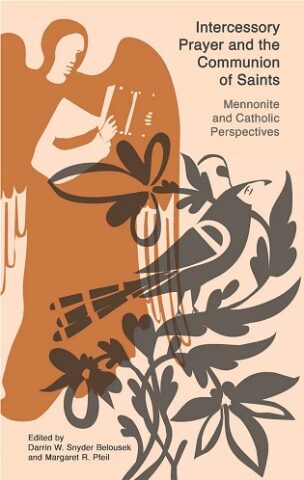
Intercessory Prayer and the Communion of Saints: Mennonite and Catholic Perspectives, Edited by Darrin W. Snyder Belousek and Margaret R. Pfeil

CA$29.95
Order from Pandora Press
Also available on Amazon.com and Amazon.ca

“This miracle will be one of the bridges between Roman Catholics and Mennonites in an ecumenical point of view,” said Pope John Paul II in 2003 on the occasion of the canonization of Joseph Freinademetz, S.V.D. He was speaking of the miraculous healing of Jun Yamada, son of a Japanese Mennonite pastor, through the joint intercessions of Catholics and Mennonites united by faith in Jesus and love of God. That miracle, as John Paul predicted, has inspired ongoing ecumenical friendships, dialogues, and engagements between Mennonite and Catholics, leading to this volume. Moved by this healing story, Bridgefolk, a Mennonite-Catholic ecumenical movement in North America, centered its annual conference in 2015 on that story. Following that conference, the Mennonite Catholic Theological Colloquium convened in 2016 to consider the Christian practice of intercessory prayer and doctrine of the communion of saints from the perspectives of both traditions. This volume collects the presentations from those two events, including the personal and theological reflections of Nozomu Yamada, brother of Jun, and Alfonso Fausone, S.V.D., who initiated the intercessions for Jun.

Praise for Intercessory Prayer and the Communion of Saints

“In a culture where the “praying hands” emoji is nearly ubiquitous, this mind-blowing collection—narratives surrounding an amazing healing and carefully articulated theological reflection—is a must read, whether or not we have an established prayer practice. Here we are offered the fruit of decades of Mennonite-Roman Catholic conversation. And although the volume does not directly address this, Intercessory Prayer reminds Euro-American Anabaptist descendants of rich and faithful insights blossoming among siblings in Christ in other cultures.”

—Nancy R. Heisey, Professor at Eastern Mennonite Seminary and Past-President of Mennonite World Conference

“This book constitutes an excellent contribution to what was once thought to be church-dividing and off limits: the communion of Saints and intercessory prayer. While written as part of Mennonite-Catholic dialogue, and not least, stemming from the ecumenical conversations of Bridgefolk, this work is of benefit to all Christians. Clear articulations of both Mennonite and Catholic positions in dialogue add to the value of this book. I highly recommend it.”

—Maxwell E. Johnson, Professor of Theology, The University of Notre Dame

Book review:
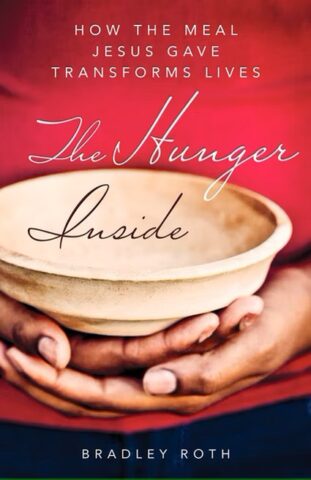
The Hunger Inside by Bradley Roth

The Hunger Inside: How the Meal Jesus Gave Transforms Lives
by Bradley Roth, Paraclete Press, 2022 (224 pages)

Reviewed by Marlene Kropf

In a welcoming, conversational style, pastor-author Brad Roth offers both a personal story of encounter with the Eucharist, and thoughtful historical and biblical reflections on the role of the Eucharist in the church’s life and witness. His purpose in writing, he says, is to leave a “bread crumb trail” to the Lord’s Table for others to discover the richness of the feast to which all are invited.

Raised in an evangelical Mennonite family and congregation in Illinois, Roth grew up with infrequent exposure to the Lord’s Table. Like many other Protestant churches, his congregation celebrated communion only a few times a year. And when they did obey Jesus’ command to eat and drink at the Lord’s Table, the church taught him that the bread and cup were symbols, nothing more. Yet a hunger persisted within him for something more – for a more vivid experience of the living presence of the Risen Christ. Though he knew Jesus, he had not encountered him.

No one was more surprised than he was, Roth says, by the turn of events which brought him to recognize that more was going on in communion than he could account for with his mind alone. His heart was being stirred and his body enlivened by the palpable presence of Jesus. Hours after the ritual, he could still feel the lingering frisson of joy emanating from the meal.

To understand his own experience more fully and to encourage others to do the same, Roth went “deep and wide” in his search to illumine what God is doing in the communion ritual and what is happening in those who partake of God’s gifts. In one of his strongest chapters, he lays a foundation for the idea of a “sacramental universe” in which God’s presence and activity are known not only through the revelation of scripture but through the molecules and atoms of the material world itself. He draws on a wide array of thinkers and writers as varied as Augustine, Hans De Ries, Immanuel Kant, David Brooks, and Marie Kondo to support his vision of the sacraments as “the way God communicates his grace into human life in real time.”

Having established a sturdy foundation, Roth goes on to examine biblical themes traditionally associated with eucharistic theology: sacrifice, communion, hospitality, thanksgiving, remembrance, real presence, marriage supper, and mission. What stands out in these chapters is their breadth, clarity, and blend of scholarly sophistication with on-the-ground experience and vocabulary. For example, he uses contemporary metaphors to good effect when he speaks of the Lord’s Supper as a “superconductor” of God’s action or the encounter on the Emmaus road as “the Christian Big Bang” because it is the moment when the Christian sacramental universe unfolds. Likewise, his description of real presence comes alive when he says, “Jesus is not present because he has hacked reality and imposed himself, but because reality was always meant to be open to him.” Such fresh comparisons and analogies will delight and enlighten readers.

In the midst of theological explorations, Roth does not avoid some of the thorny questions surrounding communion: Who can participate? What about children? What is the relationship between baptism and communion? His discussions are generous; even when his study leads to conclusions that satisfy him, he finds what is worthy in varying viewpoints.

A feature of Roth’s eucharistic theology that many will appreciate is his attention to Anabaptist voices. Though Roman Catholic, Orthodox, and some Protestant traditions have given exhaustive attention to the Eucharist, Mennonites and other Anabaptists, with few exceptions, have not explored this territory in depth.

An original contribution of Roth’s thinking is the connection he makes between “Gelassenheit” and the bread and wine of communion. Describing Gelassenheit as “Anabaptism’s little treasure,” Roth defines this German loan-word as the stance of disciples who are being transformed as they “yield to the will, ways, work, and presence of Christ.” In a brilliant analogy, he perceives the miracle of communion as a similar transformation: the bread and wine yield to the presence of Christ and become a kind of material expression of Gelassenheit, representing “bits of mended reality, a reality that depends on and finds its fulfillment in the risen Christ who in his resurrected body is not limited to a local presence in heaven but can be anywhere with his people.” The Bread of Heaven indeed!

Despite the thoroughness of Roth’s work, he misses a maternal aspect of communion that would have enriched his book, especially in his treatment of Jesus’ words, “This is my body … this is my blood.” Since the early days of Christian history, theologians such as Irenaeus and Chrysostom perceived Jesus as our Mother, feeding us during gestation and nourishing us at his breast in the blood flowing from his side. “Christ himself is food,” they agreed, not as a theological abstraction but as a warm and intimate feeding like that of an infant at her mother’s breast. The 14th century mystic, Julian of Norwich, wrote similarly:

Our precious Mother Jesus can feed us with himself and does most courteously and most tenderly with the blessed sacrament, which is the precious food of true life … our tender Mother Jesus can lead us easily into his blessed breast through his sweet open side.

In a final inspiring chapter, “Ite missa est” (“Go, it is dismissed”), Roth makes a strong connection between the celebration of communion and the church’s life of mission. He says, “The grammar of Christian worship isn’t a period, but a colon. You have been gathered, you have heard the word, you have been fed at Christ’s table: now go forth.” What follows are

heartwarming stories – an account of what happened when his own congregation made communion a centerpiece of their life for a year as well as stories from other faith communities.

With regard to the Bridgefolk community, both Roman Catholics and Mennonites will benefit from reading The Hunger Inside. The book offers Roman Catholics an inside look into the mind and experience of Mennonites who have not been formed in a sacramental world view; it can also refresh and renew their own understanding and experience of Eucharist. Because of Roth’s attentiveness to scripture and especially to Anabaptist history, the book can also provide a reliable pathway for Mennonites who desire a deeper and broader understanding and experience of the Lord’s Supper. Though Roth may have intended the book to offer a “bread crumb trail” toward such understandings, many readers will find instead that they have been served huge chunks of nourishing whole-grain bread on their journey. Let’s eat!


Click here to order from Paraclete Press
Click here to order from a local bookstore through Bookshop.org
Click here to order from Amazon.com
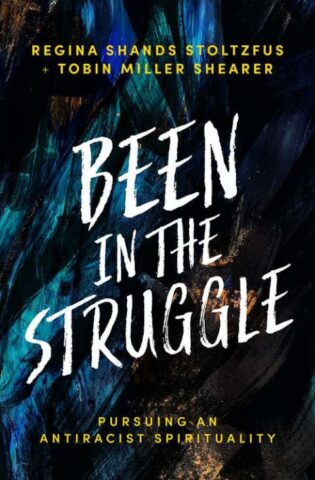
National Catholic Reporter reviews Mennonite book on antiracist spirituality

Franciscan Fr. Daniel P. Horan — the director of the Center for Spirituality and professor of philosophy, religious studies and theology at Saint Mary’s College in Notre Dame, Indiana — has reviewed a recent book by Mennonite authors Regina Shands Stoltfus and Tobin Miller Shearer for National Catholic Reporter. Entitled Been in the Struggle: Pursuing an Antiracist Spirituality, the book was recently published by Herald Press. Horan writes:

In the book’s introduction, Stoltzfus and Shearer recount the challenges they faced and resistances they encountered, including from church leadership, which will resonate with the many observations and experiences of those engaged in the work of racial justice in the Catholic Church.

I believe that Been in the Struggle has a lot to offer Catholics seeking resources to address the “soul-sickness” of racism.

Many of the key themes presented in the book — the dynamics of systemic racism, its presence in popular culture, the meaning of whiteness and a culture of white supremacy — will be familiar to readers who have engaged anti-racism resources in other venues. What is distinctive about Stoltzfus and Shearer’s approach is the attentiveness to the spiritual implications for the work of anti-racism.

To read Fr. Horan’s review, click here.

Bridgefolk participants explain importance of pre-Reformation sources in new Mennonite hymnbook

Voices Together hymnal cover

In a recent post on the Mennonite Church USA website, Bridgefolk participants Sarah Kathleen Johnson and Carl Bear share why the committee that compiled Voices Together, the new Mennonite hymnbook, made sure to include pre-Reformation texts and tunes. Some excerpts:

Singing pre-Reformation songs reminds us that the Anabaptist tradition was deeply influenced by and connected to the previous fifteen centuries of Christian history — both the bad and the good. 

Owning this history as part of our history is essential for robust engagement in decolonial work for justice, locally and globally. It prevents us from failing to acknowledge our complicity in the foundations of colonialism established in this era, without which the Christian tradition, including the Anabaptist tradition, would not exist in the manner it does today.  

At the same time, singing early Christian and pre-Reformation songs connects Mennonites to the essential and life-giving theological insights and artistic riches of ancient and medieval Christians, across cultures, with whom we join our voices and celebrate the ways in which God has been active in the church of all ages.

“Connecting with the past in worship today is a way to remember God’s faithfulness to all generations. It joins our local communities with a vibrant church that has followed Jesus in many cultures and circumstances. It helps us keep the struggles of the present in perspective. Recognizing God’s faithfulness throughout a history marked by constant change can free us from fearing change and fearing the future.” — “Worship Leader Edition,” 202 

To read the entire post, click here.

Education for Peace in a Multi-Religious World: A Christian Perspective

Joint Ecumenical Document

Education for Peace in a Multi-Religious World: A Christian Perspective
Document issued 21 May 2019 by Pontifical Council for Inter-religious Dialogue and the World Council of Churches.

The purpose of this 13-page document is to encourage churches and Christian organizations to reflect on the structural roots of what has led to the disruption of peace in the world, and on their own current practices and priorities in relation to education and peacemaking. At the same time, it is hoped that the document, issued 21 May 2019, may assist a wider conversation on education for peace involving followers of other religions, as well as social and political actors in our multi-religious world, taking into consideration specific historical and cultural contexts.

Download full document: Education for Peace in a Multi-Religious World: A Christian Perspective (pdf)

Pope calls for nonviolence in 2017 World Day of Peace message: U.S. religious leaders respond

Press release
Catholic Nonviolence Initiative
12 December 2016

Today in his message “Nonviolence: A style of politics for peace,” for the 50th World Day of Peace, celebrated each year on 1 January, Pope Francis urges people everywhere to practice active nonviolence and notes that the “decisive and consistent practice of nonviolence has produced impressive results.”

Continue reading “Pope calls for nonviolence in 2017 World Day of Peace message: U.S. religious leaders respond”

Major new resource documents Mennonite ecumenical dialogue

PICKWICK_Template
Click here to order from publisher.

Ecumenical dialogue is not an end in itself. It serves as an indispensable instrument to overcome the divisive, mutual misinterpretations of the past. Ecumenical encounters pave the way toward healing painful memories and lead to a deeper understanding of the church’s given unity, thus becoming a more credible witness of that truth.

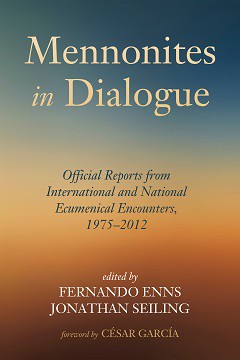
Edited by Fernando Enns and Jonathan Seiling, Mennonites in Dialogue is a collection of all conversation texts involving Mennonites on international and national levels, covering forty years of encounters with Roman Catholics, Lutherans, Reformed, Baptists, and Seventh-Day Adventists, among others. The texts illustrate growth in agreement as well as identify the remaining convictions that still divide. Continue reading “Major new resource documents Mennonite ecumenical dialogue”

A papal encyclical, a Mennonite resolution, and the relevance of Anablacktivism

2015-8-4-lawrence-jennings-photo-300x225LAWRENCE JENNINGS of Infinity Mennonite Church in New York City has been involved in community and economic development for more than three decades. Since 2013, he has been affiliated with GreenFaith, first as a Fellow, and currently as a lead organizer of the new Restoration Nation faith communities/green jobs initiative. A member of the Thomas Berry Forum for Ecological Dialogue at Iona College, he was one of the key organizers of the People’s Climate March faith contingent, and has ongoing involvement with the People’s Climate Movement, the organizing body that took shape after the March. In these involvements, as well as his work with The Groundswell Group and Moral Mondays, he works closely with faith communities and inner city and “frontline” groups that often are overlooked or excluded. He authored the Open Letter from African American clergy on Climate Change as part of the “Our Voices” campaign, and is on the Steering Committee of Interfaith Moral Action on Climate, both of which aim to encourage people of to speak out about the moral and scientific urgency of the environmental crisis. Lawrence was asked by GreenFaith to write a response to the Pope’s newly released environmental teachings from the Anabaptist/Mennonite perspective. His article originally appeared in two parts on the Mennonite Church USA website (here and here).  Continue reading “A papal encyclical, a Mennonite resolution, and the relevance of Anablacktivism”

Liturgical Press and Augsburg Fortress co-publish extraordinary new resource to celebrate Christian unity

MINNEAPOLIS AND COLLEGEVILLE, MINNESOTA (January 2015)—Liturgical Press, the Roman Catholic publishing house of Saint John’s Abbey in Collegeville, Minnesota, and Augsburg Fortress, Minneapolis, the publishing ministry of the Evangelical Lutheran Church in America (ELCA), are pleased to announce the co-publication of One Hope: Re-Membering the Body of Christ, a resource to help Catholic and Lutheran communities walk together, recognizing and nourishing unity at a grassroots level.

In August 2014, six gifted pastoral leaders and scholars—three Lutheran and three Catholic—gathered for six days at a retreat center in the central Minnesota farmlands. Through intense prayer, discussion, debate, laughter, and work, they created a resource to help Catholics, Lutherans, and all Christians prepare for and mark the 500th anniversary of the Reformation in 2017. The result is One Hope: Re-Membering the Body of Christ.

The essays in One Hope explore experiences and activities that Catholics and Lutherans share and that connect to the living of their faith in embodied ways: breathing, eating, singing, forgiving, serving, and dying. One Hope will serve as a welcome resource for adult faith formation and parish discussion groups made up of Catholics, Lutherans, or members of other denominations.

Continue reading “Liturgical Press and Augsburg Fortress co-publish extraordinary new resource to celebrate Christian unity”