Bridgefolk is a movement of sacramentally-minded Mennonites and peace-minded Roman Catholics who come together to celebrate each other's traditions, explore each other's practices, and honor each other's contribution to the mission of Christ's Church.
Due to various technical difficulties, it has taken us a few months to post videos from our summer conference in Winnipeg. We apologize for the delay.
Thankfully, they are now available by clicking here. You will find keynote addresses by Dr. Jennifer Otto and Fr. John Klassen OSB, along with Q&A sessions following each one. Also available is a panel discussion with stories of ecumenical dialogue.
Bridgefolk participant and liturgist Sarah Kathleen Johnson recently shared findings from her research on occasional religious practice and its contributions to grassroots ecumenism in a lecture at the Centre for Christian Engagement at St. Mark’s College in Vancouver.
Johnson has introduced the concept of occasional religious practice as a novel yet intuitive way to describe, analyze, and respond to widespread patterns she has observed in three years of ethnographic fieldwork in the Anglican Diocese of Toronto. While church leaders often see the pattern as a problem, Johnson notes ways that it can contribute to grassroots ecumenical dialogue. In her lecture Johnson explored these dynamics in dialogue with Roman Catholic priest Fr. Nick Meisl and Anglican deacon Rev. Alisdair Smith.
Occasional religious practice is a way of relating to religion that is characterized by participation in religious practices occasionally rather than routinely, most often in connection with certain types of occasions, including holidays, life transitions, and times of crisis. In a North American religious landscape characterized by declining participation in religious institutions, increasing uncertainty about matters of faith, and a growing population who identify as nonreligious, occasional religious practice is a primary way that people continue to relate to religion.
One of the major challenges that ecumenical dialogue between estranged Christian churches always faces is the question of eucharistic intercommunion: Can they share the Lord’s Supper, or Table of the Lord, or Eucharist, as varying traditions call it?
After struggling with this question for nearly ten years, the board of Bridgefolk — the grassroots organization for dialogue between Mennonites and Roman Catholics — decided that they could not resolve it. There were simply too many ecclesial and liturgical differences. They would need to explore a different approach in order to celebrate, liturgically, the measure of unity and communion that Bridgefolk participants were experiencing when they came together.
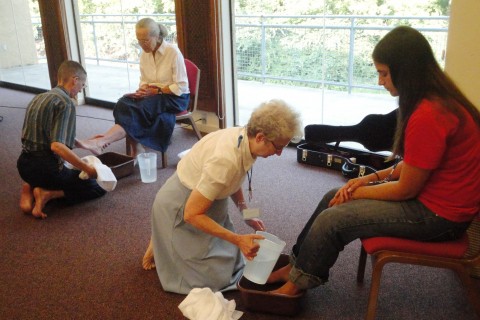
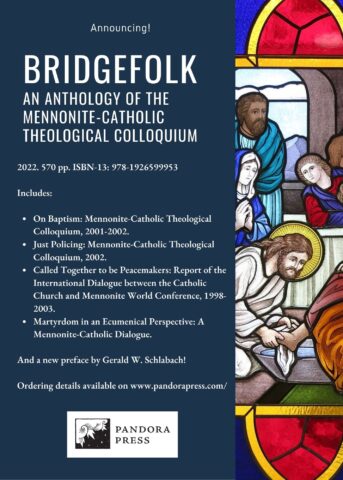
Footwashing service at Bridgefolk 2011.
As a result, the Bridgefolk board charged Professor Mary Schertz of the Anabaptist Mennonite Biblical Seminary and Abbot John Klassen OSB of Saint John’s Abbey with the task of creating a liturgical framework for footwashing. Now, after practicing this rite in its annual conferences for nearly 15 years, Bridgefolk is making it available to all Christians on its webpage, at www.bridgefolk.net/rite-of-footwashing, along with background materials.
As is well known, in John’s Gospel, chapter 13, where one would expect to find an account of Jesus handing on the Eucharist to his disciples, instead he washes their feet in a profound act of service and humility. Since deepening ecumenical relationships involve precisely those commitments, and since John’s Gospel provides a precedent, a rite of footwashing seemed to offer an alternative expression of communion where the sharing of Eucharist is not yet canonically allowed.
In response, Schertz and Klassen created a full liturgy that draws on both Mennonite and Catholic traditions. It includes a formal opening with the sign of the cross, a formal liturgical greeting (from Saint Paul), a specially crafted opening prayer, followed by a Liturgy of the Word (first reading, responsorial psalm, Gospel, and homily). They also composed a major prayer modeled after a eucharistic prayer which includes an institution account, an epiclesis, and anamnesis. After this prayer, the invitation to the sacrament of footwashing follows. The rite concludes with a sign of peace, intercessions, a concluding prayer, and an invitation to an agape meal.
Schertz and Klassen likewise structured an agape meal with formal prayers and scripture that echoes eucharistic language from the early Christian centuries (Didache, chapters 9 and 10). The liturgy opens to a simple meal shared by all participants. A variety of hymns and chants from both Mennonite and Catholic traditions can surround these elements, and a menu of possible scripture readings is available for different situations.
“Bridgefolk has found that this foot washing-agape rite has served us well as a body,” notes Klassen, “because we have freedom to choose preachers and presiders, men or women, from either tradition. The celebration of this rite has become the high point of our conferences each year because it embodies our unity in the mission of Jesus Christ.”
Klassen also notes that the experience of taking an existing rite and shaping it for Bridgefolk’s specific purposes has brought the group to a fundamental insight about the work of mutual exchange. “In formal ecumenical dialogues, there tends to be little formal prayer and liturgical experience because usually those very elements are contested, and adequate ecumenical agreement does not yet exist to practice them. As Bridgefolk, we found it essential to create and shape some existing liturgical experiences to help us celebrate our being together.”
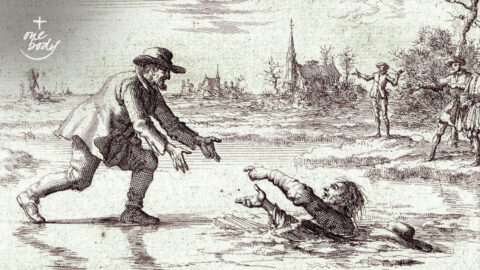
Woodcut of 16th-century Anabaptist leader and eventual martyr Dirk Willems halting his escape from prison to rescue the guard pursuing him. From Wikimedia Commons.
In this recently-published article, Dr. Jeremy M. Bergen of Conrad Grebel University College at the University of Waterloo introduces the Anabaptist-Mennonite movement for Canadian Catholics and reflects on its significance for other Christians.
Jeremy Bergen
Just over 500 years ago, on January 21, 1525, several adults gathered in a home in Zurich. After prayer and discussion, former Catholic priest George Blaurock asked one of the men present, a university student named Conrad Grebel, to baptize him. After Grebel did so, Blaurock proceeded to baptize the others gathered there. This group had initially been keen on Ulrich Zwingli’s religious reforms in the city, but were frustrated by its slow pace and the role of the secular authorities in implementing change. The emerging movement of dissenters believed that baptism was exclusively for (adult) believers. They placed an emphasis on a life of discipleship as following the teachings and example of Jesus, and the local congregation as a voluntary community of committed believers who interpret the Bible together. They believed in the separation of church and “state,” and the rejection of the sword. A movement with these commitments emerged in Switzerland, South Germany, and the Netherlands.
This ritual act in 1525 marked the beginning of the Anabaptist movement. …
Bridgefolk board member Michelle Sherman draws our attention to the importance of Pope Francis’s second apostolic exhortation for all people of goodwill on the climate crisis, Laudate Deum [“Praise God”], released on the Feast of St. Francis of Assisi, October 4. Sherman notes that the theme coincides with that of the Rooted and Grounded conference that Bridgefolk had co-sponsored just days before, in place of its own 2023 annual conference.
Encouraging Bridgefolk participants to read the document, Sherman notes that it is relatively short and can be read in one sitting. She offers the following excerpts in order to illustrate how its message resonates with that of the recently conference:
11. It is no longer possible to doubt the human – “anthropic” – origin of climate change. Let us see why. The concentration of greenhouse gases in the atmosphere, which causes global warming, was stable until the nineteenth century, below 300 parts per million in volume. But in the middle of that century, in conjunction with industrial development, emissions began to increase. In the past fifty years, this increase has accelerated significantly, as the Mauna Loa observatory, which has taken daily measurements of carbon dioxide since 1958, has confirmed. While I was writing Laudato Si’, they hit a historic high – 400 parts per million – until arriving at 423 parts per million in June 2023. [7] More than 42% of total net emissions since the year 1850 were produced after 1990. [8]
69. I ask everyone to accompany this pilgrimage of reconciliation with the world that is our home and to help make it more beautiful, because that commitment has to do with our personal dignity and highest values. At the same time, I cannot deny that it is necessary to be honest and recognize that the most effective solutions will not come from individual efforts alone, but above all from major political decisions on the national and international level.
72. If we consider that emissions per individual in the United States are about two times greater than those of individuals living in China, and about seven times greater than the average of the poorest countries, [44] we can state that a broad change in the irresponsible lifestyle connected with the Western model would have a significant long-term impact. As a result, along with indispensable political decisions, we would be making progress along the way to genuine care for one another.
73. “Praise God” is the title of this letter. For when human beings claim to take God’s place, they become their own worst enemies.
We are created out of Love and for Love. Conflict is a regular part of this human journey and an opportunity to grow. How do we grow into the persons and communities that God calls us to become? How do we construct a more sustainable just peace?
In October the Catholic Nonviolence Initiative, a project of Pax Christi International, offered a series of virtual lectures on gospel nonviolence:
Why ‘Nonviolence?’ (includes 2 young adult speakers)
Returning to and Exploring the Power of Nonviolence
Christian Foundations of Nonviolence
Embracing Nonviolence: A New Moral Framework
Embracing Nonviolence: Transforming the Church.
These lectures are now available for personal or group study. All five videos are divided into speaker chapters, and the presentations run from between 15 to 29 minutes. Immediately following each presentation is a slide that has three discussion/essay questions.
A one-stop web page for these resources is available at https://cniseries.info. The page includes find brief lecture and presentation summaries, a link to each video and a downloadable study guide.
Videos from the 2022 Bridgefolk conference, “Standing at the Crossroads” are now available online at Bridgefolk’s website. The conference “stood at the crossroads” in two ways: It offered the opportunity to look back in gratitude and forward as participants discerned a future path for Mennonite-Catholic dialogue and peacemaking.
Additionally, the conference continued the ongoing exploration of what it means for Mennonites and Catholics who seek a Just Peace to address issues of racial justice, which it began at its 2018 Conference. In particular, Bridgefolk sought to engage with indigenous communities, acknowledging the legacy of injustice and harm done by the historic removal of indigenous communities from traditional homelands by European settlers and the forced attendance of indigenous children at residential schools. The conference featured stories, including indigenous voices, of this work of repair and healing at the institutional, community, and personal levels.
We invite you to linger prayerfully at the crossroads by sharing videos of the conference sessions in parish or congregational settings and discussing how you and your community are called to respond.
Videos from five conference sessions are available on the 2022 conference website, along with the discussion questions used at the conference. Click here to visit.
Pope Francis makes historic apology to Indigenous of Canada for church abuses
by Nicole Winfield
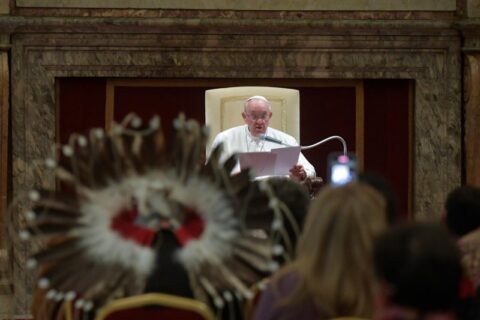
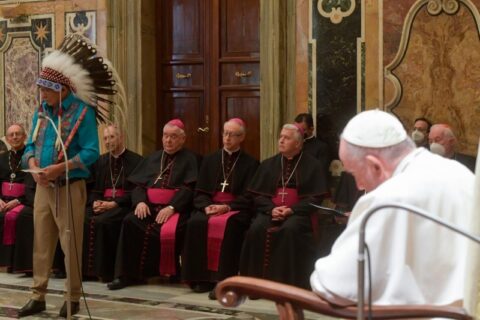
VATICAN CITY (AP) — Pope Francis on Friday made a historic apology to Indigenous Peoples for the “deplorable” abuses they suffered in Canada’s Catholic-run residential schools and said he hoped to visit Canada in late July to deliver the apology in person to survivors of the church’s misguided missionary zeal.
Francis begged forgiveness during an audience with dozens of members of the Metis, Inuit and First Nations communities who came to Rome seeking a papal apology and a commitment for the Catholic Church to repair the damage. The first pope from the Americas said he hoped to visit Canada around the Feast of St. Anna, which falls on July 26 and is dedicated to Christ’s grandmother.
More than 150,000 native children in Canada were forced to attend state-funded Christian schools from the 19th century until the 1970s in an effort to isolate them from the influence of their homes and culture. The aim was to Christianize and assimilate them into mainstream society, which previous Canadian governments considered superior. … To continue reading, click here.
But is it enough? Here are representative responses:
Murray Sinclair – Ojibwe lawyer, judge, and senator from Manitoba who chaired Canada’s Truth and Reconciliation commission – calls Francis’s expression of contrition “a major step” but argues that the Catholic Church must go on to address deniers.
Jeremy Bergen – Mennonite theologian who studies church apologies for historical wrongs – elaborates on needed next steps and insists that the Catholic Church must not only apologizes for the actions of sinful Catholics but take responsibility for harms it has inflicted as an institution.
Associated Press reporter Peter Smith anticipates that US churches to will now face their own reckoning concerning boarding schools.