Bridgefolk is a movement of sacramentally-minded Mennonites and peace-minded Roman Catholics who come together to celebrate each other's traditions, explore each other's practices, and honor each other's contribution to the mission of Christ's Church.
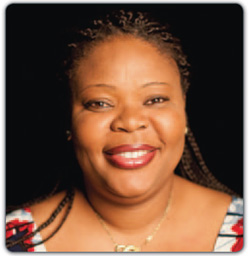
Harrisonburg, VA (EMU) — One of the three women receiving the 2011 Nobel Peace Prize, Leymah Gbowee, is closely connected with the “peace-church tradition” of the Mennonites.
Gbowee, who shares the prize with Liberian President Ellen Johnson Sirleaf and women’s rights activist Tawakkul Karman of Yemen, earned a master’s degree in conflict transformation from the Center for Justice and Peacebuilding (CJP) at Eastern Mennonite University (EMU) in Harrisonburg, Virginia. She attended CJP’s Summer Peacebuilding Institute in 2004 and completed its Strategies for Trauma Awareness and Resilience (known as “STAR”) program in 2005.
EMU’s Center for Justice and Peacebuilding (CJP) was one of the first university graduate programs in conflict and peacebuilding field. CJP’s Summer Peacebuilding Institute, the first of its kind, has become a model for other peacebuilding institutions around the world.
Gbowee led a nationwide women’s movement that was instrumental in halting Liberia’s second civil war in 2003.
“Leymah Gbowee mobilized and organized women across ethnic and religious dividing lines to bring an end to the long war in Liberia, and to ensure women’s participation in elections,” noted the Norwegian Nobel Committee in making the award. “She has since worked to enhance the influence of women in West Africa during and after war.” Continue reading “Nobel Prize winner connected to peace-church tradition”→
Writing in the Sept. 12 issue of the Mennonite Weekly Review, Andre Gingerich Stoner observes that leaders of Christian churches from around the world are increasingly concluding that the just war theory is obsolete. Stoner is director of holistic witness and interchurch relations for Mennonite Church USA. Here is his commentary:
In a remarkable shift, a key World Council of Churches statement describes the concept of a just war as obsolete. It calls for a fundamental shift in ethical practice to what it calls “just peace.”
The Ecumenical Call to Just Peace repeatedly lifts up the life, teachings, death and resurrection of Jesus as the model for Christian peacemaking.
The 13-page document is peppered with sentences like, “Jesus told us to love our enemies, pray for our persecutors, and not to use deadly weapons … Despite persecution, he remains steadfast in his active nonviolence, even to death.”
There were two state-sanctioned executions in the United States on September 21, 2011. In Georgia, Troy Anthony Davis, an African American man, was put to death for the 1989 murder of Savannah police officer Mark MacPhail. In Texas, Lawrence Brewer, a white supremacist, was executed for his participation in the racist hate crime dragging murder of James Byrd in Jasper in 1998. As theologians, scholars, and social justice advocates who participate in the public discussion of Catholic theology, we protest the state-sanctioned killings of both of these men, and we call for the abolition of the death penalty in the US. Continue reading “Catholic theologians in the U.S. speak out against the death penalty”→
Drawing especially on her experience with Iranian Shiites, former Bridgefolk Board member Susan Kennel Harrison recently spoke at Eastern Mennonite University’s Interfaith Forum recently. Her forum presentation, “You Can’t Talk to Them – Peacemaking and Dialogue,” focused on the importance of building relationships with persons of other religious affiliations, particularly fundamentalists, in order to promote understanding and respect. The talk is available as a podcast at http://emu.edu/now/podcast/2011/09/14/cie-interfaith-forum-susan-kennel-harrison.
Geneva (WCC) — A call for solidarity with the poor was delivered to a gathering of religious and political and civil society leaders from all over the world by one of the presidents of the World Council of Churches (WCC). The meeting on the topic “Bound to Live Together: Religions and Cultures in Dialogue” is taking place from 11-13 September in Munich, Germany.
Silver Spring, Maryland, USA– Representatives of the General Conference of Seventh-day Adventists and the Mennonite World Conference held the first of several theological conversations June 28 to July 1, 2011 at the world headquarters of the 17 million-member Seventh-day Adventist Church in Silver Spring, Maryland. Continue reading “Mennonites begin ecumenical dialogue with Seventh-Day Adventists”→
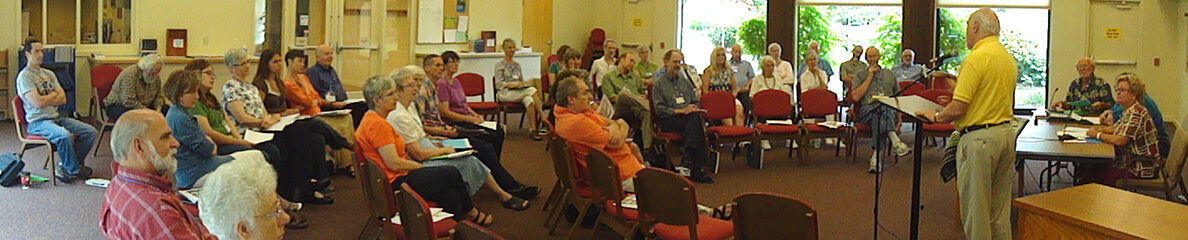
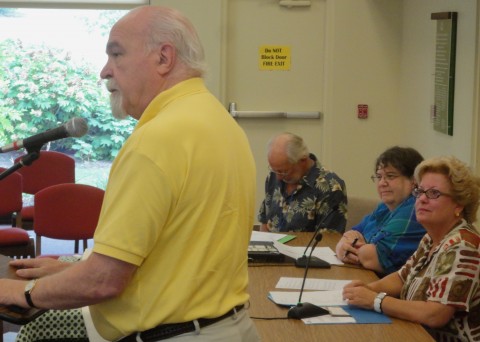
Bridgefolk co-founder Ivan Kauffman speaks during discussion following panel on common worship. Panel members, left to right: Stanley Kropf (moderator), Mary Schertz and Alice Noe.
Akron, Pennsylvania (BRIDGEFOLK) – “The Holy Spirit works in and through human failure, not around it,” Mennonite biblical scholar Mary Schertz told Catholics and Mennonites gathered at the headquarters of Mennonite Central Committee August 4-7 for the 2011 conference of Bridgefolk, a grassroots movement for dialogue and unity between Mennonites and Roman Catholics.
Peter was in a position to deny Jesus only because he was trying to be faithful to his promise, Schertz explained. He risked his life to follow Jesus into the courtyard near where he stood trial. “God worked the birth of the church out of human failure,” noted the Bridgefolk board member and professor of New Testament at Associated Mennonite Biblical Seminary. “Failure will always be present in the life of the church, but it doesn’t have to have the last word. So too with Bridgefolk. God has been at work through our failure.”
Schertz’s insight helped conference participants name the mix of joy and pain that they continue to share as Bridgefolk enters its second decade as a movement. “This was Bridgefolk’s tenth annual conference,” Bridgefolk co-founder Weldon Nisly commented later, “and I think we have matured. We feel the pain of church disunity as acutely as ever. But holding that pain together has also led to a deep trust and mutual love. We are clearer than ever that it is only ours to live in hope, not to ‘fix’ the church’s disunity. Yet we find ourselves celebrating the fruit that God has brought from our failure.” Continue reading “Bridgefolk celebrates the fruit God brings through human failure”→
In the lead-up to Bridgefolk’s recent conference, the Vatican’s daily newspaper published a short article on Bridgefolk, and Vatican Radio followed up with a summary:
Click here for L’Observatore Romano August 10 article, then go to page 6.