by Raymond Plankey
National Catholic Reporter
Mexico City (NCR) — More than 300 theologians and pastoral workers met here last month in anticipation of the anniversaries of two events that have shaped contemporary Latin America: the 50th anniversary of the opening of the Second Vatican Council and the 40th anniversary of the publishing of Gustavo Gutiérrez’s book Liberation Theology.
These two events unleashed in Latin America a liberating process on the part of many Catholics at the grass roots as well as among theologians who reaffirmed a Latin American theology based on their own struggling people’s problems, an approach that became known as liberation theology.
The “Hope of Liberation and Theology” conference, held Oct. 5-8, was the third of a series of regional conferences planned as preparation for the main continental encounter to be held in Brazil Oct. 7-11, 2012.
“Liberation theology has moved from the original small group of theologians to people struggling within civil society for social change as well as to the academic scene,” theologian Maria Pilar Aquino of the University of San Diego told NCR.
About the future of the movement, she said, “There is a need for a new spirituality with special importance given to the feminist and indigenous dimensions.”
The first regional conference was held in Guatemala in April; the second was in Chile in July. A fourth was also in October in Colombia.
The Mexico City conference began with presentations by Fr. José Sánchez, the lead coordinator of the conference; Sacred Heart of Jesus Sr. Socorro Martínez, president of the Latin American theologians’ group Amerindia; and Brazilian Fr. José Marins, author and longtime supporter of the base ecclesial communities throughout Latin America. They provided the background to the conference, explaining the importance of Vatican II and the emergence of liberation theology.
Marins said, “Vatican II was a watershed in history and the first really universal council. However, it was being betrayed even before its inauguration and has never adequately been transmitted to the grass roots within the church.”
“It was a strategic practical error to entrust the application of the conclusions of Vatican II within the church to the Curia,” he said.
Leading off the first afternoon was Enrique Dussel, an Argentine Catholic layman in exile and now nationalized in Mexico. Dussel is a professor at two Mexican universities and heads the History of the Churches in Latin America project. He shared his personal story as illustrative of growth within the church of a liberating and empowering force for change, especially among the laity.
On the second day, Doris Mayol, a Baptist theologian, delivered a paper titled “New Paradigms of Biblical/Theological Interpretation from a Liberation Theology Perspective.” She spoke of these new paradigms as a huge snake in the jungle that you know is there but only catch glimpses of now and then.
She said that we all are conditioned and influenced by our own experiences and cultures as we try to interpret biblical passages, that no one is neutral and completely objective. After lunch, discussion groups reflected on how their faith perspectives can develop new biblical interpretations more in line with present social demands.
The day concluded with a roundtable discussion on peace and human rights, open to the public at the Human Rights Commission of Mexico City. Panelists included Pilar Aquino, Mayol, Emilio Álvarez Icaza, Oscar Enríquez, Fr. Alejandro Solalinde, Fr. Pedro Pantoja and Victor Quintana.
Solalinde and Pantoja operate shelters for Central American migrants attempting to pass through Mexico. They spoke of the horrors migrants must suffer at the hands of corrupt Mexican officials and organized crime, especially the Zetas drug gang, whose members kidnap and extort them.
American Dominican Sr. Kathleen Long, director of the Cuernavaca Center for Intercultural Dialogue on Development in Mexico, joined this discussion. “As Christians we are called once again to see the pain and struggle of those who migrate throughout Mexico in face-to-face encounters as Jesus did, listening to their pain and working energetically for change across borders,” she said. “The church of the people of God will be with the people as is Fr. Alejandro Solelinde in Oaxaca.”
The third day featured a presentation by Pilar Aquino titled “The Construction of Peace: Religious Initiatives for Transforming Violent Conflict.” Much has been done in this field already and there is no need to always be “reinventing the wheel,” she said. She suggested more study of others’ experiences, making special reference to Mennonite efforts.
On the final day, as participants discussed commonalties that arose during the conference, a consensus formed that suggested the need for a significant shift in mindset within church and society. Their discussion can be summarized in these statements:
- The present neoliberal capitalist mindset of a consumer society is not sustainable;
- There is a need to develop a theology of sufficiency;
- Fulfillment comes from being more, not having more things;
- The old adage “Live simply so that others can simply live” rings true and the survival of all will depend on building a new society that values solidarity and sustainability.
And then this question: “Can our church play an important role in this urgent task?”
The organizers had hoped that the Mexico City conference would have an ecumenical flavor and so partnered with a number of non-Catholic Christian organizations. The conference was held at the Mexican Theological Community in the southern part of Mexico City. This community is a 60-year-old collaborative ecumenical effort of Baptist, Methodist, Lutheran and Anglican seminaries.
Invitations were extended to theologians in the United States and Canada, even though their realities are quite distinct from the common reality of Latin America and the Caribbean. Only two came from the United States; a few U.S. missionaries working in Mexico and some Mexicans or Latin Americans working in the U.S. attended. No Canadians were present.
Before arrival, each participant was asked to enroll in one of six discussion groups to allow for maximum participation and generate the conclusions from the bottom up, which is clearly the vision and dynamic of this effort within Latin America. The themes of each group were ecclesial practice, economy, ecology, citizen participation, migration and human rights. A permeating theme throughout all the groups was the present situation of violence in Mexico and the struggle to regain peace.
The process used was “observe, judge, act,” the dynamic used in base ecclesial communities and even by the Latin American bishops in some of their meetings.
Amerindia has sponsored this series of regional conferences. A group of Latin American Catholic theologians — self-described as “progressives” — Amerindia began as an informal advisory group to bishops attending the Latin American Episcopal Conference’s meeting in Puebla, Mexico, in 1979. The group would eventually formalize its structure and extend membership beyond professional theologians to include other pastoral agents working in grass-roots organizations. The group also accompanied the Latin American bishops to their conferences in Santo Domingo, Dominican Republic, in 1992 and Aparecida, Brazil, in 2007. The group gathered in Rome in 1997 for the world Synod of Bishops on Latin America. It was at this meeting that they acquired the name Amerindia.
Raymond Plankey is the author of Questioning Myths of God and Country, a memoir of his 50 years as a Catholic lay missionary in Latin America. Plankey attended the original 1972 Christians for Socialism Conference in Santiago, Chile, one of the seminal events in the history of Latin America.
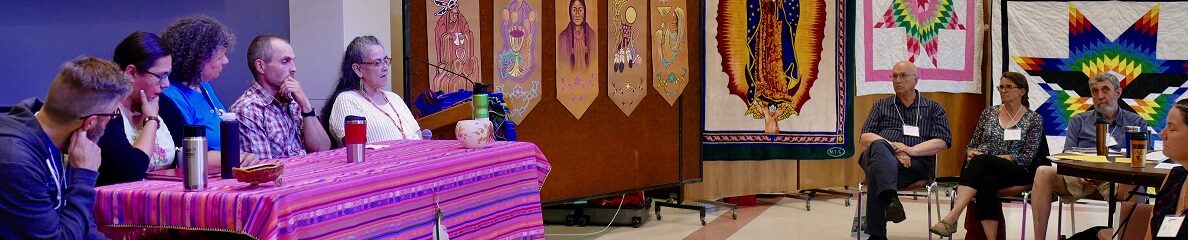
 A keynote address by Br. Jeffrey Gros, FSC, to the 2011 National Workshop on Christian Unity last May has recently come to our attention. In it he called attention to the use of footwashing at a historic service of repentance and reconciliation, in which representatives of the Lutheran World Federation confessed 16th-century persecution of Anabaptists as a sin. This “icon” should serve as a model for planning similar commemorations as Christians around the world mark the 500-year anniversary of the Protestant Reformation in 2017, he said.
 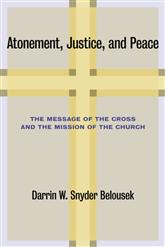 Bridgefolk participant and board member Darrin Snyder Belousek has just published a major new book on atonement. The book develops a biblical theology of the cross in connection with justice and peacemaking. Published by Eerdmans, the book is entitled Atonement, Justice, and Peace: The Message of Cross and the Mission of the Church. Belousek notes that “one chapter focuses on ecumenical peacemaking in the church and is directly influenced by my experience in and reflection on Bridgefolk.” Here is the publisher’s description and a link to purchase online: