22 years in Bridgefolk:
John Klassen OSB reflects

By John Klassen OSB
Catholic co-chair of the board, 2002-2024
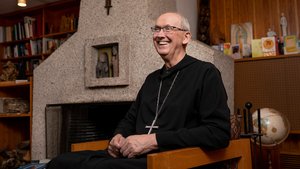
Fr. John Klassen OSB

As a “grassroots dialogue” between Mennonites and Roman Catholics, Bridgefolk began in a classic Benedictine way. It started small. There were a number of creative energies behind it. In the first place there was an amazing group of 25 people who gathered at Laurelville Mennonite Church Center in Mount Pleasant, Pennsylvania in August 1999.  

Some of these were couples in so-called “mixed marriages,” a Mennonite and a Catholic who had married. A number were persons who sought deepened spirituality or commitment to peacemaking in the other’s tradition. During the weekend, each person shared their story. Because of the striking differences between these two religious traditions, their stories carried grace as well as pain. No theologizing, no hypotheticals, simply speaking in the first person. When we speak of Bridgefolk as a grassroots dialogue, this is what we mean: close to the ground, close to human experience, but shot through with profound theological reflection and a deep love for the breadth and depth of these two traditions.

A second major impulse for Bridgefolk came from the success of the first international dialogue between Mennonites and Roman Catholics. Working across a five-year period (1998-2003), six Mennonite and six Roman Catholic leaders drafted and wrote a report named “Called Together to Be Peacemakers.” These were theologians, church historians, and scripture scholars, who listened deeply and well to each other. What distinguishes this work from almost all other ecumenical efforts within the Catholic environment is that no previous ecumenical work between Mennonites and Catholics had been done at the national level. The report itself is a fine piece of thoughtful work in that it faces significant differences in the interpretation of church history, the stance towards infant baptism, and the authorization of ministers within the respective church. The authors also pointed to further work that needed to be done, for example, a study of the violence against Mennonites throughout their history because of ecclesiology and their refusal to be drafted into an army.  

A third crucial ingredient in the founding of Bridgefolk was the presence of a core group of passionate, committed leaders who were willing to invest time and energy to the evolution of this idea. These included Gerald Schlabach, Ivan and Lois Kauffman, Marlene and Stanley Kropf, Weldon Nisly, William Skudlarek, Margaret O’Gara, and myself. How to embody the work of peacemaking and the mutual exchange of gifts between Mennonites and Catholics in a way that grew out of those who came together? The group decided to start by hosting a summer conference at Saint John’s Abbey in 2002. There were many topics and speakers and we focused explicit attention to building relationships, simply building trust. This developed into a series of summer conferences that always included worship, praying and singing from both traditions, sharing the reading of Scripture, and giving space for informational questions.  

After three summer conferences at Saint John’s, the leadership group was convinced that the fourth conference needed to be in a Mennonite setting. Eastern Mennonite University in Harrisonburg, VA, stepped forward to host the conference. This move began a pattern of alternating the conference between Catholic and Mennonite locations. This significant move embodied having a conversation between two real partners and giving each other a feel for each other’s unspoken and unarticulated traditions. Later on, the board invited a sister from Saint Benedict’s Monastery in Minnesota and the community has become a Catholic host for the conference (2012). Finally, in 2013 we had our first conference hosted by Canadian Mennonites, at Conrad Grebel University College in Waterloo, Ontario.  

As a Bridgefolk group we danced around the question of shared Eucharist for many years. At the outset of these comments, let me observe that there is no standard Catholic believer in Eucharist and probably no such Mennonite creature either. Eucharistic faith is deeply personal. However, there are significant differences between Catholics and Mennonites and the ritual by which we celebrate Eucharist. The Roman Catholic rite is well defined and structured; one can go across the Catholic world from country to country, in different languages, and encounter a fundamentally similar liturgical experience. Within Mennonite churches, even though there has been significant attention to liturgical renewal and retrieval within the communion, there is an enormous variation across local churches.

For two years running (2012-2013), we created a “double Eucharist,” with a unified Liturgy of the Word and Eucharistic prayer and institution narrative from each tradition. This liturgy required an enormous effort in its preparation and the gathered assembly also needed to be prepared for what was going to unfold. The first year we did this really well. The second year, not so well, because we had enough new participants who did not have the deep background for this liturgical expression and were left profoundly puzzled by the complexity. Like many good scientific experiments, this one failed, but we learned a lot from it! 

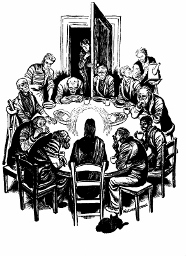
As a result, the board charged Professor Mary Schertz and me to create a liturgical frame for foot washing. As is well known, in John’s gospel, chapter 13, where we would expect to find an account of Jesus handing the Eucharist to his disciples, instead he washed their feet. We created a Liturgy of the Word with opening prayers, and a major prayer modeled after a eucharistic prayer which includes an institution rite, an epiclesis, and anamnesis. Finally, we added an agape meal with formal prayers and scripture that echoed eucharistic language from the early centuries.  We have found that this foot washing / agape rite has served us well as a body because we have freedom to choose preachers and presiders, men or women, from either tradition.  

This experience of taking an existing rite and shaping it for our specific purposes brought us to a fundamental insight for the work of mutual exchange. In formal dialogues, there tends to be little formal prayer and liturgical experience because it is usually those elements that are contested and for which ecumenical agreement does not yet exist. As Bridgefolk, we found it essential to create and shape some existing liturgical experiences to help us celebrate our being together. For example, from the very beginning we sang hymns together, from both of our traditions. When we explored the meaning of the “communion of saints” we discovered that while we have a very different theology of intercession, both of our traditions have an overlap of reverence for martyrs in our respective church. Thus, we created a “litany of martyrs and holy ones,” which integrates men and women martyrs and which we routinely sing together at some stage of our conferences.  

I must include some comments about Ivan and Lois Kauffman and their novel experiment in founding the Michael Sattler House at the edge of the property of Saint John’s Abbey. This unique experiment in offering hospitality to those who needed a place for prayer, resting, and gathering their wits was fittingly named after the Benedictine prior (second in command) of Saint Peter’s Abbey in Germany in the 16th century (1490-1527). Sattler left the community (1525) and became a theological leader in the early Anabaptist movement. He and his wife Margaretha were martyred in 1527. My minds reels at the collection of delightful ironies present in the witness of hospitality provided by Ivan and Lois in memory of Michael Sattler. I enjoyed many a rich conversation and refreshment in this place of encounter and nourishment.  

While conferences in the first fifteen years or so focused on specific elements in our shared Christian tradition such as baptism, Eucharist, prayer and discipleship, and ordained ministry, especially as these relate to peacemaking, in the past four conferences we have focused our attention on the way we as specific Christian communities have responded to issues of social injustice such as the evil of racism and the thorny issues around land, settlers, and indigenous peoples. This focus is not without tension in relationship to Bridgefolk’s founding mission but as abbot of Saint John’s Abbey until January 7, 2024, I personally benefitted hugely from the presentations and discussions at all these conferences.   Those who have been involved with Bridgefolk over the past twenty-two years would probably cite different key moments along the way. 

This short essay is not meant to be a history but rather a reflective essay from an outgoing co-chair of the Bridgefolk board. My term as abbot overlapped the founding of this grassroots effort in what has indeed been an ecumenical exchange of gifts.

Benedictine life and care for the environment

In a recent issue of the Journal of Social Encounters, Fr. John Klassen, former abbot of Saint John’s Abbey and former Bridgefolk co-chair, outlined four themes in Benedictine spirituality that contribute to care for the environment. Drawn from the Rule of Saint Benedict — community of goods, stability, frugality and a contemplative stance. To read Fr. Klassen’s article, click here.

Saint John's Abbey Arboretum
Saint John’s Abbey Arboretum in Minnesota.

Board profile: Gilbert Detillieux

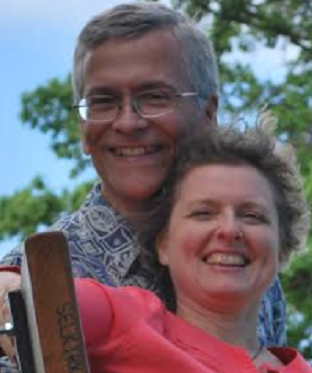
Gilbert Detillieux and Laura Funk

Gilbert Detillieux started attending Bridgefolk conferences in 2013, when it was hosted by Conrad Grebel College in Kitchener-Waterloo, Ontario, Canada. He and his wife, Laura Funk, had been hearing about Bridgefolk almost since they started dating in 2005. He being Roman Catholic and she Mennonite, Bridgefolk drew their attention. Gilbert’s interest in ecumenism predated his meeting Laura, so the ecumenical nature of Bridgefolk appealed to him. What won both of them over, however, was the warm welcome they received at their first conference, and the network of like-minded friends they quickly formed.

Abbot John Klassen invited Gilbert to join the board in 2017, and he has served since then. Attending board meetings and annual conferences has helped deepen and solidify Bridgefolk friendships. It also brought additional responsibilities, small at first, and then a very big one: helping to plan the 2019 conference, which was hosted by Canadian Mennonite University in Winnipeg—only the second Bridgefolk conference held in Canada.

Gilbert and his wife Laura worked as a team to organize the conference, together with a local planning committee. They invited Sr. Eva Solomon CSJ to be the Roman Catholic keynote speaker, and Steve Heinrichs the Mennonite keynote. Sr. Solomon brought a wealth of knowledge from her Anishinabe (Ojibway) background, and Heinrichs was at the time director of Indigenous-Settler Relations for Mennonite Church Canada. A panel discussion provided additional Roman Catholic, Mennonite, and indigenous perspectives. The conference opened with the staging of the play Discovery: A Comic Lament, which was both entertaining and thought-provoking. The planning group was grateful for the participation of several indigenous attendees, mostly affiliated with St. Kateri Tekakwitha Indigenous Catholic Church in Winnipeg. Despite the hectic and stressful nature of conference planning, Gilbert found it very rewarding and a highlight of his board involvement to date.

Gilbert considers his participation on the board both a pleasure and privilege. He misses those who have transitioned off the board during his tenure but has been happy to learn to know new board members, appreciating the greater diversity of voices and perspectives that new board members have brought.

Why we “proceed through friendship”

It was 2003 and Bridgefolk had publicly launched, the summer before, with its first annual conference. Within our founding circle we were aware of the worldwide Sant’Egidio movement based in Rome. Sant’Egidio is a lay-led, Vatican-approved, “ecclesial movement” that has been active in peacemaking and solidarity with the poor since the 1960s. It gained international attention when it helped mediate an end to a 16-year civil war in Mozambique in 1992. As Mennonites and Catholics looking for models of how to combine the best of our traditions, Bridgefolk leaders felt great affinity for Sant’Egidio.

Following the Mozambique peace agreement, the Sant’Egidio community in Rome had sent a married couple, Paola Piscitelli and Andrea Bartoli, to New York to monitor United Nations compliance with the accord, while encouraging new Sant’Egidio chapters in the United States. When I learned that Andrea would be visiting my campus in Saint Paul, Minnesota, I jumped at a chance to meet him. We shared professional and vocational interests in international peacemaking, but what I really wanted to do was pick his brain about this hybrid ecclesiological category of “ecclesial movements” – officially recognized in the Catholic Church yet grassroots and participatory like Mennonites.

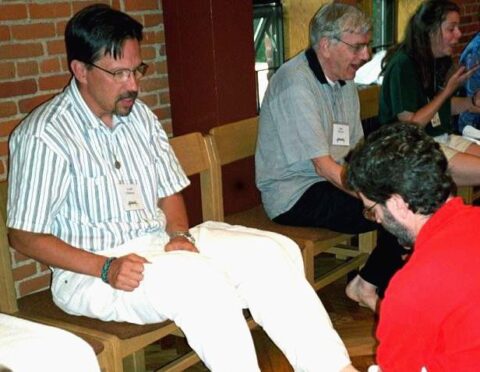
Footwashing at Bridgefolk conference
Gerald Schlabach (right) and Andrea Bartoli (left) wash one another’s feet at 2003 Bridgefolk conference.

“Proceed through friendship.” That was Andrea’s response. As we took a stroll around my university, I wanted to talk about canon law and historical precedents and ecclesiology. As a co-founder and then-co-chair of Bridgefolk, I hoped to map out some kind of master plan for Bridgefolk participants like me who wanted somehow to identify as both Mennonite and Catholic. Instead, simply, “Proceed through friendship.”

Andrea’s counsel reflected Sant’Egidio’s sense of its own charism or spiritual gift. The movement sees friendship as key to its own bridgebuilding through service to the poor, peace-building, and prayer (see here and here). In turn, both Andrea’s counsel and Sant’Egidio’s charism surely reflect the Italian culture in which Sant’Egidio was formed as well. Though he didn’t say so, I suspect that Andrea found my American preoccupation with planning and projects bemusing. Instead, he was gently nudging me toward a more relational – indeed a more organic – approach. As a theologian and Christian ethicist, I should have recognized this already; friends of mine have placed friendship at the very center of the Christian life.

After I shared Andrea’s counsel with other Bridgefolk leaders, “proceed through friendship” quickly became a motto of our own. We didn’t have to solve everything doctrinally or structurally. We weren’t going to anyway – that should have been obvious – but the motto helped us relax.

Theologians and practitioners of interreligious and ecumenical (or interchurch) dialogue emphasize that dialogue can and should happen in multiple ways. In the standard list of different types of interreligious dialogue, the “dialogue of theological exchange” is only one. “Dialogue of religious experience” happens as we share prayers, spiritual practices, and life stories without expectation of conversion. “Dialogue of action” happens as we work together for the common good through service, peacemaking, and mobilization for justice. And then there is the simple and basic “dialogue of everyday life” in which people of different faiths learn to know and trust one another as neighbors. And friends. The counsel to proceed through friendship has guided Bridgefolk intuitively into all four forms of dialogue.

This is not to say that Bridgefolk has achieved nothing more concrete than warm fuzzies and good vibes. Through the Mennonite-Catholic Theological Colloquium, Bridgefolk offered resources to the international bilateral dialogue between representatives of Mennonite World Conference and the Vatican’s Pontifical Council for Promoting Christian Unity – then helped disseminate its findings. Even while strengthen friendships, Bridgefolk’s annual conferences have explored tough issues, from obstacles to sharing Eucharist to racial injustice and land reparation. Some of these have led to real breakthroughs, as with Bridgefolk’s development of a Mennonite-Catholic liturgy of footwashing to celebrate the unity we have come to experience despite obstacles to intercommunion. A case could be made that Bridgefolk has been freer to contribute creatively both to the international dialogue between Mennonites and Catholics, and to the wider ecumenical movement, precisely because it has depended on friendship not on an official mandate.

Friendship can devolve into insularity and cliquishness, of course. As the Bridgefolk movement moves into its third decade, this is a danger that will require self-awareness to avoid. When old friends at a party greet each other with warm bear hugs, they do well to keep their eyes open for newcomers hanging back shyly in the corners and draw them into conversation too. When conversation turns to reminiscing, old friends should work backstories into their stories, in order to initiate rather than exclude.

When a “friend group” is mindful of such dangers, however, friendship can remain invitational. Indeed, in a break-out session at Bridgefolk’s most recent conference, the moderator asked how participants had gotten involved in the movement, and many said that a friend had simply invited them. So long as the accent in “proceed through friendship” is as much on invitation to interested newcomers as on old timers sharing old times, friendship can be its own antidote to insularity.

Over the years, proceeding through friendship has been a way for Bridgefolk to expand its network more through word of mouth than through marketing itself. The 20-year history of Bridgefolk has coincided with the rise of social media as a way to maintain virtual communities and friendships – insofar as any virtual friendship can really be deep and authentic. Like many movements and organizations Bridgefolk has made use of social media as a tool to stay connected. But we have not depended on social media to advertise ourselves and grow thereby. Given all the toxicity that has gotten baked into social media over the last 20 years – religious social media as much as political – that may be for the best.

Some of us in Bridgefolk still dream of a day when it might be possible to find a canonical model like “ecclesial movement” that would make it possible to formally identify simultaneously as Mennonite and Catholic. Many of us long for a day when some form of intercommunion or Eucharistic recognition becomes possible. Even if such hopes only ever find fulfillment beyond our lifetimes, we can hope to be preparing the way now.

But ecclesial movements, like religious orders, only have reason to exist if they embody and channel a charism – a spiritual gift that God has called them to share in a particular way. In friendship, Sant’Egidio was willing to share its charism of friendship with Bridgefolk. So whatever else comes from Bridgefolk’s own way of proceeding through friendship, we will hold on to our own charism in the only way that anyone holds on to God’s gifts – by sharing and them giving away.

Gerald W. Schlabach

September 2022

Embodying oneness through the enfleshment of the Eucharist

We are Each Other’s Bread and Wine
no. 13

by Melody Pannell
Director of Diversity and Community Engagement
at the University of Virginia in Charlottesville, Virginia

Mennonite Mission Network invited Melody Pannell to share a reflection on World Communion Sunday, Oct. 3. She dovetails her thoughts with 1 Corinthians 11:17-22 (NRSV). Mennonite Mission Network published the reflection on October 27, 2021 and has given permission to Bridgefolk to include it in this series on Eucharist and Peacemaking, We are Each Other’s Bread and Wine.

1 Corinthians 11:17-22 (NRSV)

As a child growing up at Seventh Avenue Mennonite Church in Harlem, New York City, New York, one of my favorite songs to sing together as a congregation was “We Are One in the Spirit.” This song was not in our traditional Mennonite hymnal book. It was considered a contemporary hymn and was written in the 1960’s by Peter Raymond Scholtes (1938-2009). He was a parish priest and choir director, who created the song for an ecumenical event.

Experiencing many different cultures and aspects of social identities within my church and community, I developed a deep appreciation for the lyrics of this unifying song.

We are one in the Spirit, we are one in the Lord;
And we pray that all unity may one day be restored.

To continue reading click here.

Hildegard of Bingen: A Model of Mennonite-Catholic Bridging

Bridgefolk participant Julia Smucker has jut published an article in U.S. Catholic magazine on ways that the 12th-century abbess, mystic, and musician has been “a companion on my meandering journey” of faith. Julia writes:

Hildegard’s ambiguity makes her an appropriate guide on my own journey, which has been characterized by in-betweenness and pilgrimage in various ways, most recently as I brought my Mennonite heritage into communion with the Catholic Church. Hildegard’s honest self-awareness and genius for integrating ideas helped show me the possibility of living such a duality and the contribution it may yet make in this church I now call home. Her example helps me to articulate what I hope I am also becoming: a complex woman of conviction and questions, reconciling differences and pointing to the connectedness of all things.

The appears in the February 2012 issue of U.S. Catholic (pages 63-64) or online by clicking here.

“Catholics and Anabaptists Working Together for Peace” by Ross Ahlfeld

Gerald Schlabach is quoted by the UK Catholic weekly, The Tablet (21 July 2020):

“Bridgefolk Mennonite-Catholic, Gerald Schlabach, author of A Pilgrim People – Becoming a Catholic Peace Church, states – ‘we do not begin by assuming that a ‘peace church’ must mean pacifist church. Rather, we start by encouraging our Catholic communities to become ever more skillful at working through their conflicts without recourse to violence and without demeaning one another’s dignity.’”
https://www.thetablet.co.uk/blogs/1/1535/catholics-and-anabaptists-working-together-for-peace

“Catholic-Mennonite Gathering Planned for Winnipeg”

Article online by Will Braun, Canadian Mennonite 23:13 (24 June 2019), 16-17. PDF of the complete issue is also available. Will is a senior writer for the magazine.

The 18th annual Bridgefolk conference will be held at Canadian Mennonite University, Winnipeg, MB, Canada, 25-28 July 2019. The theme is “Toward a Just Peace: Indigenous-Settler Reconciliation Through Friendship.”