by Father Ron Rolheiser, OMI
Last week’s column suggested three areas for liberal self-scrutiny. It’s time for the flip-side. What three areas might conservatives ponder? Continue reading “Three Things for Conservatives to Ponder”
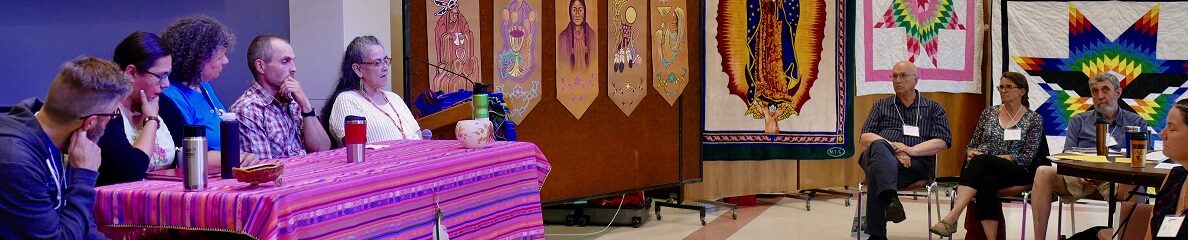
Bridgefolk is a movement of sacramentally-minded Mennonites and peace-minded Roman Catholics who come together to celebrate each other's traditions, explore each other's practices, and honor each other's contribution to the mission of Christ's Church.
Last week’s column suggested three areas for liberal self-scrutiny. It’s time for the flip-side. What three areas might conservatives ponder? Continue reading “Three Things for Conservatives to Ponder”
Things rarely are simple. Nothing, save God, comes without a shadow.
That’s good to keep in mind when we assess the pros and cons of liberals and conservatives. Each brings something to the table and each too has an achilles heel.
What is the achilles heel within liberal Catholicism? I suggest three places where liberal Catholicism (Protestantism included) might want to do some self-scrutiny: Continue reading “Three Things for Liberals to Ponder”
Never has there been such a growth in the life of the Church as is occurring today throughout the world.
The Church has entered a new era as many groups burst forth like a new spring. There is a virtual explosion of ideas and commitment as Catholics develop and utilize their skills in living out the faith in their daily lives. This development reminds us of initiation of religious communities of the past.
Catholics, especially young Catholics, are revolting against the usual life scenario to which we have been accustomed: Go to the university, buy a house (a nice house with a nice lawn), have babies, make money for their college, make money for retirement, retire, have a painless death and a nice eulogy. If one is lucky there will be some recognition for one’s wealth creation by church or state. Continue reading “Crisis in the Catholic Church versus New Springtime”
Good Friday 2004
The following is an excerpt from the homily delivered on Good Friday at the Celebration of the Lord’s Passion by the Papal Household preacher, Capuchin Father Raniero Cantalamessa. The complete homily is available at http://www.zenit.org/article-9864?l=english.
The passion of Christ, described prophetically in the Deutero-Isaiah text [Isaiah 52:13-53:12] and historically in the Gospels in our present liturgy, has a special message for the times in which we are living. The message is: No to violence! Continue reading “Christ Brought About a New Kind of Victory”
NEWS RELEASE
Mennonite World Conference (MWC)
February 4, 2002
ASSISI, Italy — Religion should never be used to justify violence, war or terrorism by any government or group in the current hostile world environment. Rather, all religions should together commit themselves to justice and peace. These strong beliefs led Pope John Paul II to invite leaders of world religions to gather here to pray for global peace.
The papal invitation to gather in Assisi, Italy on January 24, 2002 for a Day of Prayer for Peace in the World was issued to heads of numerous Christian denominations from Orthodox to Evangelical to Quaker, to leaders of the Jewish and Muslim faiths and of several Eastern religions. Among them was Mesach Krisetya, president of Mennonite World Conference, who came from Indonesia. Others came from as far as Korea, Japan, India and Russia as well as from nearby countries. Continue reading “World Religious Leaders Gathered in Assisi Seen as ‘Champions of Peace’”
JOINT NEWS RELEASE
Mennonite World Conference and
Pontifical Council for Promoting Christian Unity
January 28, 2002
ASSISI, Italy – The fourth meeting of the Mennonite-Catholic international dialogue took place at St. Anthony’s Guest House of the Franciscan Sisters of the Atonement, in Assisi, Italy, November 27th-December 3rd, 2001. Co-sponsored by the Mennonite World Conference (Strasbourg) and the Pontifical Council for Promoting Christian Unity (Vatican City), the dialogue began in 1998 and is anticipated to run for at least five annual sessions after which it will issue a report. Dr. Helmut Harder (Mennonite, Winnipeg, Canada) and Bishop Joseph Martino (Catholic, Philadelphia PA, USA) are co-chairmen.
The presentations given in this session of the dialogue focused especially on two themes. On one theme concerning the sacraments, papers were presented on the Mennonite side by Dr. Helmut Harder (“What Anabaptists-Mennonite Confessions of Faith Say About Baptism and the Lord’s Supper”) and on the Catholic side by Rev. Dr. James F. Puglisi, SA, Rome (“Contemporary Theology of the Sacraments with Particular Attention to the Christian Initiation [Baptism and Eucharist]”). On a second theme concerning relations between church and state in the Middle Ages, papers were presented from the Mennonite perspective by Dr. Neal Blough, Paris, France (“From the Edict of Milan to Vatican II, via Theodosius, Clovis, Charlemagne and the Fourth Lateran Council”) and from the Catholic perspective by Dr. Peter Nissen, Nijmegen, The Netherlands (“Church and Secular Power[s] in the Middle Ages”). Continue reading “Joint News Release: Mennonite-Catholic International Dialogue”
NEWS RELEASE
Mennonite World Conference (MWC)
January 28, 2002
ASSISI, Italy – Global Anabaptist-related churches may be surprised to learn that Catholics believe in baptizing adults on confession of faith. Wasn’t voluntary adult baptism at the root of the turmoil and persecution of Anabaptists in the 16th century in Europe?
Baptism and the Lord’s Supper were topics discussed here November 27 to December 3, 2001, at the fourth of five Mennonite-Catholic Dialogues begun in 1998. Continue reading “Mennonites and Catholics Find Common Ground on Adult Baptism”
Greeting to the Mennonite Delegation
November 26, 2001
Walter Cardinal Kasper
Dear Friends,
I am delighted to welcome you to the Pontifical Council for Promoting Christian Unity.
We are very happy that a dialogue between the Mennonite World Conference and the Catholic Church has been underway since 1998. Be assured of my best wishes and prayers for a fruitful meeting in Assisi in the days ahead, and in due time, for a report of the round of dialogues that will be useful for both of our communities.
I know that from the start this dialogue has had as one of its aims the hope of contributing to a healing of memories between our two communions. Continue reading “Walter Cardinal Kaspar’s letter on Mennonite-Catholic dialogue”
The place was overcrowded and noisy, and the food was unimpressive. Meals and meetings were held outside or in tents, depending on the weather. Visitors slept (and many snored loudly) in tents and overcrowded barracks. One had to stand in long lines (often up to 30 minutes) for everything, especially food. It hardly seemed like a setting for meaningful prayer, but my visit to Taizé turned out to be one of the most spiritually meaningful weeks of my life.
And not just for me. During the hot July week when I visited, Taizé welcomed more than 4,500 pilgrims, mostly young adults, from many denominations and from 60 nations (including a thousand from Eastern Europe). Summer weeks typically see between 2,500 and 6,000 visitors, with a total of 100,000 each year-although Taizé is off the beaten path (in France’s Burgundy region, midway between Lyons and Geneva).
What attracts so many to this place?