Reflection by Jim Loney, missing CPT member in Iraq

In defence of the Sacred Heart
by Jim Loney
Catholic New Times,  Sept 26, 2004

(Jim Loney is one of the four Christian Peacemaker Team members missing in Iraq.  Thanks to Tom Finger, Mennonite theologian and Bridgefolk participant, for drawing this reflection to our attention.)

I was never a big fan of the Sacred Heart. In fact, the Sacred Heart used to make me see red: white-bread, saccharine-soaked images of Jesus staring into the blue with puppy-dog eyes; robes and hair flowing in pious cascades; stow-book religious “camp” for the spiritually infantilized.

But, on a high summer Sunday morning in ordinary time, in a little country church located on the banks of the Saugeen River (back in the days of our failed attempt to begin a rural Catholic Worker community, but that’s a whole other story), it happened. The Sacred Heart changed my heart….

To continue, go to
http://www.findarticles.com/p/articles/mi_m0MKY/is_14_28/ai_n6245080

A Call to Pray and Fasting for CPT

Bridgefolk:

Many of you have been following news from Iraq about the four members of Christian Peacemaker Teams who went missing more than a week ago.  Rooted in the Mennonite Church and other historic peace churches, CPT is now a broader ecumenical effort to develop and practice active nonviolent alternatives amid conflicted situations.  One of the missing CPTers is a Catholic peace activist from Ontario, Jim Loney.

While Bridgefolk does not have a direct affiliation, many of us have followed its work with interest and a few of us have been directly involved.  Most notably, board member Weldon Nisly was part of a delegation to Iraq at the time the war broke out.

Below you will find two short news releases from earlier today, one from the Mennonite Church USA, and the other from CPT itself.

Please join with many others around the world in praying for the safety of the CPT team members, for the witness of creative nonviolence that they seek to extend, and for the suffering people of Iraq.

Gerald W. Schlabach
Executive Director, Bridgefolk Continue reading “A Call to Pray and Fasting for CPT”

Roman Catholic Church & World Council of Churches recommit to dialogue and collaboration

World Council of Churches – Update
Contact: + 41 22 791 6153 +41 79 507 6363 media@wcc-coe.org

For immediate release – 22/11/2005

A TRIED AND TRUE EXPRESSION OF PARTNERSHIP AND COLLABORATION, THE JOINT WORKING GROUP BETWEEN THE ROMAN CATHOLIC CHURCH AND THE WCC SET TO TACKLE NEW CHALLENGES

Becoming a “trusted partner” for one another “has been perhaps the most enduring achievement of the past four decades” of collaboration between the Roman Catholic Church and the World Council of Churches (WCC), and this continued cooperation “must be considered one of the significant achievements of the modern ecumenical movement”. Continue reading “Roman Catholic Church & World Council of Churches recommit to dialogue and collaboration”

Presentations to Mennonite Catholic Theological Colloquium now available

All of the presenters at the July meeting of the Mennonite Catholic Theological Colloquium have now provided text versions of their presentations.  You can find them by going to the newly re-designed section of our website for Theological Dialogue and Reflection:  http://www.bridgefolk.net/theology/colloquia/2005theology.

The topic of the colloquium was “How Are We ‘Called Together?'”  A Mennonite and a Catholic panel was asked to comment on the final report of the international dialogue between Mennonite World Conference and the Pontifical Council for Promoting Christian Unity by answering the question, “What have we learned and what’s next?”  Mennonite panelists were Nancy Heisey and Earl Zimmerman; Catholic panelists were Margaret Pfeil and Drew Christiansen SJ.

The event began with a keynote address by John A. Lapp, church historian and former Executive Secretary of Mennonite Central Committee on “Ecumenical Dialogue as a Ministry of Reconciliation.”

Michiana Bridgefolk forms around centering prayer in Northern Indiana

More than a 100 Mennonites and Catholics in the Northern Indiana area came together for centering prayer last summer, contributing to the formation of one of the first local Bridgefolk groups.  Marlene Kropf, Bridgefolk co-chair notes that “one of the good things that came out of this experience was becoming friends and realizing how many interests and visions we have in common. Though we come from very different traditions, our vision for the church and for spiritual growth and renewal is remarkably similar.”  The newspaper of the Fort Wayne – South Bend diocese has done a feature on the summer meetings.   Here are the opening paragraphs, and a link for the entire story.

Continue reading “Michiana Bridgefolk forms around centering prayer in Northern Indiana”

Christianity Today cover story on the “New Monasticism” movement

Tne “New Monasticism Project” seeks to bring together Christian communities — Catholic, Protestant, and often Evangelical — that are seeking to be “schools of conversion” to lives of discipleship and that drawing on ancient monastic traditions to do so.

Recently Christianity Today magazine featured a cover story on the “New Monasticism” movement, highlighting the commitment of many of these communities to “blighted urban settings all over America.”  You can read the article at http://www.christianitytoday.com/ct/2005/009/16.38.html.

Also recently published is a book entitled School(s) for Conversion: 12 Marks of New Monasticism.  Bridgefolk co-founder Ivan Kauffman contributed a chapter to the book.  More information and links for ordering is available at http://www.thesimpleway.org/index.php/store/product/schools-for-conversion.


Cardinal Ottaviani and why the labels don’t work

Here is a news story that is 6 years old, reporting on events 55 years old.  So why share it now?

During one of the discussion periods at our Bridgefolk conference in July, there was a question about the hierarchy of the Catholic Church and a comment about “liberals” and “conservatives.”  I offered a further comment reminding the group that those standard labels can be surprisingly unreliable.  To illustrate I mentioned the example of an influential cardinal and Vatican official who has a reputation as an ultraconservative. After all, he led a group of bishops at the Second Vatican Council that tried hardest to put a brake on the reforms we associate with the council.  I could not remember his name, but I recalled that his support for the section of the Pastoral Constitution (Gaudium et spes) concerning war played a key role in garnering support for the council’s harsh judgment on modern war and groundbreaking support for pacifism as a legitimate option for Catholics.

The cardinal was Alfredo Ottaviani, and an account of his role and his reasons appeared in the magazine Salt of the Earth, published by the Claretians, who also publish U.S. Catholic.  The article, by Tom Cornell, is entitled “How Catholics Began to Speak Their Peace.”  It is available online at http://salt.claretianpubs.org/issues/chistory/peace.html.  Opening paragraphs appear below.

Continue reading “Cardinal Ottaviani and why the labels don’t work”

A Tribute to Brother Roger of Taizé

by Ken Henke, Princeton Theological Seminary

On Tuesday, August 23, funeral services will be held for Brother Roger of Taizé. At the age of 90, he was attacked with a knife by a woman, most probably mentally disturbed, in the midst of community prayer in the Church of Reconciliation at Taizé, France. He died shortly afterward.

The son of a Swiss Reformed pastor, at age 25 he left his native Switzerland and came bicycling into the tiny, poor hamlet of Taizé in France, seeking a place where he could quietly devote himself to a life of prayer and contemplation. A peasant woman, keeper of the keys to the run-down house and property which Roger Schutz had come to look at, begged him to buy the house and stay. Later on, when asked, “Why Taizé?” Roger Schutz was to say: “I chose Taizé because the woman was poor. Christ speaks through the poor, and it’s good to listen to them. Anyone who begins with the poorest of the poor is not likely to go wrong.” Continue reading “A Tribute to Brother Roger of Taizé”

Study edition of Called Together to be Peacemakers now available

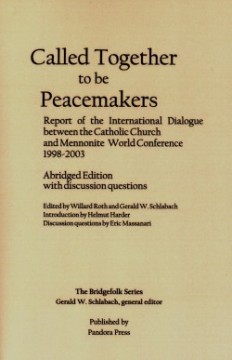
In 2003, theological exchange between Mennonites and Roman Catholics marked a historic milestone as delegations to the first international dialogue between representatives of Mennonite World Conference and the Pontifical Council for Promoting Church Unity released a final report summarizing their five years of conversation.  “Called Together to be Peacemakers” (available at http://www.bridgefolk.net/theology/dialogue) offers a common narrative of watershed events in church history especially during the 16th and 4th centuries.  It explores theological perspectives that the two traditions both share and dispute concerning the nature of the Church, sacraments/ordinances, and peacemaking.  It closes with mutual confessions of repentance for past violence and recrimination, thus inviting a “healing of memories.”
A group of Bridgefolk volunteers has now collaborated with Pandora Press to publish a study version of this watershed document suitable study in a variety of settings.  The text has been abridged.  Helmut Harder, co-chair of the international dialogue, provides an introduction. Discussion questions and other tools are designed to give maximum flexibility to different kinds of study groups.

Some groups will commit themselves to in-depth study. Others will want to familiarize themselves with Mennonite / Catholic dialogue, but have limited time. Many will come with specific interests in peacemaking, local Christian cooperation or worship and spirituality. Some will have designated leaders and others will pass around leadership of their discussions. Three features allow study groups to tailor their preparation, reflection and discussion:

  • The appendix at the end of the book offers study plans of various length and focus, along with additional suggestions.
  • Discussion questions appear throughout the document, near relevant paragraphs.
  • Paragraph numbers from the full original document are retained for groups and individuals who wish to study more thoroughly, or for leaders seeking background.

Please consider using this resource in your congregation, parish or classroom.  Or better yet, use it as an opportunity to carry on a Mennonite-Catholic dialogue in your local setting.   Bulk rates are available.

Click here to order individual copies. Or write to Pandora Press (bookshop@pandorapress.com) for bulk orders.


from the back cover:

Called Together to be Peacemakers, the report of the International Mennonite-Catholic dialogue, is aimed at fostering a healing of memories. We are therefore delighted to see that the report is being used by Mennonites and Catholics in different localities. Although this abridged version has no official status, it will no doubt help to make the Report even more accessible.
This abridged version nicely summarizes perspectives found in the full report, At the same time the readers will be aware that they can get to the original in order to find the fuller expression of Mennonite and Catholic perspectives on the issues treated.

We hope that Called Together to be Peacemakers helps to foster new and closer relations between Catholics and Mennonites, and other Christians as well.

Larry Miller
Mennonite World Conference

John A. Radano
Pontifical Council for Promoting Church Unity