A Tribute to Brother Roger of Taizé

by Ken Henke, Princeton Theological Seminary

On Tuesday, August 23, funeral services will be held for Brother Roger of Taizé. At the age of 90, he was attacked with a knife by a woman, most probably mentally disturbed, in the midst of community prayer in the Church of Reconciliation at Taizé, France. He died shortly afterward.

The son of a Swiss Reformed pastor, at age 25 he left his native Switzerland and came bicycling into the tiny, poor hamlet of Taizé in France, seeking a place where he could quietly devote himself to a life of prayer and contemplation. A peasant woman, keeper of the keys to the run-down house and property which Roger Schutz had come to look at, begged him to buy the house and stay. Later on, when asked, “Why Taizé?” Roger Schutz was to say: “I chose Taizé because the woman was poor. Christ speaks through the poor, and it’s good to listen to them. Anyone who begins with the poorest of the poor is not likely to go wrong.” Continue reading “A Tribute to Brother Roger of Taizé”

Study edition of Called Together to be Peacemakers now available

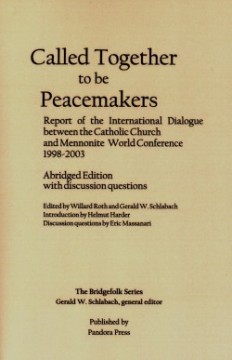
In 2003, theological exchange between Mennonites and Roman Catholics marked a historic milestone as delegations to the first international dialogue between representatives of Mennonite World Conference and the Pontifical Council for Promoting Church Unity released a final report summarizing their five years of conversation.  “Called Together to be Peacemakers” (available at http://www.bridgefolk.net/theology/dialogue) offers a common narrative of watershed events in church history especially during the 16th and 4th centuries.  It explores theological perspectives that the two traditions both share and dispute concerning the nature of the Church, sacraments/ordinances, and peacemaking.  It closes with mutual confessions of repentance for past violence and recrimination, thus inviting a “healing of memories.”

A group of Bridgefolk volunteers has now collaborated with Pandora Press to publish a study version of this watershed document suitable study in a variety of settings.  The text has been abridged.  Helmut Harder, co-chair of the international dialogue, provides an introduction. Discussion questions and other tools are designed to give maximum flexibility to different kinds of study groups.

Some groups will commit themselves to in-depth study. Others will want to familiarize themselves with Mennonite / Catholic dialogue, but have limited time. Many will come with specific interests in peacemaking, local Christian cooperation or worship and spirituality. Some will have designated leaders and others will pass around leadership of their discussions. Three features allow study groups to tailor their preparation, reflection and discussion:

  • The appendix at the end of the book offers study plans of various length and focus, along with additional suggestions.
  • Discussion questions appear throughout the document, near relevant paragraphs.
  • Paragraph numbers from the full original document are retained for groups and individuals who wish to study more thoroughly, or for leaders seeking background.

Please consider using this resource in your congregation, parish or classroom.  Or better yet, use it as an opportunity to carry on a Mennonite-Catholic dialogue in your local setting.   Bulk rates are available.

Click here to order individual copies. Or write to Pandora Press (bookshop@pandorapress.com) for bulk orders.


from the back cover:

Called Together to be Peacemakers, the report of the International Mennonite-Catholic dialogue, is aimed at fostering a healing of memories. We are therefore delighted to see that the report is being used by Mennonites and Catholics in different localities. Although this abridged version has no official status, it will no doubt help to make the Report even more accessible.
This abridged version nicely summarizes perspectives found in the full report, At the same time the readers will be aware that they can get to the original in order to find the fuller expression of Mennonite and Catholic perspectives on the issues treated.

We hope that Called Together to be Peacemakers helps to foster new and closer relations between Catholics and Mennonites, and other Christians as well.

Larry Miller
Mennonite World Conference

John A. Radano
Pontifical Council for Promoting Church Unity

Mennonite, Catholic theologians discuss
“How we are called together”

Press Release:
How Are We “Called Together?”
A Mennonite/Catholic Theological Colloquium
Eastern Mennonite University, Harrisonburg, VA
July 20-21, 2005

By Marilyn Stahl

Harrisonburg VA, August 4, 2005 (BRIDGEFOLK) — Roman Catholics and Mennonites gathered at Eastern Mennonite University on July 20-21 to reflect on “Called Together to Be Peacemakers,” the report of the first international dialogue between the Pontifical Council for Promoting Christian Unity and the Mennonite World Conference.  Approximately 30 theologians, historians and ecumenists attended.

Released in 2004, the report includes a common narrative of significant events in church history, focusing on the 4th and 16th centuries.  It explores areas of theological convergence and divergence between the two traditions on topics such as the nature of the church, sacraments and peacemaking.  It closes with mutual confessions of repentance for past violence and recrimination, as a path to the healing of memories.

The gathering was the first in-person program of the Mennonite/Catholic Theological Colloquium (MCTC) and was held immediately before the annual Bridgefolk conference.  Bridgefolk is a movement for grassroots dialogue and unity between Mennonites and Roman Catholics.  The MCTC convened to respond to the international dialogue’s report, with the theme “How Are We ‘Called Together’?”

The colloquium opened on Wednesday evening with an address by John A. Lapp, Executive Secretary Emeritus of Mennonite Central Committee, entitled, “Ecumenical Dialogue as a Ministry of Reconciliation.”   He noted many signposts of reconciliation between Mennonites and Catholics around the world and stressed that reconciliation is integral to the ministry of the church.

In response, Abbot John Klassen of St. John’s Benedictine Abbey in Collegeville, Minn., reiterated that ecumenism is never an “add-on,” but is at the very heart of the gospel.   As expressed by Jesus in the Johannine tradition:  “I have come so that you might be one.”  Abbot John also addressed the relationship between forgiveness and reconciliation and the importance of hospitality.

The next day, a Mennonite panel and a Catholic panel responded to the report.  The Mennonite respondents were Earl Zimmerman and Nancy Heisey, both of Eastern Mennonite University’s Bible and Religion Department.  Heisey is president of Mennonite World Conference.  The Catholic respondents were Margaret R. Pfeil of the University of Notre Dame and co-founder of a Catholic Worker House in South Bend, and Drew Christensen, S.J., editor in chief of America.  Christensen was a participant in the five-year dialogue and contributed to drafting the report.

In his remarks, Zimmerman contended that re-reading history together is one of the really significant developments in the report.  He expressed a desire for a study from a Catholic perspective on the life of the 16th century martyr Michael Sattler, a former Benedictine monk who wrote the Schleitheim Confession, a foundational Anabaptist text.

Zimmerman also noted that, in America, both Mennonites and Roman Catholics have been shaped by our experiences as immigrant churches and religious minorities in a predominately Protestant society, and noted the differing acculturation responses of the two traditions.  He encouraged participants to continue the on-going dialogue between our traditions, noting that there is “no great disappointment where there is no great love.”

The second Mennonite respondent, Nancy Heisey, noted that more than half of the world’s Mennonites live in the global South and framed her remarks on the basis of what she hears from Mennonites in that region.  While acknowledging the enthusiasm for dialogue with Catholics among Mennonites in North America and parts of Europe, Heisey noted a more hesitant response among Mennonite communities in Latin America and parts of Africa and Asia, due in part to different historical situations.       She affirmed the importance of communicating the significance of the international dialogue to Mennonite communities in the global South.  She juxtaposed the Mennonite concept of a global koinonia among congregations in the Mennonite World Conference with the term “catholicity.”  She also noted that her predecessor as president of MWC, Mesach Krisetya, participated without reservation in the pope’s Day of Prayer for Peace at Assisi because, Heisey said, he understood that we need each other.

The Catholic respondents brought additional perspectives.  As a Catholic, Margaret Pfeil asserted that the report didn’t go far enough in calling Catholics to deep mourning and real repentance for the persecution of Anabaptists in the 16th century.  Remembering the martyrs, and recognizing that Christianity is an incarnational, flesh-and-blood religion, she posed the question of what might be worthy of our blood as a sign of our baptismal commitment today.  She suggested that local churches need to cultivate the spiritual weapons for discipleship, and introduced the concept of “liturgical asceticism.”  She stated that, springing from the waters of baptism and the eucharist, liturgical asceticism is “the discipline required to become an icon of Christ and make his image visible in our faces.”  She asked how our worshipping practices shape our Christian response to the social dimension of sin, challenging both communities to act in greater solidarity with the poor and to name and dismantle unjust structures of power.

Drew Christiansen, a participant in the international dialogue, noted that Mennonites and Catholics share a commitment to live out the call to holiness of life in the postmodern world.  Both traditions must discern good and evil in secular developments, or, in the language of Vatican II, “read the signs of the times by light of the gospel.”  This call is not limited to nonviolence, but includes love of the poor,  and requires personal and communal discernment.  Secondly, in a challenge to Mennonites, he posed a question about church and culture.  Does God speak to the Church through the world? This question was framed by Vatican II’s Pastoral Constitution on the Church in the Modern World, Gaudium et Spes, which “expressed gratitude for what the Church had been taught even by those who had persecuted her.”

Following the presentations, the participants meet in affinity groups around the themes of history, ecclesiology, sacraments and theology, peacemaking, and healing of memories to consider next steps in the dialogue.   Among the many suggestions for additional study were (1) exploring connections between spirituality, peace and asceticism; (2) exploring together what prevents Roman Catholics and Mennonites from sharing the bread and wine; (3) exploring the question of how institutions repent; and (4) promoting and developing ways of both deeply understanding of others’ perspectives and respectfully challenging the unstated assumptions or prejudices in the others’ perspectives.

Pandora Press recently published a condensed version of Called Together to Be Peacemakers, with study questions, to help make the scholarly study more accessible to local parishes and congregations.  The Bridgefolk Series, published by Pandora Press, was established to share resources, papers, conference talks and other conversations that are contributing to the exchange of gifts between Mennonites and Roman Catholics.  Other topics in this series include On Baptism, ed. Gerald W. Schlabach, 2004; and Just Policing, ed. Ivan J. Kauffman, 2004. Books may be ordered from www.pandorapress.com or on the Bridgefolk website at www.bridgefolk.net.
Wise counsel on “bridging” many divides

The latest cover story in Sojourners magazine caught my eye for an obvious reason — it is about “bridging.”  No, it is not about Mennonite-Catholic or even Catholic-Protestant bridging.  It is about left-right, blue-state-red-state bridging.  Those divides are quite familiar within both the Mennonite and the Catholic Church, however.  And the article offers some wise counsel for any Christian in any kind of bridging ministry.  So here are the opening paragraphs, and a link to the entire article for those who are interested in reading on.  — Gerald Schlabach  Continue reading “Wise counsel on “bridging” many divides”

Prayers and gifts for Zimbabwe

As part of our recent Bridgefolk conference we joined with churches around the world in prayer on July 24 for our brothers and sisters in Zimbabwe.  We also took up a collection for the Brethren in Christ (Mennonite-affiliated) and Roman Catholic churches of Zimbabwe, which totaled $1,500.  The following news release from Mennonite World Conference provides an update on this global day of prayer and mentions Bridgefolk along the way. Continue reading “Prayers and gifts for Zimbabwe”

A few announcements

The Bridgefolk Board met in conjunction with our July conference in Harrisonburg, Virginia, and wishes to make a few brief announcements:

  • Our 2006 conference will be held at Saint John’s Abbey, either July 5-8 or July 6-9.  We will hold the conference in conjunction with Saint John’s annual Monastic Institute, July 1-7.  On the occasion of the abbey’s sesquicentennial celebration, the institute will include a focus on new forms of monastic life, including lay communities.  Mark your calendars for the next Bridgefolk conference and consider participating in the Monastic Institute as well.
  • With regret, we accepted the resignation of Sheri Hostetler, pastor of San Francisco Mennonite Church.  Sheri has found that her responsibilities as a new mother have made it difficult to travel to Bridgefolk meetings. Many thanks for your friendship, service and prayers, Sheri.
  • With gratitude, we elected Susan Kennel Harrison to the Bridgefolk Board.  Susan is a chaplain and doctoral student at the University of Toronto.
  • Meanwhile, behind the scenes other developments have been in the works:  As of last April, Bridgefolk is incorporated in the state of Minnesota as a non-profit organization.  We have also applied to the U.S. Internal Revenue Service for tax-exempt, 501(c)(3) status.  This will facilitate acceptance of grants and donations in the future, which is something that a few of you have asked about.  While we are committed to continue “proceeding through friendship” above all, we do anticipate doing some modest fund-raising within a few months.  Stay tuned.

Update on Lutheran Mennonite Dialogue

For Immediate Release

July 8, 2005

LUTHERAN-MENNONITE INTERNATIONAL STUDY COMMISSION BEGINS WORK ON CONDEMNATIONS OF ANABAPTISTS

Strasbourg, France – The first meeting of the Lutheran-Mennonite International Study Commission took place at the Institute for Ecumenical Research here June 27 to July 1. The Lutheran World Federation (LWF) and the Mennonite World Conference (MWC) sponsor this Study Commission.

The mandate of the commission is to consider the condemnations of Anabaptists in Lutheran confessional writings and their applicability to the teaching of Anabaptists/Mennonites today.

The commission heard major papers by Lutheran Prof. Dr. Gottfried Seebass, Heidelberg, Germany, and Mennonite Prof. Dr. John Roth, Goshen, Indiana, (USA) on “The Condemnations of Anabaptists in the Augsburg Confession and the Book of Concord: Their Historical Meaning, Purpose and Effect.”

Through its deliberations the commission became more deeply sensitive to the lasting memory of the suffering of Anabaptists at the time of the Reformation as a result of persecution by civil authorities in Roman Catholic, Lutheran and Reformed areas. For Mennonites, the condemnations in Lutheran confessions have played a role in this regard. The commission is also aware that Christians of all confessions were victims of persecution in that period. Reflection on this matter raises serious questions concerning the theological rationale for pursuing religious and social goals by violent means, including torture and killing. Continue reading “Update on Lutheran Mennonite Dialogue”

MWC news release on Mennonite / Lutheran dialogue

The following news release concerns an ecumenical dialogue between Mennonites and Lutherans that in many ways parallels the dialogue between the Mennonite World Conference and the Pontifical Council for Promoting Church Unity.  Many of you will find it of interest.


NEWS RELEASE
Mennonite World Conference

For Immediate Release
June 20, 2005

MENNONITES AND LUTHERANS WEIGH
16TH CENTURY ANABAPTIST CONDEMNATIONS

Strasbourg, France – Does the condemnation of Anabaptists spelled out in the
1530 Augsburg Confession apply to Mennonite World Conference member and
related churches today?

Mennonite and Lutheran scholars, theologians and historians will offer their
perspectives on this question at the first international MWC and Lutheran
World Federation Study Commission to be held at the Ecumenical Institute
here June 27 – July 1.

Planning for the international commission began in 2004 and will build on
national dialogues that have already been held between Mennonites and
Lutherans in France, Germany and the United States over several years. Those
discussions touched on similarities and differences between the faith groups
around issues such as baptism, the Lord’s Supper and relations between
church and state. But they also dealt with the Augsburg Confession and its
condemnation of Anabaptists, which is still foundational in Lutheran liturgy
and theology worldwide.

What connections exist between the Augsburg Confession’s condemnation of
Anabaptists and their execution in Lutheran lands in the 16th century? Does
the confession perpetuate mistaken images of Anabaptists and justify the
violence against them? What consequences emerge for relationships between
today’s Mennonites and Lutherans?

Questions such as these were raised in national dialogues. The commission
will consider whether conclusions reached there on these and other questions
can be received internationally.

The Study Commission’s primary work in Strasbourg will be on the Augsburg
Confession and its impact on today’s MWC and related churches. The
commission’s conclusions will be reported to the governing bodies of MWC and
the LWF for further action and possible official statements. Planners
anticipate three annual international dialogues.

Co-chairing the commission will be Rev. Rainer Burkhart, Mennonite church
leader in  Germany, and Dr. Gottfried Seebass, Lutheran theologian, also
from Germany. Co-secretaries for the commission are Dr. Larry Miller from
Strasbourg, MWC executive secretary, and Rev. Sven Oppegaard from Geneva,
LWF Associate General Secretary for Ecumenical Affairs.

Study Commission members include participants from each of the previous
national dialogues. Other Mennonites among them are Dr. Claude Baecher,
theologian and professor from France; and Dr. John Roth, church history
professor from Goshen College (USA). New to Lutheran/Mennonite discussion is
Hellen Bradburn, a Mennonite theologian from Arusha, Tanzania, an area that
has approximately three million Lutherans.


Ferne Burkhardt, News Editor
Mennonite World Conference

German Mennonite theologian Fernando Enns lectures on the role of peace churches in ecumenical movement

NEWS RELEASE
Mennonite World Conference
For Immediate Release

June 14, 2005

Fernando Enns lectures in Canada address

‘A peace church in conversation’

Waterloo, Ont. (Canada) — “Our insights do not only belong to ourselves,
but are our gifts to the whole church.” This was Dr. Fernando Enns’
challenge to Anabaptist/Mennonites in his March 16 address at Conrad Grebel
University College here. The evening lecture, entitled “The Peace Church:
Dialogue and Diversity in the Ecumenical Movement,” was part of the fifth
annual Bechtel Lectures in Anabaptist/Mennonite Studies. Continue reading “German Mennonite theologian Fernando Enns lectures on the role of peace churches in ecumenical movement”