Churches prepare for International Ecumenical Peace Convocation in Jamaica in May

The International Ecumenical Peace Convocation (IEPC) will be a “harvest festival” celebrating the achievements of the Decade to Overcome Violence which began in 2001. At the same time it encourages individuals and churches to renew their commitment to nonviolence, peace and justice.  In the video below, Mennonite theologian and ecumenical leader Dr. Fernando Enns of Germany, introduces the convocation, which will be held in Kingston, Jamaica, May 17-25.

Continue reading “Churches prepare for International Ecumenical Peace Convocation in Jamaica in May”
Pope links violence in God’s name to Antichrist

Vatican City (ENInews). Violence committed in the name of God or religion is a “favorite instrument of the Antichrist,” Pope Benedict XVI writes in a new book on the life and teachings of Jesus.

“Violence does not build up the kingdom of God, the kingdom of humanity,” Benedict writes. “On the contrary, it is a favorite instrument of the Antichrist, however idealistic its religious motivation may be. It serves not humanity, but inhumanity.” Continue reading “Pope links violence in God’s name to Antichrist”

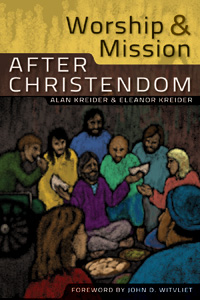
Kreiders publish new book on Worship and Mission After Christendom

Bridgefolk participants Alan and Eleanor Kreider have published a new book,  Worship and Mission After Christendom.  Their publisher, Herald Press, hints at why their work will appeal to the “sacramentally-minded Mennonites and peace-minded Catholics” who make up Bridgefolk:

Today, as Christendom weakens, worship and mission are poised to reunite after centuries of separation. But this requires the church to rethink both “mission” and “worship.” In post-Christendom mission, God is the main actor and God calls all Christians to participate. In post-Christendom worship, the church tells and celebrates the story of God, enabling members to live in hope and attract outsiders to its many tables of hospitality.

In this passionate and thoughtful study, Alan Kreider and Eleanor Kreider draw upon missiology, liturgiology, biblical studies, church history, and the vast experience of today’s global Christian church-to say nothing of their long tenure as teachers and writers in contemporary England and the United States. Academically responsible but also practical and accessible, Worship and Mission After Christendom is a much-needed guide for people who take seriously God’s call to be the church in a world where institutional religion is no longer taken for granted. Continue reading “Kreiders publish new book on Worship and Mission After Christendom

“The Road to Nonviolence:” America magazine assesses ecumenical peace efforts

Two special designations were proclaimed for this millennium’s first decade, which comes to an end this year: the Decade to Overcome Violence, sponsored by the World Council of Churches; and the International Decade for a Culture of Peace and Nonviolence for the Children of the World, sponsored by the United Nations. The core objective of the World Council of Churches’ decade was to move the concern for peace from the periphery of the churches to their very center.

To view the rest of the article, click here.

Cardinal Turkson: Today’s Wars Won’t Bring Future Peace

Justice, Peace Council President Stresses Role of Religions in Reconciliation

BERLIN, Germany, NOV. 29, 2010 (Zenit.org).- The wars of today will not lead to the peace of tomorrow, says the president of the Pontifical Council for Justice and Peace.

This was affirmed by Cardinal Peter Turkson in an address at a congress of the German Bishops’ Conference Commission for Justice and Peace.

The congress, which was held in Berlin in November, focused on the theme, “Wars of Today, Peace of Tomorrow.”

“It is becoming increasingly clear, especially in today’s world, how a seemingly ‘small’ and ‘local’ conflict can trigger ‘global’ consequences,” the prelate observed. Continue reading “Cardinal Turkson: Today’s Wars Won’t Bring Future Peace”

Vatican celebrates 50 years of ecumenical engagement

The Pontifical Council for Promoting Christian Unity (PCPCU) assembled in November at the Vatican to mark a 50-year landmark in Roman Catholic ecumenical engagement.   On Pentecost 1960, as part of preparations for the Second Vatican Council, Pope John XXIII established the Catholic Church’s first secretariat for ecumenical dialogue.  The PCPCU is its successor organization, and is the body that held an official international dialogue with Mennonite World Conference from 1998-2003. Continue reading “Vatican celebrates 50 years of ecumenical engagement”

America magazine article charts steps toward “Our Ecumenical Future;” cites Bridgefolk

A recent article in the Catholic weekly magazine America assesses by Christopher Ruddy, “Our Ecumenical Future” suggested ways for Catholic bishops to promote Christian unity.   The article makes positive mention of Bridgefolk and is available online at http://www.americamagazine.org/content/article.cfm?article_id=12544.

Here is an excerpt, in which Ruddy makes four suggestions Continue reading America magazine article charts steps toward “Our Ecumenical Future;” cites Bridgefolk”

Thirty Christian faith traditions share the peace

L-R: Philip LeMasters, McMurray University; Earl James, Reformed Church in American, New York, N.Y.

by John Bender

ELKHART, Ind.—Jamal, a Muslim refugee from Zanzibar, and Matthew, a Jew, got acquainted as their children played in a neighborhood parkette in Canada’s largest city, Toronto. Learning of Jamal’s computer skills, Matthew found him a job.

Later, as the events of September 11, 2001, unfolded, Jamal came to Matthew’s house, shaken. ”I’m so sorry, but I don’t know who to say sorry to.” Matthew invited Jamal’s family to share dinner with them.

The relationship of these neighbors represents “a testimony to the possibility of peace among peoples,” said Mary Jo Leddy, addressing the opening worship of an ecumenical peace conference, “Peace Among the Peoples,” July 28–31. Continue reading “Thirty Christian faith traditions share the peace”