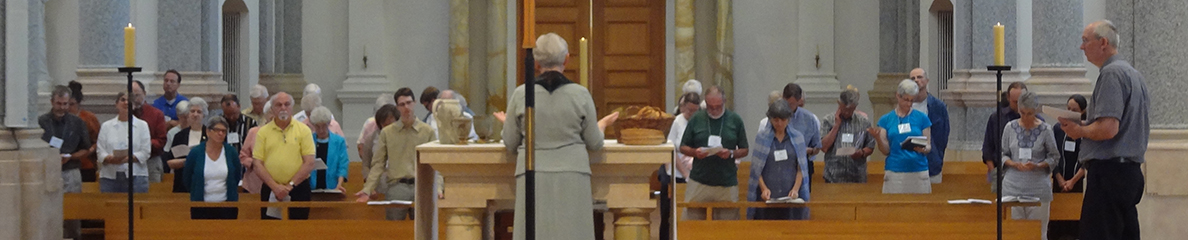
Bridgefolk is a movement of sacramentally-minded Mennonites and peace-minded Roman Catholics who come together to celebrate each other's traditions, explore each other's practices, and honor each other's contribution to the mission of Christ's Church.
Geneva (WCC) — A call for solidarity with the poor was delivered to a gathering of religious and political and civil society leaders from all over the world by one of the presidents of the World Council of Churches (WCC). The meeting on the topic “Bound to Live Together: Religions and Cultures in Dialogue” is taking place from 11-13 September in Munich, Germany.
In its September issue, US Catholic interviewed Maryann Cusimano Love on the aftermath of 9/11 and Catholic understandings of peacebuilding. Cusimano Love is a friend of Bridgefolk who teaches at the Catholic University of America in Washington DC. Among her reflections are these:
That nonviolent resistance can be very effective is something most Catholics don’t understand, but we’ve seen it in Egypt and Tunisia. Sometimes it takes an outside example to help us draw on our own tradition.
For the U.S. military, peace is the absence of the use of military force right now. So if nothing’s blowing up today, that’s peace in Iraq, right?
The Catholic Church says, not so much. You have to rebuild social relationships, restore people who have been traumatized by violence, reintegrate refugees and internally displaced persons back into their communities, and rebuild the human infrastructure.We think about peace in a sustainable and holistic way, as being about education and development.
When the U.S. military or other state organizations talk about building peace, they’re really talking about construction projects. How many roads and bridges can we put in?
The Catholic Church says building peace is not just about bricks and mortar. It’s about rebuilding the people and the human community. If you don’t do that work, then the bricks-and-mortar stuff you rebuild today is going to be blown up tomorrow.
Bridgefolk is pleased to welcome Andy Martin of Elmira, Ontario, Canada, on to its board. Andy is married to Colleen and they have three (nearly) adult children. He grew up in Waterloo region in the conservative Mennonite church, which split from the (Old) Mennonite church in the late 1950s in order to hold to a more conservative practice and theology. At the age of 31 Andy left his community of origin and his career as an automotive technician and owner of several small businesses to pursue an education. “From the beginning this was a journey to discover the bigger questions in life,” he explains.
Andy completed an undergrad degree in music and a master’s degree in counseling in Manitoba at Providence College and Seminary and a master’s degree in theology from Conrad Grebel University College/University of Waterloo, with a thesis on the influence of fundamentalism on the conservative Mennonite movement directed by Mennonite historian and Bridgefolk participant Arnold Snyder. Continue reading “Andy Martin joins Bridgefolk Board, strengthening Canadian voice”→
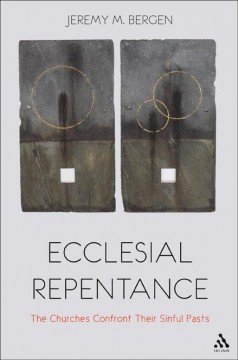
In recent years, churches have repented for historical wrongs. In his new book, Ecclesial Repentance: The Churches Confront Their Sinful Pasts, Jeremy M. Bergen tells the story of these apologies and analyzes the theological issues they raise about the nature and mission of the church.
“In a context in which churches, as well as national governments, are increasingly offering public apologies for past acts of injustice and failure,” Bergen’s book, Ecclesial Repentance: The Churches Confront Their Sinful Pasts, “represents an important contribution.” In a review by Christopher Craig Brittain of the University of Aberdeen, Britton continues, “rather than seeing ecclesial repentance as undermining the Church’s reputation, or functioning as a self-serving public relations strategy, Bergen offers a theological account of how they help the Church be faithful to its mission. The result is a sensitive reflection on the complexities and perils of public apologies, as well as a thoughtful appreciation for their potential to facilitate the healing of past wounds.’ Continue reading “New book interprets church apologies”→
This might be old news for a few Mennonites involved in Bridgefolk, but since they’ve never spoken up, it will be new news to others:
Anabaptist and Mennonite churches have long had deaconesses. But only a few years ago, well into the 20th century, the practice took a form that looks very much like a Catholic religious order, according to the Global Anabaptist Mennonite Encyclopedia Online:
By the 1950s 62 sisters had become members of the Bethel Deaconess sisterhood, 26 of whom were associated with the sisterhood in 1955. The deaconesses of this institution wore a special garb and were ordained by the church. Each sister had her place in the mother house, received full maintenance, a monthly allowance, an annual vacation, and a vacation allowance. She was expected to remain loyal and faithful to her calling but did not take an oath of celibacy. Should a deaconess change her mind, believing it to be God’s will that she serve in some other sphere apart from the sisterhood, she presented her resignation and received an honorable discharge.
Silver Spring, Maryland, USA– Representatives of the General Conference of Seventh-day Adventists and the Mennonite World Conference held the first of several theological conversations June 28 to July 1, 2011 at the world headquarters of the 17 million-member Seventh-day Adventist Church in Silver Spring, Maryland. Continue reading “Mennonites begin ecumenical dialogue with Seventh-Day Adventists”→
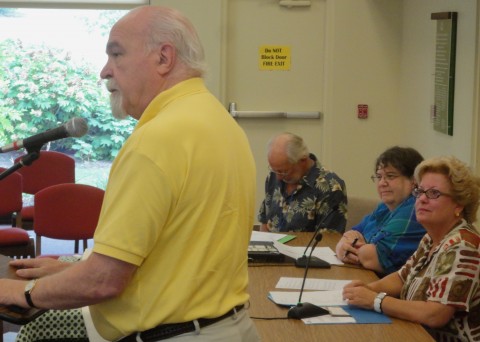
Bridgefolk co-founder Ivan Kauffman speaks during discussion following panel on common worship. Panel members, left to right: Stanley Kropf (moderator), Mary Schertz and Alice Noe.
Akron, Pennsylvania (BRIDGEFOLK) – “The Holy Spirit works in and through human failure, not around it,” Mennonite biblical scholar Mary Schertz told Catholics and Mennonites gathered at the headquarters of Mennonite Central Committee August 4-7 for the 2011 conference of Bridgefolk, a grassroots movement for dialogue and unity between Mennonites and Roman Catholics.
Peter was in a position to deny Jesus only because he was trying to be faithful to his promise, Schertz explained. He risked his life to follow Jesus into the courtyard near where he stood trial. “God worked the birth of the church out of human failure,” noted the Bridgefolk board member and professor of New Testament at Associated Mennonite Biblical Seminary. “Failure will always be present in the life of the church, but it doesn’t have to have the last word. So too with Bridgefolk. God has been at work through our failure.”
Schertz’s insight helped conference participants name the mix of joy and pain that they continue to share as Bridgefolk enters its second decade as a movement. “This was Bridgefolk’s tenth annual conference,” Bridgefolk co-founder Weldon Nisly commented later, “and I think we have matured. We feel the pain of church disunity as acutely as ever. But holding that pain together has also led to a deep trust and mutual love. We are clearer than ever that it is only ours to live in hope, not to ‘fix’ the church’s disunity. Yet we find ourselves celebrating the fruit that God has brought from our failure.” Continue reading “Bridgefolk celebrates the fruit God brings through human failure”→
As one amateur Mennonite historian likes to point out, the only real Mennonite name is Menno Simons. From there on down through history, the rest of the family names are just “add-ons.” After a series of Mennonite World Conference (MWC) secretaries named Dyck (1961-73), Kraybill (1973-90) and Miller (1990-2011) the name of García stands out as an historically recent addition to the Anabaptist family.
César García’s personal story with the Mennonite family began in Bogotá, Colombia, when his mother took him and his sister to several churches in search of a new church home. Eleven-year-old César chose the Iglesia Hermanos Menonitas Dios es Amor (God is Love Mennonite Brethren Church) as the place they would settle.
That choice was the first step on a continuing journey for García, who has come to treasure Anabaptist theology and history and has given his life to scholarship, to mission and to shaping the church from an Anabaptist perspective. Continue reading “Introducing César García, in-coming MWC General Secretary”→