The Mennonite features Mennonite Catholic visionary Gene Herr

Holy restlessness leads to home in Christ:
Gene Herr became a spiritual father to many people in his lifetime.

by Laurie Oswald Robinson

Cover story, The Mennonite, June 2012
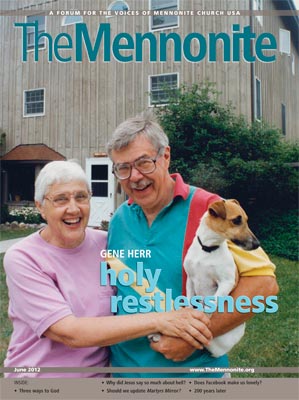
 
June 2012 cover of The MennoniteA few days before he died on Jan. 1 in Hesston, Kan., the late H. Eugene (Gene) Herr said to his daughter, Ellen Awe, “I don’t understand why I am not going anywhere.”

The comment didn’t surprise Awe. Her father, a leader and visionary in the Mennonite church, had always lived with a holy restlessness. It was born from his passion to follow God’s call, even when to do so required leaving safe and familiar lands for  daring and new territories.

To his family and friends, he seemed he was moving as a pilgrim on his way to the promised land. They saw his movement as not born of one who was lost and trying to find his way “home” alone. They believed it as born out of passion for being truly found in Christ. He desired to give himself so fully to Jesus that no mile of God’s intended journey for him would be left untraveled.

But on this day, it was time for him to rest a bit before traversing the final leg of his earthly trek.

Awe replied to her father, “It’s because you    really can’t go anywhere right now, Dad. It’s OK for you to just be here and to let us love you. …”

“He accepted this and put his trust in us and graciously let us make decisions for him,” she says. “The concept of his ‘terminal’ illness included both moving and resting. … He was terminal but not as in an end. He was in a terminal, the place where one waits for the next leg of one’s travels.”

As he battled brain cancer for two years, it seemed God was calling Herr in his final days to integrate his doing with being. The integration was a model of the Christian discipleship Gene and Mary, his wife of 56 years, shared with fellow believers in the Mennonite church and beyond. Continue reading The Mennonite features Mennonite Catholic visionary Gene Herr”
Catholics remember Anabaptist martyr

Collegeville, Minnesota (BRIDGEFOLK) – On May 20 a Benedictine abbot whose ancestors had once been Dutch Mennonites, led in commemorating the 485th anniversary of the martyrdom of Michael Sattler. Sattler had been a Benedictine, but left during the Peasants War of 1525 to become an Anabaptist leader. He is regarded as the primary author of the Schleitheim Confession.

The Abbot was Fr. John Klassen, the leader of the largest Benedictine monastery in North America, Saint John’s Abbey in Collegeville, Minnesota.

The commemoration on May 20 affirmed both the nonviolent witness of Michael Sattler, and his willingness to die for the principle of religious freedom—positions now widely accepted in the Catholic community. Fourteen members of the monastic community participated, along with two Mennonite pastors. Continue reading “Catholics remember Anabaptist martyr”

“Spirituality versus Religion: Or maybe it’s not new….” commentary by Jana Bennett

Current debates over “traditional religion” sometimes track partially with ecumenical dialogue between Mennonites and Catholics.  The following blog by University of Dayton theology professor Jana Bennett may therefore be of interest to Bridgefolk.  


I’ve been reading a lot lately around the blogosphere from people who find themselves at odds with “traditional Christianity,” by which seems to be meant “the version of Christianity I grew up with.”  One of the most interesting is here at Rachel Held Evans’ blog: Kim Van Brunt describes leaving traditional worship services, in part because she felt the traditions themselves – the bulletins and Wednesday night prayer services and so on – were stilting her family’s ability to hear and live the gospel.  Many of the commenters complained that she seemed to be advocating a church of one, an individual’s paradisaical version of Christ’s body – so before readers here jump to that conclusion, let me just say that in her own response to the comments, she now belongs to what would probably be called a “house church” – an informal gathering of people meeting to support and witness to each other.

There are others feeling compressed by “tradition”.  One of the big ones, of course, is the viral video “Why I Hate Religion but Love Jesus” which was followed up with numerous posts about being spiritual but not religious.  In another vein, there have been Catholics thinking through the contraception debates in relation to feeling like the “hierarchy”.  In still another vein, members of the “emergent church” who feel that “traditional” forms of Christianity are increasingly irrelevant.   Continue reading ““Spirituality versus Religion: Or maybe it’s not new….” commentary by Jana Bennett”

Naming the pain: a Lenten reflection on transforming the wounds of war

Carolyn Holderread Heggen

chapel address
Associated Mennonite Biblical Seminary
February 28, 2012


Carolyn Holderread Heggen

PeaceSigns, a publication of the Peace and Justice Support Network of Mennonite Church USA, recently published the following chapel address by Carolyn Holderread Heggen, psychotherapist specializing in individual and communal trauma healing.  The article caught our eye because Holderread Heggen dedicated her address to Fr. William Mahedy, a former military chaplain who experienced a “profound crisis of conscience and dedicated the rest of his life as a social worker in San Diego, starting Veterans Centers and writing profound pieces about the spiritual woundedness of Veterans.”  Her talk does more than illustrate a profound “exchange of gifts” between Mennonites and Catholics seeking peace and reconciliation in the world.  As we enter more deeply into the Paschal mystery during Holy Week, it also serves as an appropriate Lenten reflection.  


Years ago a Vietnam Christian Vet came into my therapy office, carrying a Bible, and he said, “If you want to know what it feels like to be me, read these verses.” He started pointing to some of these verses Michele read this morning (Psalm 38). I don’t know specifically what precipitated the Psalmists despair that caused him to write these verses, but I do know that I have been told by numerous Vets that it’s a good description of what they feel like. Thousands of years after those words were written psychiatrists and psychologists came up with an official diagnosis, and a new name for an old malady, a malady as old as war itself. And in 1980 the term Post Traumatic Stress Disorder, or PTSD as we commonly call it, was coined and since then has become part of our medical and lay vocabulary.

Throughout history, different names have been used to describe the effects of the emotional and spiritual pain people who have been asked to kill experience. Continue reading “Naming the pain: a Lenten reflection on transforming the wounds of war”

Please pray for Br. Jeffrey Gros, FSC

Recently we posted a news article on the Bridgefolk website: “Leading ecumenist Br. Jeffrey Gros, FSC, highlights Lutheran-Mennonite footwashing in keynote address.”  Brother Jeffrey has asked for the prayers of Bridgefolk as he prepares for surgery to treat a pancreatic tumor this month.  He writes:

I am doing very well and the MDs are optimistic. I am in chemo, will go into chemo+radiation in March in preparation for an April removal of a contained pancreatic tumor. Prognosis sounds good for now, though I have had to drop my classes at Lewis and at Catholic Theological Union, as well as miss my presidential meeting of the Society for Pentecostal Studies.

May God grant our friend and colleague peace to face surgery in hope and confidence in God’s merciful care.

American Benedictine Academy to “Seek Peace and Pursue It”

The American Benedictine Academy has chosen as the theme of its 2012 annual meeting, “Seek Peace and Pursue It: Monasticism in the Midst of Global Upheaval.”  The conference will be held at St. Scholastic Monastery in Duluth MN.  Bridgefolk board member Weldon Nisly will be one of the featured speakers.  (Those planning to attend the Bridgefolk conference in Minnesota in late July should note that the ABA conference is the following weekend, approximately three hours away.)
For more information and registration forms, go to http://www.osb.org/aba/2012/.

Leading ecumenist Br. Jeffrey Gros, FSC, highlights Lutheran-Mennonite footwashing in keynote address

A keynote address by Br. Jeffrey Gros, FSC, to the 2011 National Workshop on Christian Unity last May has recently come to our attention.  In it he called attention to the use of footwashing at a historic service of repentance and reconciliation, in which representatives of the Lutheran World Federation confessed 16th-century persecution of Anabaptists as a sin.  This “icon” should serve as a model for planning similar commemorations as Christians around the world mark the 500-year anniversary of the Protestant Reformation in 2017, he said.   Continue reading “Leading ecumenist Br. Jeffrey Gros, FSC, highlights Lutheran-Mennonite footwashing in keynote address”

Darrin Snyder Belousek wins award for article on financial crisis

Bridgefolk board member Darrin Snyder Belousek has won an award from the Intercollegiate Studies Institute for an article he wrote in 2010 in the Journal of Markets and Morality entitled ““Market Exchange, Self-Interest, and the Common Good: Financial Crisis and Moral Economy.”  The Templeton Enterprise Awards on the Culture of Enterprise are given annually to the best books and articles published in the previous year on the culture of enterprise. The awards are designed to encourage young scholars (thirty-nine or younger at the time of publication) to explore and illuminate the process by which economics and culture are related throughout the world.  Snyder Belousek, a Mennonite, notes that the article is “effectively a Catholic-Mennonite affair,” since “the tradition of Catholic Social Teaching substantially informs the argument.”

  • Click here to read the award-winning article.
  • Click here for award website.
  • Click here to read a shorter version of Snyder Belousek’s article which appeared in America magazine in 2009