Shuji Moriichi
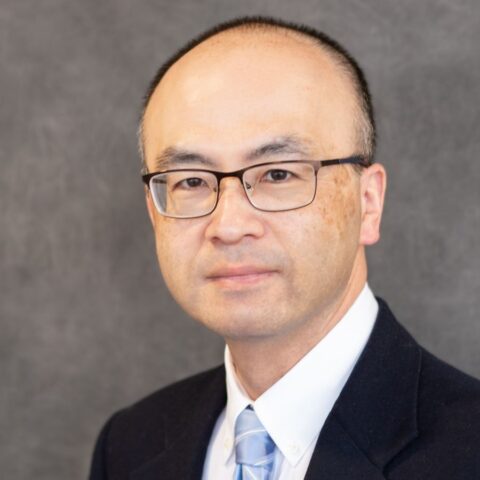
Note: Shuji Moriichi was one of the panelists in the May 5, 2026 webinar about Mennonites and Catholics working in institutions of the other’s tradition.
“This is the Emergency Department. There is a one-year-old in critical condition, and the mom is very distraught.” I received the call close to the end of our regular shift late one Friday afternoon. When I peeked into the room, I could see the tiny limp body among the adult bodies busily moving around her.
A nurse escorts the woman out of the room. “Oh, no…my baby…” The hand holding a cell phone is shaking. I introduce myself and ask the young mother her name and to spell it slowly for me, as well as her daughter’s. (In my early years of clinical chaplaincy I learned that this practice helps when our brains are in acute distress to slow down enough to regain some rational functioning and process basic surroundings.) “Pray for my daughter, please…” Her shaky voice fades, and more tears follow. As I pray, the nurse’s aid also places her hand over the mother’s shoulder.
We are going to airlift the child to the pediatric ICU in a larger hospital. The mother’s aunt arrives to give her a ride. (There is no room for a family member to ride along in a medical helicopter.) “I will go with your daughter to the heliport upstairs and watch it take off, for sure,” I assure them.
The mother had left the house only with her phone. “This is going to be a long day for you. I think it is good to have something to eat and drink with you before you leave here.” In cases like this, I often become more directive than usual. “I will take you to the cafeteria. It is free.” I remember the donation left to the pastoral care department by our former staff chaplain a few years ago, precisely for occasions like these, for people like these.
I walk them down from the cafeteria through the winding hallways to the Emergency Room parking area, where they originally came in. The young mother is no longer alone, no longer shaking. “You guys are wonderful. I love this hospital. Thank you so much.” “Please be safe on the road.” The young African American mother and I, the older Asian man (and father), wave goodbye.
If the subtitle of this essay confuses you, you probably understand the work of hospital chaplains quite well. Much of our work involves visiting patients and their family members. This personalized care for individuals with different needs seems to stand in opposition to many social ministries of the church. Marching in the streets and advocating for causes in legislatures is not what chaplains do every day (and I am glad that there are others working in such fields). It is true that many chaplains feel called to work in this type of ministry setting rather than on the visible front lines of social justice work, precisely because they prefer to work “behind the scenes” or admit that they are not “social activist types.”
And yet I will insist that hospital chaplaincy is indeed a counter-cultural social act. I have grown convinced of this, after more than twenty years in this field, and now more than ever. Many today decry that our society has become more polarized, and our culture more divisive and contentious. There has been the proliferation of “camps” in our society with specific identity labels and ideological bents, through which we screen and judge others. Each camp is continually split into more narrowly defined sub-camps, to the point that dialogue and mutual understanding feel unattainable. Churches are deeply drawn to this phenomenon, too.
It is in such a cultural climate that I see hospital chaplaincy as a counter-cultural social act. Cedar Rapids, Iowa, is not a major metro area by national standards. However, due to its proximity to the downtown area, our medical center – founded by the Sisters of Mercy 125 years ago – continues to fulfill its mission for those vulnerable in our surrounding communities in the state’s second-largest city. When we, the chaplains, get called to the emergency room, for instance, we initially know so little about the patient’s background or situation, except that the Holy Spirit facilitates this encounter. Anything that political pollsters use to categorize fellow citizens – party affiliation, educational and income levels, or any stances on issues – we do not ask. The very first question we ask ourselves is always: How can I love this person sitting right in front of me?
I have often found that chaplains are not the most articulate explainers of their own vocational calling to the outside world; they prefer to let their work speak for itself. Pope Francis, in his third encyclical Fratelli Tutti (2020), taught us that “The ability to sit down and listen to others, typical of interpersonal encounters, is paradigmatic of the welcoming attitude shown by those who transcend narcissism and accept others” (§48). Francis reminded us, expanding upon the Good Samaritan narrative, that “Jesus asks us to be present to those in need of help, regardless of whether or not they belong to our social group. In this case, the Samaritan became a neighbour to the wounded Judean. By approaching and making himself present, he crossed all cultural and historical barriers” (§81). “Service is never ideological, for we do not serve ideas, we serve people” (§115). Francis’s pronouncement echoes in my mind, clarifying why we are here each day.
In some ecumenical circles (including my own Mennonite Church USA), hospital chaplaincy is categorized as a “specialized ministry setting.” I recognize the usefulness of the category and at the same time feel put off by it. What we witness up close each day – joy and sadness, life and death, and anything in between – are universal, not specialized, human conditions.
“All are welcome!” many church marquees claim. But since many faith communities reflect ideological sorting within the larger society, do we really see all kinds of people in our places of worship? Hospital chaplains certainly do meet with people from all walks of life, the rich and the poor, the native-born and the foreign-born, church goers and “Nones,” the hopeful and the hopeless, the sober and the addicted, the newly born and the dying, all simply around basic human needs. In this sense, these specialized ministry sites are truly special places of encounter.
A CPR is in progress for more than thirty minutes, with only brief moments of pulse returning. The outcome does not look good. A large Baptist family fills the emergency room lobby, and the line stretches into the parking lot on a hot Iowa summer day. “Two people at a time,” the charge nurse announces while letting the family come in to say their final goodbye, before the resuscitation effort is formally called off, before the matriarch’s heart stops beating again. I stand outside the trauma room, and the priest chaplain is on the other side of the hallway with the family; I receive each member inside the room where the beloved anchor of the multi-generational family lies nearly lifeless, and the priest hands out cups of ice water to the rest as he sends out two more members toward me.
To repair our divided society, loving and caring for one person at a time seems too rudimentary, hardly moving the needle in the fight against systemic evils. Still, is there any better way to start? Is there any better model for rich social implications? In his first encyclical, Deus Caritas Est (2005), Pope Benedict XVI also instructed us that “Despite being extended to all mankind, [the concept of ‘neighbour’] is not reduced to a generic, abstract and undemanding expression of love, but calls for my own practical commitment here and now” (§15). What if we all approached other lives this way? Beneath any labels or classifications that separate us from others, there lies our common humanity. So, where do you find your practical commitment to serving people over ideas? We, the chaplains, are called to embody love’s explicit demand in our own here and now.
(Rev.) Shuji Moriichi, M.A., M.Div., BCC, serves as the Director of Pastoral Care at Mercy Medical Center in Cedar Rapids, Iowa. His essays have previously appeared in Mennonite Quarterly Review, Journal of Pastoral Care and Counseling, Canadian Mennonite, Anabaptist World, and Brethren Life and Thought.