The sound of a cappella harmony in a Catholic sanctuary
by Nate Showalter
Substack, 16 May 2026
reprinted with permission

Five centuries after Anabaptists were denounced by both Catholics and Protestants as dangerous radicals, a Mennonite congregation in Baltimore has purchased a former Catholic church and school complex. A recent article in Anabaptist World described the moment as “a minor Reformation.”
The former St. Thomas Aquinas Church — built in 1871 with vaulted ceilings, stained glass, a bell tower, kneelers, and a pipe organ — will now become the home of Hampden Mennonite Church.
History sometimes moves strangely.
The Catholic parish declined.
The Mennonite congregation grew.
And now descendants of people who once distrusted cathedrals, organs, and religious ornament will gather beneath soaring Gothic arches to sing a cappella hymns.
Not everything in the story is ironic.
Some of it is quietly moving.
Especially the sound.
Buildings Remember
One line in the news report stayed with me.
Before the sale, the Archdiocese issued a document formally declaring that the building had been “desanctified” and relegated to “profane but not sordid use.”
The phrase carries centuries of Catholic sacramental theology. A consecrated church is not simply another building. It has been set apart for holy use. To desanctify it is not necessarily to condemn it or abandon it, but to acknowledge that it will no longer function as a Catholic sacred space.
And yet the phrase also feels unexpectedly gentle.
“Profane but not sordid.”
Not holy in the same way.
But not reduced to commerce alone.
Not emptied of dignity.
The irony, of course, is that the new occupants are Anabaptists — heirs of a tradition once dismissed as heretical by the religious establishments of Europe.
But perhaps the deeper question is not who owns the building.
Perhaps the deeper question is what makes a place holy.
If prayers continue there,
if children continue learning there,
if Scripture is still read there,
if neighbors still gather there,
if songs still rise there —
has the building truly fallen silent?
The Sound of a Different Tradition
What fascinates me most is not the transfer of property but the transfer of sound. Catholic churches were designed acoustically as well as architecturally.
The high ceilings.
The long reverberation.
The bell tower.
The organ loft.
The stone and plaster surfaces that carry chant and congregational response.
Buildings like this were made to hold sound.
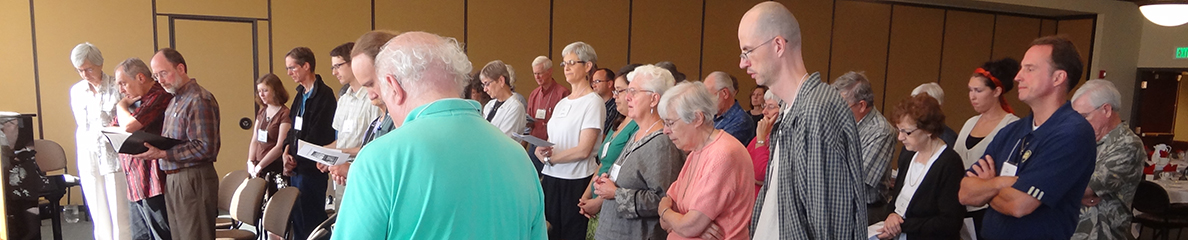
And now the sanctuary will receive another tradition of Christian sound: Mennonite four-part harmony sung without instruments.
The congregation plans to keep the pipe organ, even though it will not be used in worship services. They are also keeping the bell, the stained-glass windows, the pews, and even the kneelers.
That detail struck me deeply.
The organ will remain present but silent.
Not destroyed.
Not mocked.
Not converted into decoration for a restaurant or office lobby.
Simply retained.
Almost as an act of memory.
The building will continue speaking in more than one theological language at once.
Simplicity Inside Beauty
Historically, many Anabaptists were suspicious of elaborate church architecture. Simplicity was not merely aesthetic preference; it reflected theological concern.
Ornament could become spectacle.
Beauty could become power.
Architecture could reinforce hierarchy and distance.
And yet there is something unexpectedly beautiful about this congregation inhabiting the building without fully claiming the assumptions that produced it.
They are not turning into Catholics.
They are not pretending history did not happen.
They are not embracing sacramental theology simply because they inherited stained glass and vaulted ceilings.
But neither are they attempting to erase the building’s past. One Mennonite leader described it this way:
“The simplicity of worship still remains in a very elaborate piece of beautiful architecture.”
That sentence feels larger than Baltimore.
Many Christians today are trying to discern how to inhabit traditions, institutions, and inheritances they did not entirely build and do not entirely reject.
How do we receive beauty without becoming captive to it?
How do we honor history without idolizing it?
How do we remain faithful without imagining that faithfulness requires cultural withdrawal?
Those are not only architectural questions.
Audible Presence
What also stands out in the story is the congregation’s commitment to urban presence.
For generations, many Anabaptists moved away from cities in search of separation, stability, and communal survival. But the Baltimore congregation speaks openly about remaining distinctively Mennonite while also building relationships with neighbors very different from themselves.
Not assimilation.
Not isolation.
Presence.
A school.
A daycare.
A church bell still ringing in the neighborhood.
Children learning names.
People entering a sanctuary that still sounds like prayer.
In an era when many church buildings become condominiums, breweries, or office space, there is something quietly hopeful about a former Catholic church continuing to function as a place of worship and community life — even under a very different tradition.
The organ may remain silent during worship. But the building itself will keep singing.
And perhaps Anabaptists—who learned long ago to carry the sacred in gathered communities more than in sacred architecture—are especially prepared to hear it.
Nate Showalter writes from Los Angeles, reflecting on faith, worship, and culture through Anabaptist and ecumenical lenses. His substack Faith Made Audible listens for the Spirit’s voice in the songs, stories, and struggles of the Church.